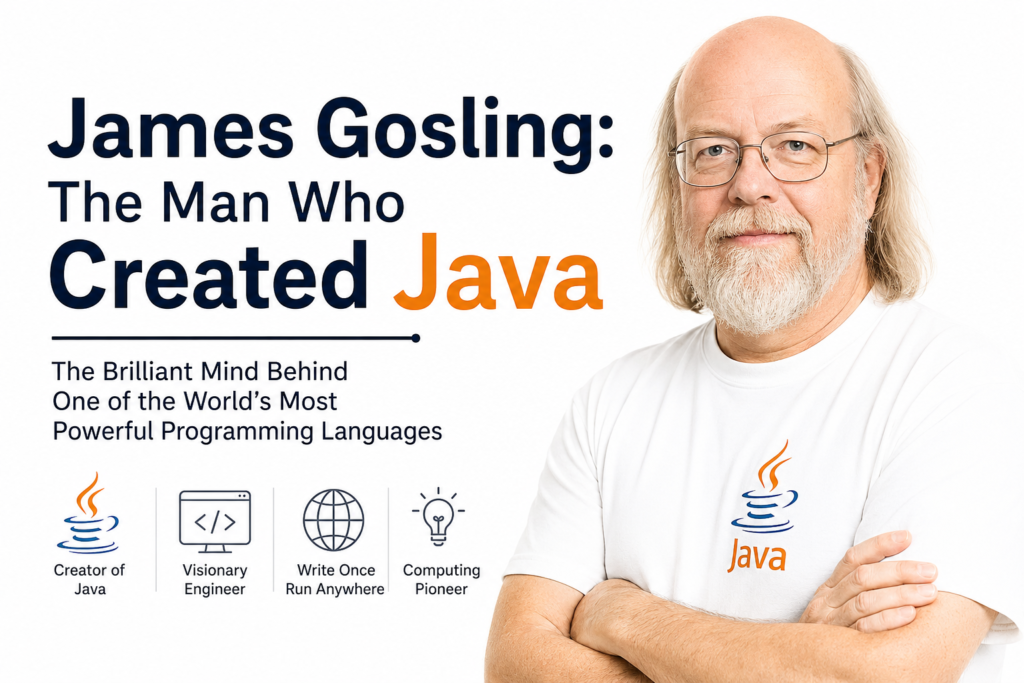
James Gosling is one of the most influential computer scientists in modern technology history. Millions of developers use Java every single day, but many people still do not know the fascinating story behind the man who created it. From building experimental software systems to becoming the father of Java, Gosling transformed the world of programming forever.
Today, Java powers banking systems, Android apps, enterprise software, cloud platforms, and even scientific applications. The success of Java did not happen by accident. It was the result of the creativity, determination, and technical brilliance of James Gosling and a team of talented Sun Microsystems engineers.
In this detailed article, you will discover the complete history of James Gosling, how Java was invented, why it became so successful, and how his ideas continue shaping the future of software engineering.
Early Life of James Gosling (1955 – 1975)
James Arthur Gosling was born on May 19, 1955, in Calgary, Alberta, Canada. From an early age, he showed deep interest in electronics, engineering, and machines. Unlike many children of his generation, he enjoyed building technical projects and experimenting with devices.
His curiosity about computers started during the rise of early computing systems. At that time, computers were massive machines mainly used by universities and governments. Gosling became fascinated by how software controlled hardware operations.
During his teenage years, he learned programming concepts independently. This passion later pushed him toward becoming one of the most important inventors of modern programming.
Many experts today include him among the greatest computer scientists who changed the world because of the long lasting influence of Java.
Education and Academic Journey (1975 – 1983)
James Gosling studied computer science at the University of Calgary. His academic performance quickly stood out because of his deep understanding of software systems and compiler technologies.
Later, he attended Carnegie Mellon University, where he earned his PhD in computer science. His doctoral work focused heavily on operating systems and compiler design.
The years at Carnegie Mellon University played a major role in shaping his thinking. He developed advanced knowledge about source code compiler systems, software architecture, and operating system communication.
The university environment also introduced him to high level research projects involving distributed computing and graphical systems.
Because of his achievements, Gosling became recognized as one of the most talented Carnegie Mellon University alumni in computer science history.
Gosling Emacs and Early Software Innovations
Before Java existed, James Gosling already had a strong reputation in programming circles. One of his early famous creations was Gosling Emacs.
Gosling Emacs was a text editor designed for UNIX systems. At the time, programmers needed efficient tools for writing and editing code. His editor became popular because of its flexibility and powerful customization capabilities.
This project demonstrated his ability to build practical software tools that developers truly needed.
Another important project during his early career was the NeWS window system. This graphical windowing system used PostScript technology and was developed while working at Sun Microsystems.
The NeWS window system showcased Gosling’s deep understanding of graphical computing and software development methodology.
These innovations helped establish his reputation long before the origin of Java language changed computing forever.
Joining Sun Microsystems (1984 – 1990)
In 1984, James Gosling joined Sun Microsystems. This technology company would later become one of the most important firms in software history.
Sun Microsystems engineers focused heavily on networking systems, UNIX workstations, and enterprise computing. The company encouraged innovation and experimentation.
At Sun Microsystems, Gosling worked on advanced distributed systems and programming environments. During this period, software developers faced many compatibility problems.
Programs often worked on one machine but failed on another because operating systems and hardware architectures were different.
This major challenge inspired Gosling to think about a programming language that could run anywhere without modification.
That idea eventually became the foundation of Java’s revolutionary write once run anywhere philosophy.
The Birth of Java (1991 – 1995)
The most important moment in the history of James Gosling came in 1991.
A small team at Sun Microsystems started working on a secret project called the Green Project. The goal was to develop software for interactive consumer electronics.
At first, Gosling created a language called Oak programming language. The language was designed to be simple, secure, portable, and reliable.
However, Oak later received a new name because the trademark already existed. The team eventually renamed it Java.
The answer to why java is named java is surprisingly simple. The team often drank coffee while working, and the name came from Java coffee.
Java became revolutionary because of its portability. Programs compiled into bytecode instead of machine specific instructions.
The Java Virtual Machine origin was one of the most brilliant parts of the design.
Instead of running directly on hardware, Java applications ran inside the JVM.
This made Java applications compatible across multiple operating systems.
The basic compilation process looked like this:
public class HelloWorld {
    public static void main(String[] args) {
        System.out.println("Hello, Java!");
    }
}
After compilation:
HelloWorld.java → Bytecode → JVM → Any Operating SystemThis bytecode compilation process changed programming forever.
Why Java Became a Global Success (1995 – 2005)
When Java officially launched in 1995, the internet was rapidly growing.
Developers desperately needed a language capable of supporting web applications and distributed systems.
Java solved several major problems:
- Platform compatibility
- Memory management
- Security
- Object oriented programming
- Network support
Because of these strengths, Java spread rapidly across the software industry.
Companies used it for enterprise applications, banking systems, web servers, and mobile devices.
The popularity of Java also sparked discussions like java vs javascript explained, because many beginners confused the two languages.
Despite similar names, Java and JavaScript are entirely different technologies.
Java focused on enterprise level software and portability, while JavaScript became the language of web browsers.
James Gosling and Object Oriented Programming
One reason Java succeeded was its strong object oriented design.
The language made OOP easier and safer for developers.
Key Java OOP principles include:
class Car {
    String brand;

    void display() {
        System.out.println(brand);
    }
}
This simple structure helped developers understand reusable software components.
Today, many developers still search for java oop concepts explained because OOP remains central to Java development.
James Gosling believed programming languages should help developers write clean and maintainable software.
His focus on simplicity gave Java an advantage over complicated languages.
Many developers also viewed Java as a cleaner C++ alternative because it removed dangerous memory operations and simplified syntax.
The Growth of Java Across Industries
Over time, Java expanded into nearly every major technology sector.
Java became widely used in:
- Banking software
- Enterprise systems
- Android applications
- Scientific computing
- Cloud platforms
- Web servers
- Big data processing
Android development especially helped Java dominate the mobile industry for years.
Millions of developers entered programming because of Java tutorials and beginner courses encouraging people to start learning java today.
Java also became central to university education worldwide.
Its readable syntax and stability made it ideal for teaching software engineering concepts.
James Gosling’s Philosophy About Programming
James Gosling always believed software should solve real problems instead of creating unnecessary complexity.
His philosophy centered on:
- Reliability
- Portability
- Simplicity
- Performance
- Developer productivity
The famous write once run anywhere philosophy became one of the most successful ideas in computing history.
This philosophy allowed businesses to save massive amounts of money because software no longer needed separate versions for every operating system.
It also helped Java dominate enterprise environments.
Challenges and Criticism Faced by Java
Even successful technologies face criticism.
Java received complaints about:
- Performance speed
- Verbose syntax
- Memory usage
- Complex enterprise frameworks
Some developers preferred newer languages.
Discussions like java vs python: which to learn became common as Python gained popularity in data science and AI.
However, Java remained dominant because of its stability, security, and huge ecosystem.
Large companies continued trusting Java for mission critical systems.
James Gosling himself often participated in technical discussions about language evolution and software design improvements.
James Gosling Leaves Sun Microsystems (2010)
In 2010, Oracle acquired Sun Microsystems.
After the acquisition, James Gosling eventually left the company.
This marked the end of a major era in software history.
Despite leaving Sun Microsystems, Gosling continued contributing to technology through research, consulting, and engineering roles.
His influence remained enormous because Java had already become one of the world’s most important programming languages.
The history of James Gosling became deeply connected with the evolution of modern software development.
Java’s Influence on Modern Programming
Java inspired countless programming languages and frameworks.
Technologies influenced by Java include:
- Kotlin
- Scala
- Groovy
- C#
- Android SDK systems
Java also shaped enterprise software development standards.
Modern frameworks like Spring Boot still dominate enterprise backend development.
Developers researching best java frameworks compared often discover how large the Java ecosystem has become.
Java’s architecture also influenced virtual machine technologies used in many modern languages.
The Legacy of the Father of Java
Today, James Gosling is widely called the father of Java.
His contributions changed the software industry permanently.
The creator of Java programming language helped make software development more accessible, portable, and reliable.
Without Java, modern enterprise computing would look very different.
Many experts consider Gosling among the greatest famous software architects of all time.
His innovations influenced generations of programmers and software companies worldwide.
The story of who invented Java is ultimately the story of a computing pioneer who believed software should work everywhere.
Java in the Modern Era (2015 – Today)
Even after decades, Java remains one of the world’s most used programming languages.
Modern Java supports:
- Cloud computing
- Artificial intelligence systems
- Big data platforms
- Android apps
- Enterprise APIs
- Financial software
Oracle continuously updates Java with new features and performance improvements.
Developers closely follow the future of java & what’s coming because Java continues evolving rapidly.
Java also remains highly important in the future of software engineering because businesses depend on scalable and secure enterprise systems.
Code Example Showing Java Simplicity
One reason Java became popular was its readable structure.
Example of a simple calculator:
public class Calculator {

    static int add(int a, int b) {
        return a + b;
    }

    public static void main(String[] args) {
        System.out.println(add(5, 10));
    }
}
This clean syntax made Java easier for beginners compared to several older programming languages.
It also encouraged structured programming practices.
James Gosling’s Lasting Global Impact
The impact of James Gosling extends far beyond programming.
His work influenced:
- Software education
- Enterprise computing
- Mobile applications
- Internet technologies
- Cloud infrastructure
- Developer communities
Today, billions of devices rely on Java based systems.
The origin of Java language became one of the most important events in computing history.
From universities to multinational corporations, Java remains everywhere.
This incredible success proves why James Gosling deserves recognition among the greatest inventors of modern programming.
Frequently Asked Questions (FAQs)
Who is James Gosling?
James Gosling is a Canadian computer scientist best known as the creator of Java programming language. He worked at Sun Microsystems and helped revolutionize software development.
Why is James Gosling called the father of Java?
He designed and led the development of Java during the early 1990s. His ideas about portability and simplicity shaped the language.
What was Java originally called?
Java was originally named Oak programming language before being renamed Java.
What is James Gosling famous for besides Java?
He is also known for Gosling Emacs, the NeWS window system, and his contributions to distributed computing.
Why did Java become so popular?
Java became popular because of platform independence, strong security, object oriented design, and the JVM architecture.
Is Java still important today?
Yes. Java remains one of the world’s most widely used programming languages in enterprise software, Android development, cloud computing, and financial systems.
Conclusion
James Gosling changed the software world through innovation, vision, and engineering brilliance. His work at Sun Microsystems led to the creation of Java, a programming language that transformed computing forever.
The success of Java was not simply about technology. It was about solving real world problems in a practical and scalable way. The write once run anywhere philosophy became one of the most successful ideas in programming history.
Today, the legacy of james gosling continues through billions of devices, enterprise systems, cloud applications, and developer communities around the world. From the Oak programming language to the global success of Java, his journey remains one of the most inspiring stories in computer science history.