Every great scientific breakthrough has a human story behind it, and the max planck journey is one of the most remarkable in the history of physics. This is not simply the story of an equation or a constant named after a brilliant mind. It is the story of a deeply traditional man, trained rigorously in classical physics, who found himself dragged reluctantly toward a discovery that would dismantle everything he had been taught to believe about the universe.
Tracing the max planck journey from his early education in nineteenth century Germany to his eventual acceptance as the father of quantum theory reveals a fascinating tension between tradition and revolution, one that defined both his career and his character.
Childhood Roots and Early Influences (1858 – 1874)
Max Karl Ernst Ludwig Planck was born on April 23, 1858, in Kiel, Germany, into a family steeped in academic and legal tradition. His father was a respected professor of law, and this environment of discipline, structure, and intellectual seriousness shaped Planck’s approach to life and science from an early age.
Interestingly, the max planck journey did not begin purely in science. As a young student, Planck displayed remarkable talent as a piano musician physicist in training, excelling in music alongside his academic studies. He seriously considered a career in music before ultimately choosing physics, a decision that would quietly determine the future direction of modern science.
Formal Education and Classical Training (1874 – 1879)
Planck’s formal academic path began at the university of munich, where he studied mathematics and physics with notable dedication. However, it was his later years studying under two towering figures, hermann von helmholtz and gustav kirchhoff at the University of Berlin, that truly shaped his scientific foundation.
This period of planck classical physics training proved essential to his later development. Both Helmholtz and Kirchhoff were deeply committed to classical thermodynamics, a tradition Planck absorbed completely. In fact, one of his professors reportedly discouraged him from pursuing physics altogether, suggesting most major discoveries had already been made. Planck ignored this advice, driven by genuine fascination with the laws governing heat, energy, and entropy.
The Dissertation That Set the Stage (1879)
In 1879, Planck completed his doctoral studies with a thermochemistry dissertation focused on the second law of thermodynamics, a topic that might have seemed narrow and technical at the time. Few could have predicted that this seemingly modest academic work would eventually connect directly to one of the most important scientific discoveries in history.
This early focus on entropy and energy conservation reveals just how deeply rooted the max planck journey was in classical thermodynamics long before quantum theory ever entered the picture. Planck spent years mastering the very framework he would later be forced to challenge.
Building an Academic Career in Germany (1880 – 1889)
Following his doctorate, Planck pursued an academic career germany path that was fairly typical for ambitious physicists of his era, taking positions first at the University of Munich and later at the University of Kiel. Throughout this period, Planck continued refining his understanding of classical thermodynamics, publishing work that steadily built his reputation within German scientific circles.
This slow, methodical academic rise stands in sharp contrast to the sudden revolutionary leap that would define the later stages of the max planck journey, highlighting just how gradual and traditional his early career truly was.
Becoming Max Planck Professor Berlin (1889)
A pivotal moment arrived in 1889, when Planck secured a position at the University of Berlin, eventually becoming a max planck professor berlin appointment that placed him at the very center of German physics. Berlin at this time was one of the most prestigious scientific hubs in the world, and Planck’s position there connected him directly to the leading minds and institutions of the era, including the prestigious prussian academy of sciences.
This appointment gave Planck both the resources and the intellectual environment necessary to tackle the stubborn blackbody radiation problem that would soon consume his research entirely.
The Turning Point: Solving an Unsolvable Problem (1900)
By the late 1890s, Planck had turned his full attention toward the blackbody radiation problem, a puzzle involving how heated objects emit energy across different wavelengths. Classical formulas repeatedly failed at short wavelengths, predicting impossible infinite energy output, a crisis known as the ultraviolet catastrophe.
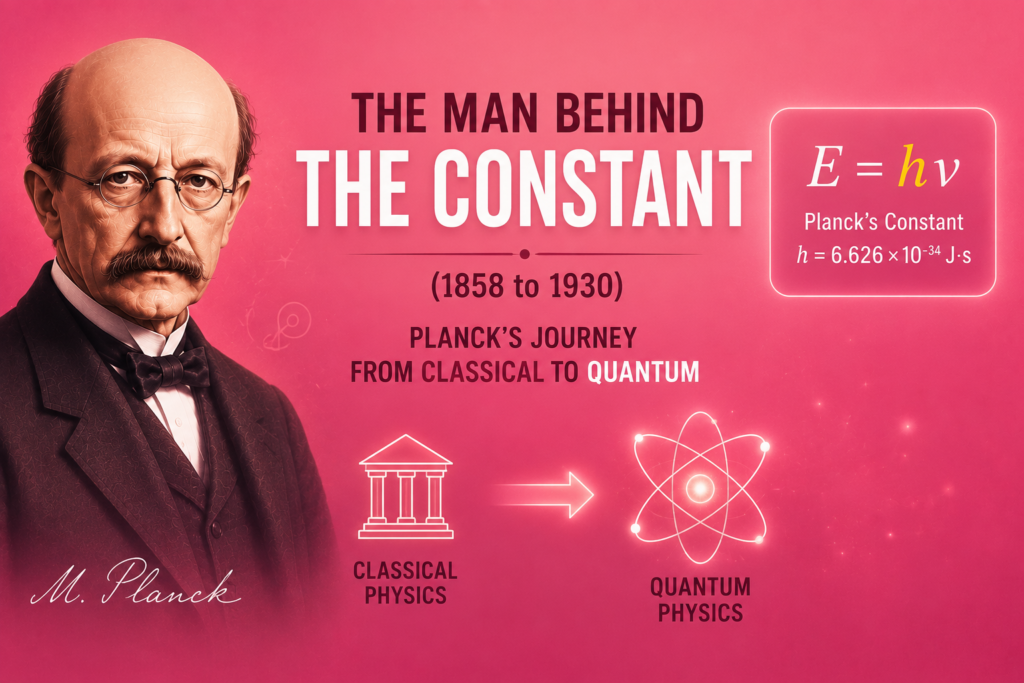
In December 1900, after years of painstaking work, Planck proposed a radical solution. He suggested that energy is emitted only in fixed, discrete packets called quanta, an idea now known as the quantum hypothesis, expressed through the equation:
E = hν
Here, E represents energy, ν (nu) is frequency, and h is planck’s constant, approximately 6.626 × 10⁻³⁴ joule seconds. This single equation marked the true turning point in the max planck journey, transforming him from a respected classical physicist into the reluctant founder of an entirely new scientific era.
A Reluctant Revolutionary
What makes the max planck journey so uniquely compelling is Planck’s own discomfort with his discovery. Trained deeply in classical physics, Planck initially viewed quantization as nothing more than a convenient mathematical trick, hoping it might eventually be reconciled with traditional continuous energy models.
It took years, and confirmation from other physicists, particularly Albert Einstein’s application of quantum theory to the photoelectric effect explained, before Planck’s own community fully accepted the physical reality behind his equation. Even then, Planck himself remained personally cautious about embracing every implication of the growing quantum revolution, a hesitation that reveals the deeply human tension at the heart of his scientific legacy.
Recognition and Later Years (1918 – 1930)
In 1918, Planck received the Nobel Prize in Physics for his discovery of energy quanta, formal recognition of a breakthrough he had approached with such initial reluctance. Throughout the 1920s, Planck remained an active and respected figure within German physics, continuing his work at the Prussian Academy of Sciences while watching the field he had unintentionally founded grow into a fully developed scientific discipline through the contributions of Heisenberg, Schrödinger, and others.
By 1930, Planck had become one of the most respected elder statesmen of physics, a living bridge between the classical world he was trained in and the quantum world he had unknowingly created.
Personal Life of Max Planck
Beyond his professional achievements, the personal life of max planck was marked by both deep intellectual passion and profound tragedy. His continued love of music throughout his life reflected the same discipline and sensitivity he brought to his scientific work. However, Planck also endured immense personal loss, including the deaths of several of his children throughout his lifetime, hardships that tested his resilience even as his scientific reputation continued to grow.
Why Planck’s Personal Journey Still Matters
The max planck journey offers something rare in the history of science: a genuine, well-documented example of a scientist reluctantly overturning his own deeply held beliefs based purely on where the mathematics and evidence led him. Planck’s legacy in modern physics continues today, influencing everything from semiconductor technology to ongoing research into quantum computing, all traceable back to a discovery its own creator was initially hesitant to fully accept.
The Legacy: Max Planck Quantum Universe
Planck’s personal transformation from classical physicist to reluctant quantum pioneer helped establish what we now call the Max Planck Quantum Universe, a reality built on discrete energy quanta rather than smooth classical assumptions. This deeply human journey, from traditional academic training to revolutionary discovery, remains one of the most compelling stories in the history of science.
Frequently Asked Questions
What shaped Max Planck’s early education?
Planck studied at the University of Munich and later Berlin, training under Hermann von Helmholtz and Gustav Kirchhoff, which grounded him deeply in classical thermodynamics.
Did Max Planck want to be a musician instead of a physicist?
Yes, Planck showed considerable talent as a pianist during his youth and seriously considered pursuing music before ultimately choosing a career in physics.
Why is Max Planck called a reluctant revolutionary?
Planck introduced the quantum hypothesis to solve a specific radiation problem but initially viewed it as a mathematical convenience rather than a literal description of physical reality, remaining hesitant about its full implications.
What personal hardships did Max Planck experience?
Planck endured significant personal tragedy throughout his life, including the loss of several of his children, even while his scientific reputation continued to grow.
How did Max Planck’s classical training influence his quantum discovery?
His deep grounding in classical thermodynamics gave him the mathematical tools needed to solve the blackbody radiation problem, even though the solution ultimately required abandoning classical assumptions entirely.
Conclusion
The max planck journey stands as one of the most human stories in the history of science, a tale of a deeply traditional scholar who never intended to become a revolutionary. Trained rigorously in classical physics and initially resistant to his own discovery’s implications, Planck’s path from Kiel to Berlin, and from classical certainty to quantum uncertainty, reshaped humanity’s understanding of the universe forever. His personal journey reminds us that even the most reluctant scientists can end up changing the world entirely.