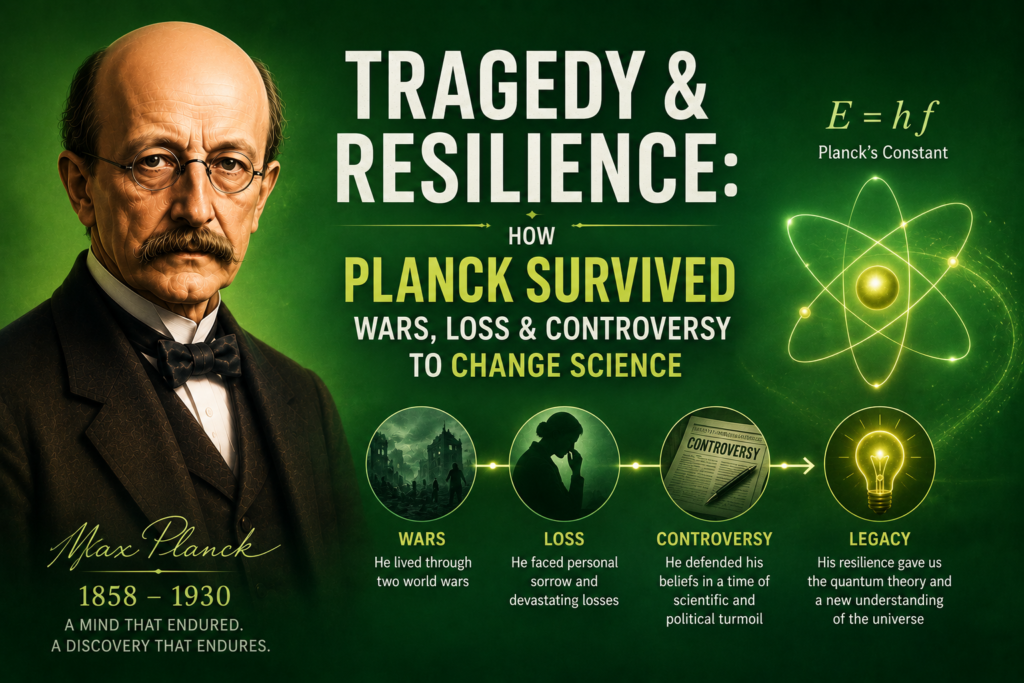
Behind every great scientific achievement lies a human life, often filled with struggles the history books rarely mention. The story of planck during world wars reveals a side of scientific history that has little to do with equations and everything to do with human endurance. Max Planck, the physicist who launched the quantum revolution, lived through two devastating world wars, personal tragedies that would break most people, and a political nightmare that tested his moral courage at every turn.
Understanding planck during world wars means looking beyond the physics entirely, into the life of a man who continued contributing to science even as his personal world collapsed around him repeatedly.
A Life Already Marked by Achievement Before the Storm (1858 – 1914)
By the time the first devastating conflict of the twentieth century began, Max Planck had already secured his place in scientific history. His quantum hypothesis, introduced in 1900, had launched an entirely new field of physics, and by 1914 he was a respected professor in Berlin, a central figure within German science.
Nothing in this earlier chapter of the max planck journey could have prepared him for what the coming decades would bring. The peaceful, methodical academic life he had built was about to be shattered repeatedly by forces entirely outside his control.
World War I and the First Devastating Loss (1914 – 1918)
When World War I erupted in 1914, it did not spare Planck’s family. His son Karl became a world war I casualty, killed in combat during the brutal fighting that defined this conflict. This was the first of many personal tragedies that would test Planck’s resilience throughout his life.
Despite this devastating personal grief, Planck continued his scientific work throughout the war years, and in 1918 he received the Nobel Prize in Physics for his discovery of energy quanta, a bittersweet recognition arriving during one of the darkest periods of his personal life. This juxtaposition, professional triumph alongside personal devastation, would become a recurring and painful pattern throughout planck during world wars.
Further Family Tragedy in the Interwar Years (1919 – 1933)
The years between the two world wars brought no relief from suffering for Planck. Both of his twin daughters died during childbirth, years apart from one another, compounding the grief he had already experienced from losing his son. Some historical accounts also point to further health related losses within his family during this period, including struggles connected to tuberculosis loss that affected many families throughout Europe during this era.
Despite this staggering accumulation of max planck family tragedy, Planck remained deeply committed to his scientific duty, continuing his work at the Prussian Academy of Sciences and supporting the growing field of quantum mechanics through mentorship and institutional leadership.
The Rise of the Nazi Regime and Moral Courage (1933 – 1938)
When the Nazi regime rose to power in 1933, Planck faced an entirely different kind of challenge, one involving moral courage rather than personal grief. As a respected elder statesman of German physics, Planck found himself navigating an increasingly hostile political environment that targeted Jewish scientists, many of whom were forced into göttingen exile or emigration entirely.
Planck attempted, within the limited power available to him, to protect Jewish colleagues and preserve scientific integrity within German institutions. Historical accounts suggest he even met personally with Adolf Hitler to advocate for continued support of Jewish scientists, though these efforts ultimately achieved only limited success given the regime’s increasingly extreme policies. This period represents one of the most morally complex chapters in planck during world wars, showing a man attempting to preserve scientific values under nearly impossible political conditions.
World War II and Unimaginable Personal Loss (1939 – 1945)
If earlier tragedies had tested Planck’s resilience, World War II delivered a blow of almost unbearable severity. His home in Berlin was destroyed by Allied bombing, obliterating decades of personal papers, scientific correspondence, and cherished belongings accumulated throughout his long career.
Far worse, however, was the fate of his son Erwin Planck. Erwin became involved in resistance activities against the Nazi regime, connected to the failed stauffenberg plot of 1944, an assassination attempt targeting Hitler himself. Following the plot’s failure, Erwin was arrested, and in January 1945, he was executed by the Nazi regime. The erwin planck execution stands as perhaps the most devastating personal tragedy in Planck’s entire life, a direct and horrifying consequence of his son’s moral stand against tyranny.
Enduring Grief While the World Burned
The compounding weight of planck personal hardships during this final period of his life is almost impossible to fully comprehend. Within a matter of years, Planck lost his home, his scientific archives, and his son, all while living through the collapse of the nation he had served throughout his entire career.
Despite these overwhelming losses, historical accounts describe Planck maintaining a quiet, dignified resilience throughout this period, continuing to correspond with scientific colleagues and advocate for the eventual rebuilding of German science once the devastating conflict finally ended.
The Mathematics That Outlasted the Chaos
Even as Planck’s personal world collapsed repeatedly across both wars, the scientific legacy he had created continued advancing steadily. The fundamental equation behind his quantum hypothesis remained unchanged and unchallenged throughout this turbulent period:
E = hν
Here, E represents energy, ν (nu) is frequency, and h is planck’s constant, approximately 6.626 × 10⁻³⁴ joule seconds. This equation, developed decades before the wars that would devastate his personal life, continued quietly reshaping physics regardless of the political and personal chaos surrounding its creator, a testament to how scientific truth can persist independent of the turmoil affecting even its own discoverer.
Rebuilding After the War (1945 – 1947)
Remarkably, even after enduring such staggering personal tragedy, Planck spent his final years helping rebuild German scientific institutions in the aftermath of World War II. He continued advocating for scientific integrity and rational thought, values that had guided him throughout even the darkest periods of planck during world wars.
Planck passed away in October 1947, having lived through an extraordinary and often devastating span of history, from the unification of Germany through two world wars, personal tragedy, and the complete transformation of physics itself.
Why This Story of Resilience Still Matters
The human story behind planck during world wars offers something rarely discussed alongside the scientific legacy of quantum mechanics. It reveals a man whose moral courage and personal endurance were tested repeatedly across decades of war, loss, and political upheaval, yet who continued contributing meaningfully to science and advocating for ethical scientific practice throughout.
Planck’s legacy in modern physics extends beyond equations and constants, encompassing this deeper story of human resilience under almost unimaginable circumstances, a legacy that continues inspiring reflection on the relationship between scientific duty and personal integrity during history’s darkest periods.
The Legacy: Max Planck Quantum Universe
The Max Planck Quantum Universe he unknowingly created stands as a permanent testament not just to his scientific genius, but to his extraordinary personal resilience throughout decades of tragedy. His discoveries launched the quantum revolution that continues shaping modern physics, even as the man behind them endured losses that few historical figures have ever faced with comparable dignity and quiet strength.
Frequently Asked Questions
How did World War I affect Max Planck personally?
Planck lost his son Karl during World War I, a devastating personal tragedy that occurred even as his scientific reputation continued growing toward his eventual 1918 Nobel Prize.
What happened to Erwin Planck during World War II?
Erwin Planck, Max Planck’s son, was executed in January 1945 after being connected to the failed Stauffenberg plot against Adolf Hitler.
Did Max Planck oppose the Nazi regime?
Planck attempted to protect Jewish scientists and preserve scientific integrity within German institutions, though his influence under the Nazi regime remained limited.
How many personal tragedies did Max Planck experience?
Planck endured the deaths of multiple children, including his son Karl in World War I, both of his twin daughters during childbirth, and his son Erwin’s execution in 1945.
How did Max Planck respond to such overwhelming personal loss?
Despite repeated tragedy, Planck continued contributing to physics and advocating for scientific integrity, eventually helping rebuild German scientific institutions after World War II.
Conclusion
The story of planck during world wars reveals a dimension of scientific history rarely told alongside equations and discoveries. Behind the physicist who launched the quantum revolution stood a man who endured the loss of multiple children, the destruction of his home, and the devastating execution of his son, all while continuing to serve science and advocate for moral integrity during history’s darkest chapters. This remarkable resilience, as much as any equation, defines the true legacy of Max Planck.