In December 1900, Max Planck could not have imagined that his reluctant solution to an obscure radiation problem would one day help power machines capable of computations classical computers could never achieve. Yet the deep connection between planck and quantum computing is undeniable, a direct line running from a nineteenth century thermodynamics puzzle to the cutting edge quantum processors being developed in laboratories today.
Understanding planck and quantum computing means tracing how a single mathematical insight about energy quanta eventually became the theoretical foundation for an entirely new era of computing technology, one poised to reshape cryptography, medicine, and artificial intelligence alike.
The Origins: Planck’s Quantum Hypothesis (1900)
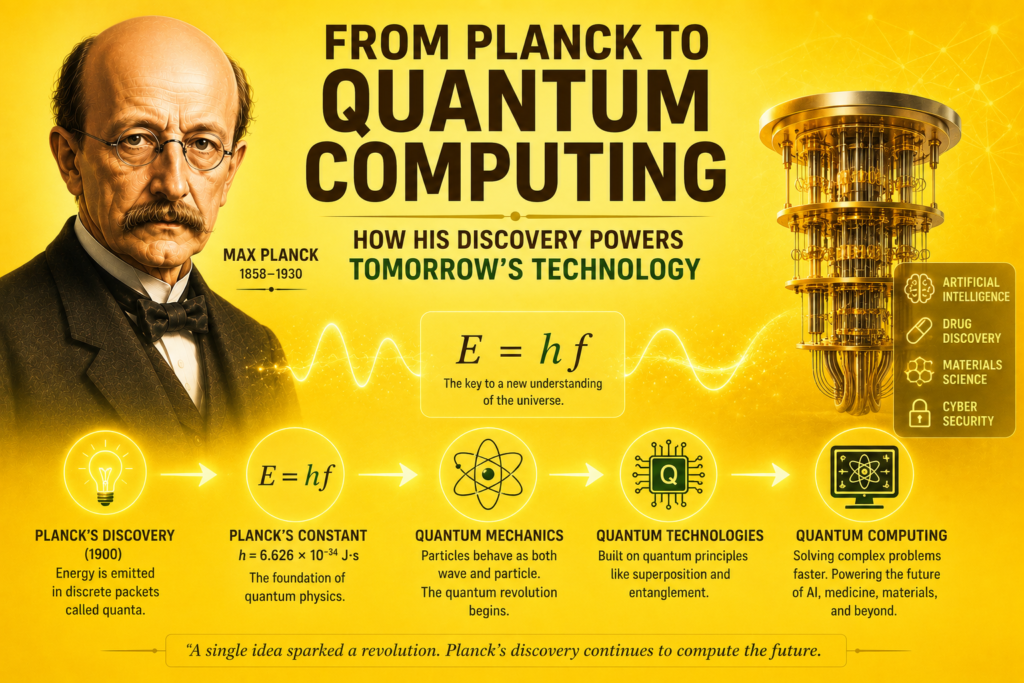
To understand planck and quantum computing, you first need to understand where quantum theory began. In 1900, Planck proposed his quantum hypothesis while solving the blackbody radiation problem, suggesting that energy is exchanged only in fixed, discrete packets rather than flowing continuously. This idea was expressed through his now legendary equation:
E = hν
Here, E represents the energy of a quantum, ν (nu) is frequency, and h is planck’s constant, approximately 6.626 × 10⁻³⁴ joule seconds. Planck himself viewed this as a mathematical convenience rather than genuine physical reality, never imagining that his equation would eventually underpin an entire technological revolution more than a century later.
From Theory to Technology: The Semiconductor Revolution (1940s – 1960s)
The first major technological application connecting planck and quantum computing arrived through the development of semiconductors. Quantum mechanics, built directly on Planck’s original energy quantization, explains how electrons behave within crystal structures like silicon, enabling the creation of transistors that eventually powered the entire silicon valley physics revolution.
Without quantum theory’s explanation of discrete electron energy levels, modern computing as we know it simply could not exist. Every transistor inside every computer chip relies on quantum principles first hinted at by Planck’s original 1900 breakthrough, making this an essential, if often overlooked, chapter in the planck and quantum computing story.
Lasers: Another Quantum Legacy
Beyond semiconductors, lasers represent another crucial technological descendant of Planck’s original work. Laser technology relies directly on wave-particle duality, the principle that light behaves as both a wave and discrete photon particles, a concept that traces back through Einstein’s explanation of the photoelectric effect explained, itself built upon Planck’s quantum hypothesis.
Lasers now play essential roles in modern computing infrastructure, including fiber optic communication systems that transmit data at extraordinary speeds across the globe, further deepening the practical connection between planck and quantum computing technology.
Understanding Quantum Bits: The Building Blocks of Quantum Computing
Modern quantum computing relies on fundamentally different computational units called quantum bits, or qubits, which behave quite differently from the simple binary bits used in classical computers. While classical bits exist strictly as either 0 or 1, qubits can exist in a state of superposition processing, representing both 0 and 1 simultaneously until measured.
This strange but powerful property directly descends from the same quantum principles Planck’s original hypothesis helped establish. Without his foundational insight into discrete, quantized energy states, the entire theoretical framework enabling quantum bits qubits simply would not exist.
Quantum Entanglement and Computational Power
Another critical concept powering modern quantum computers is quantum entanglement, a phenomenon where two or more particles become correlated in such a way that measuring one instantly affects the state of the other, regardless of distance separating them. This bizarre behavior, deeply rooted in the same quantum framework Planck helped originate, allows quantum computers to perform certain calculations exponentially faster than classical machines.
By harnessing both superposition and entanglement together, quantum computers can theoretically solve specific complex problems, such as factoring extremely large numbers or simulating molecular structures, far more efficiently than any classical supercomputer currently in existence.
Real World Applications Emerging Today
The practical implications of planck and quantum computing extend across numerous industries already. Quantum cryptography, for instance, leverages quantum mechanical principles to create theoretically unbreakable encryption methods, since any attempt to intercept quantum encoded information inevitably disturbs the system in a detectable way.
Pharmaceutical companies are also exploring quantum computing applications for simulating complex molecular interactions, potentially accelerating drug discovery processes that currently take years using classical computational methods. Financial institutions are similarly investigating quantum algorithms for portfolio optimization and risk analysis, tasks involving computational complexity that classical computers struggle to handle efficiently.
Why Classical Computers Cannot Replace Quantum Systems
It is worth noting that quantum computers are not simply faster versions of classical computers. They excel specifically at particular types of problems involving massive parallel calculations, such as simulating quantum systems themselves or breaking certain cryptographic codes, while remaining less efficient for many everyday computing tasks that classical transistors handle perfectly well.
This distinction matters when discussing planck and quantum computing, since the technology represents a fundamentally different computational paradigm rather than a straightforward upgrade path from existing classical computing infrastructure built on traditional semiconductors and transistors.
The Ongoing Research Connecting Planck’s Legacy to Modern Computing
Today’s leading technology companies and research institutions continue building directly upon the theoretical foundation Planck established over a century ago. Planck’s legacy in modern physics lives on through massive research investments into quantum processors, quantum error correction, and scalable quantum architectures capable of eventually outperforming classical supercomputers across an increasingly wide range of applications.
This ongoing research represents perhaps the most direct, tangible connection between planck and quantum computing, transforming what began as abstract theoretical physics into concrete engineering challenges being actively solved in laboratories around the world today.
Challenges Still Facing Quantum Computing Development
Despite remarkable progress, significant challenges remain before quantum computing achieves widespread practical application. Qubits remain extremely sensitive to environmental interference, requiring extraordinarily controlled conditions, often near absolute zero temperatures, to maintain stable quantum states long enough for meaningful computation.
Researchers continue working to develop more stable, scalable qubit architectures capable of overcoming these technical limitations, work that continues to draw directly from the same quantum mechanical principles Planck’s original hypothesis helped establish more than a century ago.
The Legacy: Max Planck Quantum Universe
The technological revolution now unfolding within quantum computing represents perhaps the most futuristic expression of what has become known as the Max Planck Quantum Universe, a reality where discrete, quantized principles first identified in 1900 now power some of humanity’s most advanced technological ambitions. From semiconductors to quantum cryptography, this ongoing story demonstrates how deeply Planck’s original insight continues shaping the technological frontier today.
Frequently Asked Questions
How is Planck connected to quantum computing?
Planck’s 1900 discovery of energy quanta established the theoretical foundation of quantum mechanics, which directly underlies the principles powering modern quantum computing technology.
What are qubits in quantum computing?
Qubits are the fundamental units of quantum computing, capable of existing in superposition, representing both 0 and 1 simultaneously, unlike classical binary bits.
Why are semiconductors important to quantum computing history?
Semiconductors rely on quantum mechanical principles to control electron behavior, making them essential to both classical computing and the broader development of quantum computing history.
What makes quantum computers different from classical computers?
Quantum computers use superposition and entanglement to process certain types of complex calculations exponentially faster than classical computers, though they are not universally faster for all tasks.
What challenges remain in quantum computing development?
Quantum computers face challenges including qubit instability and extreme sensitivity to environmental interference, requiring highly controlled conditions to maintain functional quantum states.
Conclusion
The connection between planck and quantum computing reveals how a single theoretical breakthrough from 1900 continues shaping humanity’s technological future more than a century later. What began as Max Planck’s reluctant solution to a stubborn radiation problem eventually became the foundation for semiconductors, lasers, and now the emerging field of quantum computing itself. As researchers continue pushing the boundaries of qubits, entanglement, and quantum cryptography, Planck’s original insight remains as relevant and powerful today as it was during those transformative final months of 1900.