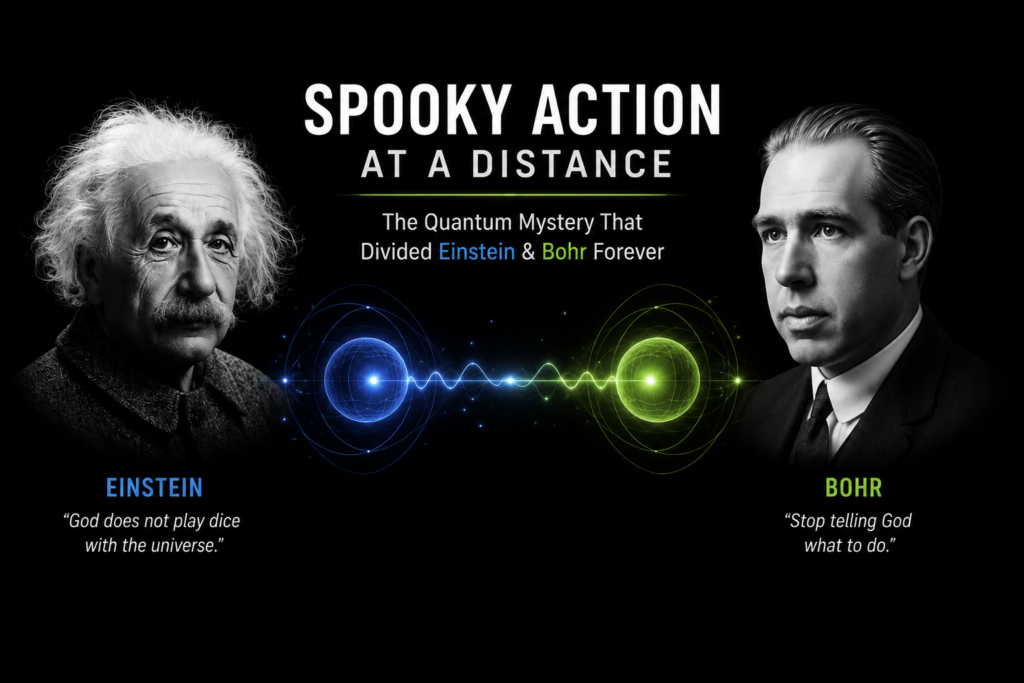
Imagine two coins, separated by billions of miles, somehow always landing on opposite sides the instant either one is flipped, no matter how far apart they travel. This sounds like pure fantasy, yet something remarkably similar actually happens in nature, a phenomenon Albert Einstein dismissively called spooky action at a distance. This strange quantum mystery would eventually divide Einstein and Niels Bohr for the remainder of their lives, sparking a debate that took decades of careful experimentation to finally resolve.
Understanding spooky action at a distance means confronting one of quantum mechanics’ most genuinely bizarre confirmed phenomena, one that challenges our most basic intuitions about space, distance, and cause and effect throughout the physical universe.
What Exactly Is Spooky Action at a Distance?
Spooky action at a distance refers to the phenomenon of quantum entanglement, where two or more particles become correlated in such a way that measuring a property of one instantaneously determines the corresponding property of its distant partner, regardless of the physical distance separating them. This entangled particles behavior appeared to violate everything classical physics had taught scientists about how the universe should work.
According to established physics, no influence or information should travel faster than light. Yet quantum correlation between entangled particles seemed to happen instantaneously, faster than any light signal could possibly travel between them, creating exactly the kind of instant correlation physics mystery that troubled Einstein so deeply.
Einstein’s Deep Discomfort with Entanglement
Einstein first articulated his objection to spooky action at a distance through the famous EPR paradox, published alongside colleagues Podolsky and Rosen in 1935. Einstein’s entanglement objection centered on his conviction that physical reality must respect what physicists call local causality, the principle that objects can only be directly influenced by their immediate surroundings, never by instantaneous action across vast distances.
Einstein argued that if quantum mechanics truly predicted spooky action at a distance, then either the theory violated relativity’s speed limit, or some hidden, deeper explanation must exist, one involving predetermined properties established when the entangled particles were originally created, rather than genuine instantaneous influence occurring at the moment of measurement.
Bohr’s Radically Different View
Niels Bohr viewed spooky action at a distance through an entirely different philosophical lens. Rather than treating entangled particles as two separate objects mysteriously communicating across space, Bohr’s non-locality view proposed that entangled particles must be understood as forming a single, unified quantum system, regardless of their physical separation.
According to Bohr’s reply to Einstein, measuring one particle within an entangled pair does not send any signal or information to its distant partner. Instead, the entire entangled system, from the moment of its creation, exists as one indivisible quantum entity. This quantum non-separability meant that describing the particles as truly independent objects, capable of being disturbed by distant influence, misunderstood the fundamental nature of quantum reality itself.
The Mathematics Behind Entanglement
Quantum entanglement can be understood through examining spin entanglement or photon polarization correlation scenarios. Consider two particles created together in a way that conserves total angular momentum, expressed simply as their combined spin values must sum to zero. According to quantum mechanics, before measurement occurs, neither particle possesses a definite spin value independently, they exist in a combined, non-separable wave function describing the entire system together.
Only upon measuring one particle’s spin does quantum state collapse occur, instantaneously determining the corresponding value for its distant partner. This relationship holds true regardless of how far apart the particles have traveled, whether mere centimeters or, theoretically, across the entire observable universe.
Bell’s Theorem: Finally Testing the Mystery (1964)
For nearly three decades following the original EPR paper, the disagreement between Einstein and Bohr remained purely philosophical, since no experimental method existed capable of distinguishing between Einstein’s hidden variables hypothesis and genuine quantum non-locality proof. This changed in 1964, when physicist John Bell developed a groundbreaking mathematical framework known as Bell theorem, providing the first testable prediction capable of settling this decades-long dispute.
Bell’s mathematics demonstrated that if Einstein’s local hidden variables actually existed, certain statistical correlations between entangled particles would necessarily satisfy specific mathematical limits, now known as Bell inequality constraints. If quantum mechanics were correct instead, these same correlations would violate Bell’s inequalities entirely, providing a clear, testable distinction between the two competing interpretations.
Refining the Test: CHSH Inequality
Physicists John Clauser, Michael Horne, Abner Shimony, and Richard Holt later refined Bell’s original mathematical framework into what became known as the Clauser Horne Shimony Holt inequality, or simply the CHSH inequality, providing an experimentally practical version of Bell’s theoretical test suitable for actual laboratory implementation using real entangled photon pairs.
Experimental Proof: Alain Aspect’s Breakthrough (1982)
The most historically significant experimental confirmation came through the celebrated Alain Aspect experiment conducted in 1982. French physicist Alain Aspect and his research team successfully tested Bell’s inequality using genuinely entangled photon pairs separated by meaningful physical distances, employing sophisticated switching mechanisms to eliminate potential loopholes in earlier, less rigorous experimental attempts.
Aspect’s results demonstrated clear Bell inequality violation, matching quantum mechanics’ predictions precisely while directly contradicting Einstein’s local hidden variables hypothesis. This landmark experiment provided compelling evidence that spooky action at a distance represented genuine physical reality rather than merely reflecting incomplete theoretical understanding.
Later Confirmation: Closing the Loopholes
Following Aspect’s groundbreaking work, subsequent decades brought increasingly sophisticated experiments designed to close remaining theoretical loopholes that skeptics argued might still allow classical explanations. These modern quantum test experiments, conducted throughout the 2000s and 2010s using increasingly precise detection methods and greater spatial separation correlation between entangled particles, consistently confirmed quantum mechanics’ predictions with ever-increasing statistical certainty.
Why This Isn’t Actually Faster Than Light Communication
Despite its seemingly instantaneous nature, spooky action at a distance does not actually violate relativity’s restrictions on faster than light myth communication. While measurement outcomes correlate perfectly between distant entangled particles, no genuinely usable information can be transmitted through this connection alone, since individual measurement outcomes remain fundamentally random from either observer’s perspective.
This subtle distinction resolves what might otherwise seem like a direct contradiction between quantum mechanics and relativity, allowing both theories to coexist despite quantum entanglement’s genuinely non-local correlation properties.
From Philosophical Debate to Practical Technology
What began as a purely philosophical disagreement within the historic Einstein–Bohr debate has since become foundational to genuinely practical technologies. Quantum entanglement now serves as the essential quantum teleportation base underlying quantum information theory research, alongside applications in quantum cryptography and emerging quantum computing systems that directly exploit spooky action at a distance for genuinely useful technological purposes.
Why This Debate Still Matters Today
Understanding spooky action at a distance remains essential for grasping from Bohr model to modern technology developments continuing to reshape contemporary science. The historic Niels Bohr vs Einstein disagreement, though experimentally resolved decades ago, continues generating philosophical discussion regarding the deeper meaning of quantum non-locality and its implications for our fundamental understanding of physical reality.
Bohr’s Enduring Legacy
Bohr’s quantum contributions regarding entanglement and non-locality, developed through his patient philosophical responses to Einstein’s objections, established the theoretical foundation underlying modern quantum information science. This intellectual legacy, forged through decades of respectful yet uncompromising scientific disagreement, continues shaping how physicists understand correlation, measurement, and the genuinely strange interconnected nature of quantum reality.
Frequently Asked Questions
What does spooky action at a distance actually mean?
Spooky action at a distance refers to quantum entanglement, where measuring one particle instantaneously determines the corresponding property of its distant partner, regardless of the physical distance separating them.
Why did Einstein object to spooky action at a distance?
Einstein believed this apparent instantaneous correlation violated relativity’s restriction on faster than light influence, leading him to propose that hidden variables must explain the correlation instead.
How was spooky action at a distance experimentally proven?
Alain Aspect’s 1982 experiment tested Bell’s inequality using entangled photons, providing strong evidence supporting quantum mechanics’ predictions over Einstein’s local hidden variables hypothesis.
Does spooky action at a distance violate the speed of light?
No, while correlations appear instantaneous, no actual usable information can be transmitted through entanglement alone, meaning it does not violate relativity’s restrictions on faster than light communication.
How is spooky action at a distance used in modern technology?
Quantum entanglement now underlies practical applications including quantum cryptography, quantum teleportation research, and emerging quantum computing systems.
Conclusion
Spooky action at a distance stands as one of quantum mechanics’ strangest and most thoroughly confirmed phenomena, a genuine mystery that permanently divided two of history’s greatest scientific minds. From Einstein’s philosophical objections through Bohr’s radical reconceptualization of physical reality, and finally to Alain Aspect’s decisive experimental confirmation, this quantum mystery has evolved from theoretical debate into practical technological foundation. Nearly a century after Einstein first coined this dismissive phrase, spooky action at a distance remains one of the clearest demonstrations that our universe operates according to principles far stranger and more interconnected than classical intuition ever suggested.