In 1935, Albert Einstein, alongside colleagues Boris Podolsky and Nathan Rosen, published a short scientific paper that would haunt quantum mechanics for the rest of the century. The EPR paradox did not attempt to disprove quantum theory outright. Instead, it posed a far more subtle and devastating challenge, arguing that quantum mechanics, despite its remarkable predictive success, simply could not be a complete description of physical reality. This single thought experiment would eventually become one of the most consequential arguments in the history of physics.
Understanding the EPR paradox explained means confronting a genuinely profound question about the nature of reality itself, one that pitted Einstein’s deep commitment to local realism against Niels Bohr‘s radical vision of quantum interconnectedness, a disagreement that took decades of experimental physics to finally resolve.
The Paper That Started It All (1935)
The EPR paradox takes its name directly from its three authors, published under the title “Can Quantum-Mechanical Description of Physical Reality Be Considered Complete?” This EPR paper 1935 did not challenge whether quantum mechanics made accurate predictions, since its experimental success was already well established by this point. Instead, Einstein Podolsky Rosen specifically questioned quantum completeness, whether the theory provided a full, complete account of physical reality or merely an incomplete statistical approximation of some deeper, more fundamental description.
Defining Reality: The EPR Criterion
Central to the EPR paradox explained is a specific philosophical definition the authors proposed for physical reality completeness. According to their physical reality criterion, if scientists could predict the value of a physical quantity with absolute certainty, without in any way disturbing the system being measured, then that quantity must correspond to an actual element of reality, existing definitely and objectively regardless of whether anyone actually measured it.
This seemingly reasonable criterion for reality definition EPR became the foundation for their entire argument, since quantum mechanics, according to the Copenhagen interpretation, suggested that certain properties simply did not possess definite values until the specific act of measurement occurred.
The Thought Experiment: Entangled Particles
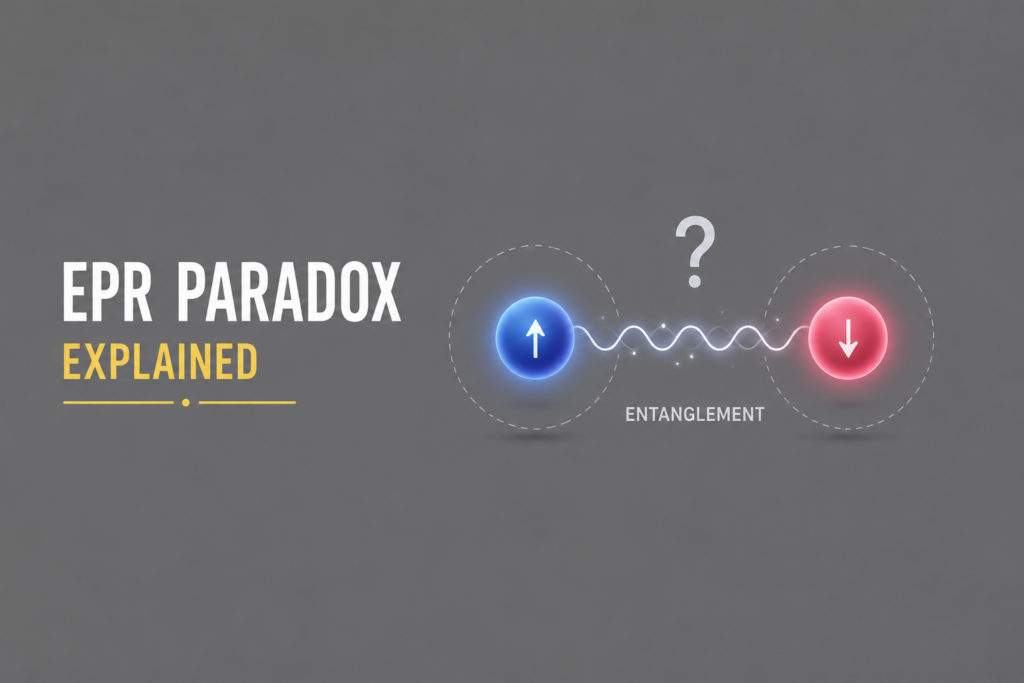
The core EPR thought experiment involves creating a pair of particles, an entangled photon pair or similarly correlated particles, produced together through some shared physical process, then allowing them to separate across significant spatial separation. According to quantum mechanics, these two particles become correlated in such a way that measuring a property of one particle instantaneously determines the corresponding property of its distant partner, regardless of the distance separating them.
This relationship can be expressed through considering commuting observables, properties that quantum mechanics predicts will always correlate perfectly between entangled particles. If a scientist measures one particle’s spin along a particular axis and finds it pointing upward, quantum mechanics predicts the distant partner particle’s spin, when measured along that same axis, will always point downward, with perfect spin correlation regardless of how far apart the particles have traveled.
Why This Troubled Einstein
Einstein found this instantaneous correlation deeply troubling, since it appeared to violate locality principle assumptions fundamental to his own theory of relativity. According to relativity, no information or influence should be capable of traveling faster than light, yet quantum entanglement seemed to suggest some kind of instantaneous correlation occurring between particles separated by potentially enormous distances.
Einstein famously dismissed this apparent connection as spooky action at a distance, arguing that such non-local correlations seemed to violate basic principles of local causality that had underpinned physics since Newton’s era. If measuring one particle could instantaneously affect its distant partner, Einstein argued, either quantum mechanics violated relativity’s speed limit, or something deeper, some hidden parameter not yet accounted for within quantum theory, must actually explain this correlation without requiring genuine instantaneous influence.
Hidden Variables: Einstein’s Proposed Solution
Rather than accepting that nature was genuinely non-local, Einstein proposed that hidden variables theory might resolve this apparent paradox. According to this local hidden variables hypothesis, both entangled particles might actually possess definite, predetermined properties from the moment of their creation, simply unknown to physicists due to quantum mechanics’ current incomplete state.
Under this interpretation, measuring one particle would not actually influence its distant partner instantaneously. Instead, both particles would have already possessed matching properties all along, information hidden within some deeper theoretical framework that quantum mechanics, in its current incomplete form, simply failed to describe. This would preserve classical realism vs quantum uncertainty by restoring local, objective reality without requiring any genuine instantaneous, faster-than-light influence between distant particles.
Bohr’s Careful Response
Bohr’s reply to Einstein regarding the EPR paradox proved characteristically nuanced and philosophically sophisticated. Rather than simply denying entanglement’s strange implications, Bohr argued that the EPR paradox actually revealed something profound about quantum mechanics’ fundamentally non-classical character, requiring physicists to abandon comfortable assumptions regarding local realism entirely.
According to Bohr’s complementarity principle and broader copenhagen interpretation framework, quantum entanglement did not represent hidden, predetermined properties waiting to be discovered. Instead, Bohr argued, the entangled particle system itself must be considered as a single, unified physical entity, regardless of the spatial separation between its individual components. Measurement performed on one part of this unified quantum system genuinely and instantaneously affects the complete description of the entire system, without violating relativity’s restrictions on information transfer.
Understanding Non-Locality Without Violating Relativity
Importantly, the EPR paradox explained through modern quantum mechanics does not actually allow faster-than-light communication or information transfer, despite the apparent instantaneous correlation between entangled particles. While measurement outcomes correlate perfectly between distant particles, no actual usable information can be transmitted through this connection alone, since the specific measurement outcome remains fundamentally random from either observer’s individual perspective. This resolves the non-locality paradox without genuinely violating relativity’s fundamental speed limit, even though the underlying quantum correlation itself remains genuinely non-local.
Bell’s Theorem: Finally Testing the Question (1964)
For nearly three decades following the original EPR paper 1935, the disagreement between Einstein and Bohr remained largely philosophical, since no experimental test existed capable of definitively distinguishing between local hidden variables and genuine quantum non-locality. This changed in 1964, when physicist John Bell developed a groundbreaking mathematical framework, now known as Bell’s theorem, providing a testable prediction distinguishing between these two competing interpretations.
Bell’s theorem precursor work demonstrated that if local hidden variables actually existed, as Einstein had proposed, certain statistical correlations between entangled particles would need to satisfy specific mathematical inequalities. If quantum mechanics were correct instead, these same correlations would violate Bell’s inequalities entirely.
Experimental Verification (1970s – Present)
Beginning in the 1970s and continuing through increasingly sophisticated experiments over subsequent decades, physicists repeatedly tested Bell’s predictions using genuinely entangled particle pairs separated by substantial distances. These experiments consistently found that measured correlations violated Bell’s inequalities exactly as quantum mechanics predicted, providing overwhelming evidence against Einstein’s local hidden variables hypothesis and strongly supporting Bohr’s original quantum mechanical interpretation.
This experimental verification effectively settled the historic Einstein–Bohr debate regarding the EPR paradox, confirming that quantum entanglement represents genuine, non-local correlation rather than merely reflecting hidden, predetermined properties awaiting discovery.
Why the EPR Paradox Still Matters Today
Beyond its historical significance within the broader Niels Bohr vs Einstein rivalry, the EPR paradox explained through modern experimental verification now underlies genuinely practical technologies. Quantum entanglement forms the essential theoretical foundation for quantum cryptography, quantum computing, and quantum teleportation research, all representing modern applications emerging directly from Bohr model to modern technology developments building upon this once purely theoretical debate.
Bohr’s Enduring Contribution
Bohr’s quantum contributions regarding the EPR paradox, developed substantially through his careful, patient responses to Einstein’s sophisticated challenges, helped establish the philosophical and mathematical foundation underlying modern quantum information science. This intellectual legacy, forged through respectful yet uncompromising scientific disagreement, continues shaping how physicists understand entanglement, measurement, and the true nature of physical reality itself.
Frequently Asked Questions
What is the EPR paradox in simple terms?
The EPR paradox is a thought experiment proposed by Einstein, Podolsky, and Rosen suggesting that quantum mechanics must be incomplete, since it seemed to allow instantaneous correlations between distant particles that appeared to violate relativity.
Why did Einstein call quantum entanglement spooky action at a distance?
Einstein used this phrase to express his discomfort with quantum mechanics predicting instantaneous correlations between distant particles, which seemed to violate the principle that nothing can travel faster than light.
How did Bohr respond to the EPR paradox?
Bohr argued that entangled particles must be considered as a single, unified quantum system regardless of distance, meaning measurement on one part genuinely affects the complete description of the whole system without violating relativity.
Was the EPR paradox ever experimentally resolved?
Yes, experiments testing Bell’s theorem throughout subsequent decades consistently confirmed quantum mechanics’ predictions, providing strong evidence against Einstein’s local hidden variables hypothesis.
How is the EPR paradox relevant to modern technology?
The EPR paradox’s exploration of quantum entanglement now underlies practical technologies including quantum cryptography, quantum computing, and quantum teleportation research.
Conclusion
The EPR paradox explained stands as one of the most intellectually significant thought experiments in the history of physics, representing Einstein’s most sophisticated challenge to quantum mechanics’ completeness. Though Einstein never lived to see the question definitively resolved, decades of subsequent experimental testing ultimately vindicated Bohr’s original quantum mechanical interpretation, confirming that entanglement represents genuine, non-local correlation rather than hidden, predetermined properties. Nearly a century after its original publication, the EPR paradox continues shaping modern quantum information science, standing as permanent testament to how even a failed challenge to established theory can illuminate profound truths about the nature of physical reality.