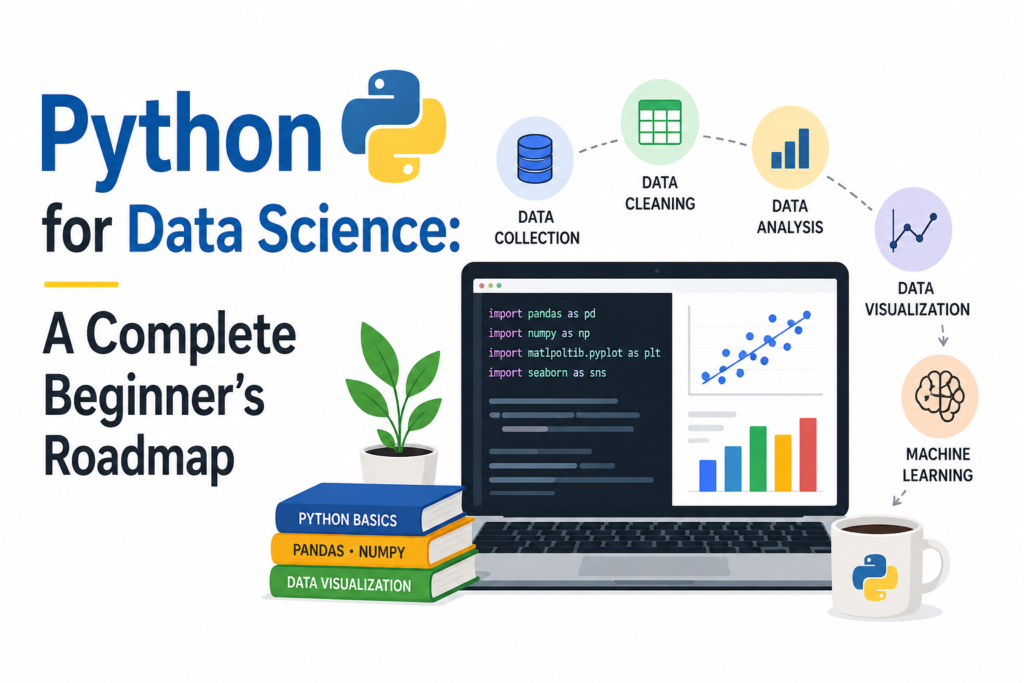
In today’s digital world, python for data science has become one of the most valuable skills you can learn. From startups to global tech companies, organizations rely on data-driven decisions to grow, compete, and innovate. Python stands at the center of this transformation because of its simplicity, versatility, and powerful ecosystem.
If you are starting your journey, this roadmap will guide you step by step. You will understand the fundamentals, tools, and skills required to succeed in the field while building a strong data science career path.
Understanding Python and Its Rise (1990 – 2000)
Python was created by Guido van Rossum, and it quickly gained popularity because of its readable syntax and flexibility. Its role in the history of programming languages is significant, as it bridged the gap between simplicity and power.
Unlike complex languages, Python allows beginners to focus on logic rather than syntax. This is why it is often recommended in Python for Beginners tutorials and courses.
Over the years, Python evolved into a dominant force in artificial intelligence, predictive modeling, and deep learning. Today, python for data science is widely used in industries like healthcare, finance, and e commerce.
Why Choose Python for Data Science in 2025
There are many reasons why python for data science continues to dominate:
First, it has a vast ecosystem of libraries that simplify data analysis and machine learning with Python. Tools like NumPy, Pandas, and Matplotlib make complex tasks easier.
Second, Python supports notebook-based development through Jupyter Notebooks. This allows data scientists to write code, visualize data, and document results in one place.
Third, Python integrates well with SQL with Python, enabling seamless database operations and Big Data Python workflows.
Finally, Python is beginner friendly yet powerful enough for advanced artificial intelligence (AI) applications.
Setting Up Your Environment (2020 – 2025)
Before diving deeper into python for data science, you need the right tools.
Start by following a reliable Python Installation Guide. Install Python, then set up Jupyter Notebooks or an IDE like VS Code.
Jupyter Notebooks are essential for data science because they support interactive coding and visualization tools. They also make it easier to share results with others.
Additionally, install important libraries such as NumPy, Pandas, Seaborn, and Scikit learn.
Learning Python Basics for Data Science
To succeed in python for data science, you must understand the basics.
Begin with Python Syntax Basics, including variables, loops, and conditional statements. These concepts are the foundation of all data science tasks.
Next, learn Python Functions & Modules to write reusable and efficient code. This will help you manage complex projects and improve productivity.
Understanding data structures like lists, dictionaries, and arrays is also crucial. These structures are used extensively in data wrangling and feature engineering.
Core Data Science Skills You Need
Python alone is not enough. You need a combination of technical and analytical skills.
Statistics for data science is essential. Concepts like probability, distributions, and hypothesis testing help you interpret data accurately.
You must also learn data cleaning techniques. Real world data is messy, and cleaning it is often the most time consuming part of any project.
Exploratory data analysis EDA is another key skill. It involves analyzing datasets to find patterns, trends, and insights.
Finally, develop strong data scientist skills such as problem solving, communication, and critical thinking.
Data Analysis and Visualization
One of the most exciting parts of python for data science is visualization.
Libraries like Matplotlib and Seaborn allow you to create graphs, charts, and dashboards. These visualization tools help you present findings clearly.
Visualization is crucial for making data-driven decisions. It transforms raw data into meaningful insights that businesses can understand.
You will also work on data wrangling, which involves transforming and preparing data for analysis.
Machine Learning with Python
Machine learning with Python is a core part of data science.
You will learn algorithms for predictive modeling, classification, and regression. Libraries like Scikit learn simplify the implementation of these models.
As you progress, you can explore deep learning using frameworks like TensorFlow and PyTorch.
Machine learning enables applications such as recommendation systems, fraud detection, and algorithmic trading.
Working with Data and Files
Handling data is a daily task in python for data science.
Learn Python File Handling to read and write data from files like CSV, Excel, and JSON.
You should also understand databases and SQL with Python. This allows you to retrieve and manipulate large datasets efficiently.
Combining Python with Big Data Python tools like Hadoop or Spark can help you manage massive datasets.
Advanced Topics in Data Science (2023 – 2025)
As you grow, you will explore advanced areas of python for data science.
Feature engineering helps improve model performance by selecting and transforming variables.
Mathematical modeling allows you to build accurate predictions and simulations.
Artificial intelligence AI and deep learning open doors to advanced applications like image recognition and natural language processing.
You may also explore Kaggle competitions to test your skills and learn from real world problems.
Building Real Projects
The best way to master python for data science is through practice.
Start with simple projects like analyzing sales data or predicting house prices.
Then move to complex projects involving predictive modeling, artificial intelligence, or financial analysis.
Projects help you build a strong portfolio, which is essential for landing jobs in the data science career path.
Career Opportunities in Data Science
Python for data science opens many career paths.
You can become a data analyst, data scientist, machine learning engineer, or AI specialist.
Industries like healthcare, finance, marketing, and technology are actively hiring professionals with these skills.
Companies value individuals who can turn data into actionable insights and support data-driven decisions.
Challenges Beginners Face
While learning python for data science, beginners often face challenges.
Understanding statistics for data science can be difficult at first.
Working with large datasets may feel overwhelming.
Debugging code and learning new libraries takes time and patience.
However, consistent practice and hands on learning can overcome these challenges.
Future of Python in Data Science (2025 – 2030)
The future of python for data science looks very promising.
With the rise of artificial intelligence AI and Big Data Python, demand for Python skills will continue to grow.
Automation, deep learning, and predictive modeling will play a bigger role in industries.
Python will remain a leading language due to its flexibility and strong community support.
Frequently Asked Questions (FAQs)
1. Is python for data science good for beginners?
Yes, Python is easy to learn and widely recommended for beginners.
2. How long does it take to learn python for data science?
It usually takes 3 to 6 months to learn basics with consistent practice.
3. Do I need math for data science?
Basic statistics and mathematical modeling are important but can be learned gradually.
4. Which tools are essential for beginners?
Jupyter Notebooks, Pandas, NumPy, and visualization tools are essential.
5. Can I get a job after learning python for data science?
Yes, with projects and skills, you can enter the data science career path.
Conclusion
Learning python for data science is one of the smartest decisions you can make today. It combines programming, statistics, and analytical thinking to solve real world problems.
By following this roadmap, you can build a strong foundation and gradually move toward advanced topics like machine learning with Python and artificial intelligence AI.
Stay consistent, practice regularly, and work on real projects. Over time, you will develop the confidence and skills needed to succeed in this exciting field.