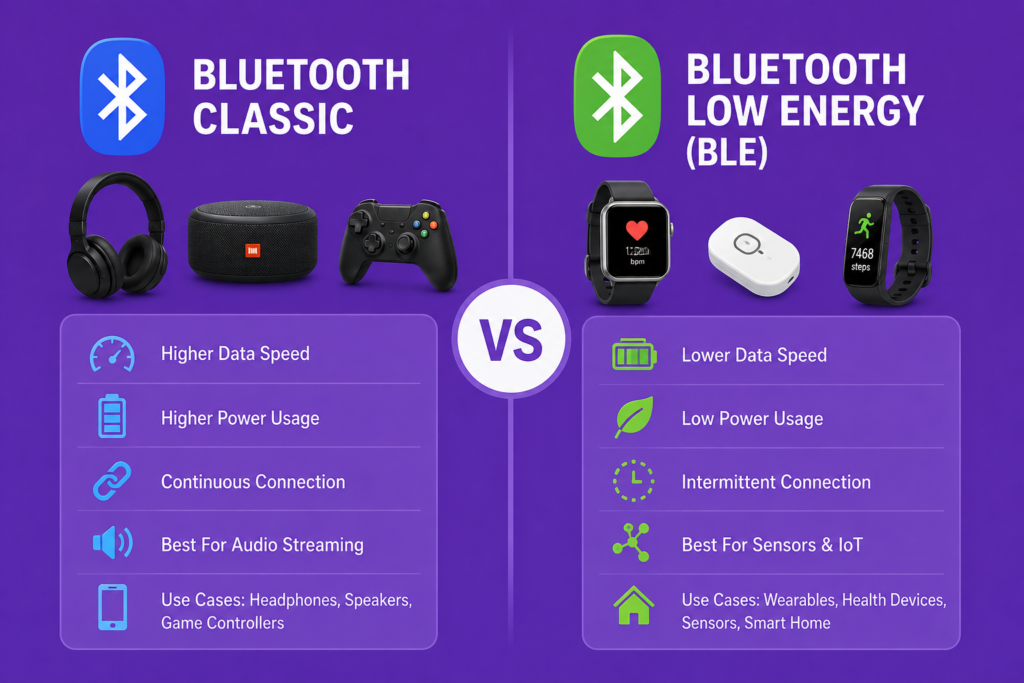
Understanding bluetooth classic vs bluetooth low energy is extremely important because modern Bluetooth devices use two very different wireless communication systems. While both technologies belong to the Bluetooth family, they are designed for different purposes, devices, and performance goals.
Bluetooth Classic focuses on continuous communication such as wireless audio streaming, gaming accessories, and hands-free calling. Bluetooth Low Energy, commonly called BLE or Bluetooth Smart, focuses on ultra-low power communication for smartwatches, fitness trackers, sensors, and IoT connectivity.
Today, billions of devices worldwide rely on one of these Bluetooth systems. Choosing the correct version affects battery life, wireless speed, latency, energy profiles, and overall performance.
The comparison between bluetooth classic vs bluetooth low energy helps consumers, developers, and technology enthusiasts understand which system works best for different situations.
This guide explains all the major differences between Bluetooth Classic and BLE, including speed, battery efficiency, use cases, wireless architecture, signal behavior, security, and future applications.
The Evolution of Bluetooth Technology (1994 – 2010)
Before understanding bluetooth classic vs bluetooth low energy, it is important to understand Bluetooth’s evolution.
Bluetooth technology started in 1994 when Ericsson engineers developed a wireless communication standard for short-range connectivity between devices.
Early Bluetooth systems mainly focused on continuous communication such as:
- Audio streaming
- File transfers
- Wireless peripherals
- Mobile phone connectivity
These systems later became known as Bluetooth Classic.
In 2010, Bluetooth 4.0 introduced Bluetooth Low Energy, also called BLE or Bluetooth Smart.
BLE completely changed the wireless industry by focusing on low power consumption and battery-powered devices.
If you want a deeper understanding of Bluetooth’s development, exploring bluetooth history explains how the technology evolved over time.
What Is Bluetooth Classic?
Bluetooth Classic is the traditional Bluetooth system used for continuous wireless communication.
It is optimized for applications requiring stable, ongoing connections and relatively higher Bluetooth data throughput.
Bluetooth Classic is commonly used in:
- Wireless headphones
- Speakers
- Gaming controllers
- Car audio systems
- Wireless keyboards
- File transfers
The system maintains a constant connection between devices while continuously transmitting data.
Bluetooth Classic prioritizes:
- Stable communication
- Audio quality
- Larger bandwidth
- Real-time performance
This makes it ideal for multimedia and entertainment applications.
What Is Bluetooth Low Energy (BLE)?
Bluetooth Low Energy, commonly called BLE or Bluetooth Smart, is designed for extremely power-efficient wireless communication.
BLE focuses on transmitting small amounts of data using intermittent data communication instead of continuous connections.
BLE devices usually communicate periodically rather than constantly.
This design dramatically improves battery life for IoT devices and wearable technologies.
BLE is commonly used in:
- Smartwatches
- Fitness trackers
- Heart rate monitors
- Smart sensors
- Beacons
- Medical devices
- Smart home systems
BLE became revolutionary because some devices can operate for months or even years on tiny batteries.
The Biggest Difference Between Bluetooth Classic and BLE
The biggest difference in bluetooth classic vs bluetooth low energy is energy usage.
Bluetooth Classic
- Constant wireless connection
- Higher power consumption
- Better for audio streaming
- Faster continuous data transfer
Bluetooth Low Energy
- Periodic communication
- Ultra-low power consumption
- Better for sensors and IoT
- Optimized for battery-powered devices
Bluetooth Classic prioritizes performance.
BLE prioritizes efficiency.
This single difference shapes nearly every other aspect of the technologies.
Power Consumption Comparison
Power management is the most important advantage of BLE.
Bluetooth Classic continuously keeps devices active and connected, which drains battery life more quickly.
BLE devices remain asleep most of the time and wake up only when needed.
This creates massive energy savings.
Bluetooth Classic Power Usage
Bluetooth Classic works best when power availability is less important.
Examples include:
- Car systems
- Gaming accessories
- Wireless speakers
BLE Power Usage
BLE works best for devices requiring long battery life.
Examples include:
- Smart sensors
- Wearables
- Fitness devices
- Medical monitoring systems
BLE made modern IoT connectivity practical on a global scale.
Connection Type Differences
Another major part of bluetooth classic vs bluetooth low energy involves connection behavior.
Bluetooth Classic
Bluetooth Classic uses constant connections.
Once paired, devices remain actively connected throughout communication.
This approach works well for:
- Music streaming
- Phone calls
- Real-time gaming
BLE
BLE uses periodic connection systems.
Devices communicate only when needed.
This approach reduces battery usage significantly.
BLE communication often relies on:
- Short data bursts
- Sensor readings
- Small packet transmission
- Intermittent data updates
The duty cycle of BLE devices remains extremely low, improving energy efficiency.
Data Throughput and Speed
Bluetooth data throughput differs greatly between the two technologies.
Bluetooth Classic Speed
Bluetooth Classic provides higher continuous transfer speeds.
This makes it better for:
- Audio streaming
- Video accessories
- Gaming devices
- Large file transfers
BLE Speed
BLE typically transfers smaller amounts of data.
It is optimized for:
- Sensor readings
- Notifications
- Smart device updates
- Location tracking
Although BLE speeds improved dramatically in newer versions, Bluetooth Classic still handles continuous multimedia better.
Audio Performance Comparison
Audio streaming is one of the biggest differences in bluetooth classic vs bluetooth low energy.
Bluetooth Classic dominates wireless audio systems because it supports stable continuous communication.
It powers:
- Wireless earbuds
- Headphones
- Car audio systems
- Portable speakers
BLE originally struggled with high-quality audio because it focused on low-power operation.
However, newer BLE systems introduced LE Audio technology, significantly improving wireless sound performance.
If you want better sound quality understanding, exploring bluetooth audio codecs explains how Bluetooth audio systems evolved.
Battery Life for IoT Devices
BLE completely transformed battery life for IoT technology.
Bluetooth Classic devices consume too much energy for many sensor networks and wearable applications.
BLE devices can operate using:
- Tiny batteries
- Coin-cell batteries
- Long-term low-energy systems
This made possible:
- Smartwatches
- Health monitors
- Smart home devices
- Beacons
- Proximity sensing systems
BLE became essential for the modern Internet of Things revolution.
Range and Wireless Coverage
Modern Bluetooth systems provide excellent wireless range, but BLE often performs surprisingly well because of its optimized communication methods.
If you want deeper technical details, learning about bluetooth range explains how modern Bluetooth versions improved wireless distance.
Bluetooth 5.0 significantly improved BLE range, making it highly effective for:
- Smart homes
- Industrial systems
- Sensor networks
- Wireless tracking
Both Bluetooth Classic and BLE now support strong wireless coverage in modern devices.
Latency and Communication Speed
Latency refers to communication delay between devices.
Bluetooth Classic
Bluetooth Classic usually provides lower latency for:
- Audio streaming
- Gaming controllers
- Voice communication
BLE
BLE focuses on low-energy efficiency instead of continuous real-time performance.
However, newer BLE systems improved latency significantly for smart devices and sensors.
The best choice depends on the device’s communication needs.
BLE Use Cases in Modern Technology
BLE use cases continue expanding rapidly.
Today, BLE powers:
- Fitness trackers
- Heart rate monitors
- Smart lighting
- Industrial automation
- Wireless medical systems
- Smart agriculture
- Location tracking systems
BLE also supports advanced smart home ecosystems involving dozens of connected devices simultaneously.
This flexibility made BLE one of the fastest-growing wireless standards in history.
Bluetooth Classic Use Cases
Bluetooth Classic still dominates many consumer electronics categories.
It remains ideal for:
- Wireless music
- Voice calls
- Gaming accessories
- Wireless keyboards
- Multimedia systems
Bluetooth Classic delivers stable continuous performance that many entertainment devices still require.
Even today, it remains extremely important.
Bluetooth Security Comparison
Both technologies use strong modern bluetooth security systems.
Modern Bluetooth security features include:
- Encryption
- Authentication
- Secure pairing
- Privacy protection
BLE introduced additional privacy improvements for smart devices and IoT systems.
Security continues improving in every Bluetooth generation.
Bluetooth Versions and BLE Evolution
BLE was first introduced in Bluetooth 4.0.
Newer bluetooth versions improved BLE dramatically by increasing:
- Speed
- Range
- Energy efficiency
- Audio support
- Mesh networking capabilities
Bluetooth 5.x versions especially improved BLE performance for large-scale smart ecosystems.
Today, BLE powers much of the modern connected world.
Bluetooth vs WiFi vs NFC
Many users compare bluetooth vs wifi vs nfc to understand wireless communication technologies.
Bluetooth
- Short-range communication
- Low energy usage
- Device connectivity
WiFi
- Internet access
- High-speed networking
- Larger bandwidth
NFC
- Very short-range communication
- Tap-based interactions
- Contactless payments
BLE and Bluetooth Classic remain some of the most versatile wireless systems available.
Which One Is Better?
The answer depends on the device’s purpose.
Choose Bluetooth Classic For:
- Wireless headphones
- Gaming systems
- Music streaming
- Multimedia devices
Choose BLE For:
- Smartwatches
- Sensors
- Smart homes
- Fitness trackers
- IoT systems
Neither system is universally better.
Each was designed for different wireless communication needs.
The Future of Bluetooth Technology
The future of bluetooth looks extremely exciting.
Future Bluetooth systems will likely combine:
- Better energy efficiency
- Smarter IoT networking
- Improved audio systems
- Enhanced wireless synchronization
- Artificial intelligence integration
The rapid growth of smart ecosystems also connects closely with the future of software engineering, where intelligent wireless communication plays a major role.
BLE especially will continue expanding within smart cities, healthcare, automation, and wearable technology.
Frequently Asked Questions (FAQs)
What is the difference between Bluetooth Classic and BLE?
Bluetooth Classic focuses on continuous communication like audio streaming, while BLE focuses on ultra-low power communication for smart devices and sensors.
Which is better for battery life?
BLE is far better for battery life because it uses low-power intermittent communication instead of constant connections.
Can BLE stream music?
Modern BLE systems with LE Audio can support music streaming, but Bluetooth Classic still dominates most audio applications.
What devices use BLE?
BLE is commonly used in smartwatches, fitness trackers, heart rate monitors, smart sensors, and IoT devices.
Is Bluetooth Classic faster than BLE?
Bluetooth Classic generally supports higher continuous data throughput for multimedia applications.
Why is BLE important for IoT?
BLE allows battery-powered devices to operate for long periods while maintaining wireless communication efficiently.
Conclusion
Understanding bluetooth classic vs bluetooth low energy helps explain how modern wireless devices achieve such different performance goals.
Bluetooth Classic remains ideal for continuous communication tasks like music streaming, gaming, and multimedia systems. BLE focuses on low power consumption, battery life for IoT devices, sensor networks, and smart ecosystems.
Both technologies transformed wireless communication in different ways. Bluetooth Classic helped launch wireless entertainment, while BLE powered the smart device revolution.
As wireless technology continues evolving, both Bluetooth systems will remain essential parts of modern connected life and future digital innovation.