The first ai winter was one of the darkest and most important periods in artificial intelligence history. During the 1950s and 1960s, scientists believed machines would soon become intelligent enough to solve human-level problems. Researchers predicted rapid breakthroughs in language understanding, robotics, reasoning, and neural learning.
However, reality turned out very differently.
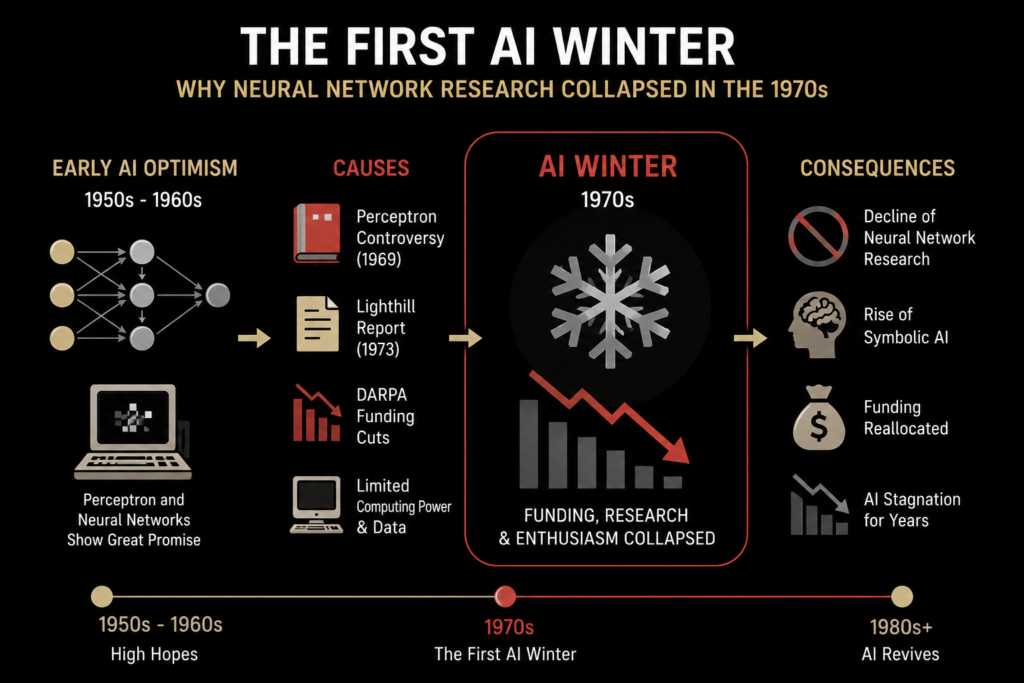
The first ai winter marked a dramatic collapse of AI research during the 1970s. Funding disappeared, public excitement faded, and many scientists abandoned neural network studies completely.
This period became a turning point in the broader history of ai because it exposed the gap between hype vs reality in artificial intelligence development.
The story of the first ai winter includes scientific controversy, institutional skepticism, funding reallocation, technological barriers, limited hardware, and failed promises. It also explains why neural networks nearly disappeared before eventually returning decades later through deep learning.
In this article, we will explore the complete history of the first ai winter, why AI research collapsed during the 1970s, what caused public disappointment, and how artificial intelligence eventually recovered.
The Early Excitement Around Artificial Intelligence (1950 – 1965)
Before the first ai winter, artificial intelligence was one of the most exciting scientific fields in the world.
Researchers believed intelligent machines might soon:
- Translate languages
- Solve mathematical problems
- Understand speech
- Simulate reasoning
- Mimic human cognition
The development of the perceptron and early neural systems created enormous optimism.
This movement strongly connected to:
Scientists such as Frank Rosenblatt believed neural learning systems might eventually become as intelligent as humans.
Government agencies, universities, and military organizations heavily funded AI research during this period.
The excitement surrounding machine intelligence continued growing rapidly before the arrival of the first ai winter.
The Foundations of Neural Network Research
The rise of AI before the first ai winter began with earlier neural discoveries.
In 1943, Warren McCulloch and Walter Pitts introduced the first artificial neuron model.
Their work became central to mcculloch and pitts neural network research.
Later, Donald Hebb introduced adaptive learning theories through the hebb learning rule.
These breakthroughs inspired researchers to build machines capable of learning from experience.
Scientists believed neural systems might eventually replicate the human brain.
This optimism shaped early AI development before the collapse of the first ai winter.
The Perceptron Revolution (1957 – 1969)
The invention of the perceptron dramatically accelerated AI excitement.
Frank Rosenblatt’s perceptron became one of the first machine learning systems capable of supervised learning and pattern recognition.
The perceptron represented a major breakthrough in:
- Image recognition
- Signal processing
- Neural learning
- Adaptive systems
The system gained massive media attention.
Researchers predicted intelligent machines would soon transform society.
The perceptron also became central to the future neural network timeline.
However, beneath the excitement, serious technical problems still existed.
These weaknesses eventually helped trigger the first ai winter.
The Perceptron Controversy (1969)
One of the biggest causes of the first ai winter was the famous perceptron controversy.
In 1969, Marvin Minsky and Seymour Papert published the influential book Perceptrons.
The book mathematically proved important limitations of single-layer perceptrons.
One major issue involved the XOR problem.
Single-layer perceptrons could not solve non-linear classification tasks.
This criticism shocked the AI research community.
The first ai winter began partly because many institutions lost confidence in neural network approaches.
The debate surrounding minsky vs rosenblatt became one of the most famous conflicts in computer science history.
The Lighthill Report (1973)
Another major event in the first ai winter occurred in 1973 with the publication of the Lighthill Report in the United Kingdom.
James Lighthill criticized AI research heavily.
The report argued that AI systems had failed to achieve meaningful progress.
It highlighted:
- Technological barriers
- Limited hardware
- Data scarcity
- Unrealistic expectations
- Weak practical applications
The Lighthill Report dramatically increased institutional skepticism toward AI.
As a result, British government funding for AI research declined sharply.
This event became one of the defining moments of the first ai winter.
DARPA Funding Cuts and Research Decline
The first ai winter worsened when DARPA funding cuts reduced financial support for AI projects in the United States.
DARPA had previously invested heavily in:
- Machine translation
- Robotics
- Neural computation
- Military AI systems
However, researchers consistently failed to meet ambitious promises.
Government agencies became frustrated by slow progress.
Funding reallocation shifted resources toward more practical computing technologies.
Many AI laboratories struggled to survive during the first ai winter.
The collapse of funding created massive research limitations across the field.
Why AI Research Failed During the 1970s
Several major problems caused the first ai winter.
Low Computing Power
Computers during the 1970s were extremely weak compared to modern systems.
Neural networks required far more processing power than available hardware could provide.
Lack of Data
AI systems require enormous datasets for effective learning.
During the first ai winter, large digital datasets barely existed.
Unrealistic Expectations
Researchers and media promised breakthroughs far beyond existing technology.
When those promises failed, public confidence collapsed.
Limited Algorithms
Efficient training methods like backpropagation had not yet matured.
This prevented neural systems from solving complex problems.
These combined factors caused widespread academic disillusionment during the first ai winter.
The Rise of Symbolic AI
As neural networks declined during the first ai winter, symbolic AI became dominant.
Researchers shifted toward:
- Rule-based systems
- Expert systems
- Logical reasoning
- Symbolic manipulation
Scientists believed symbolic AI offered more practical short-term solutions.
Connectionism and neural learning systems nearly disappeared from mainstream research.
The first ai winter dramatically changed research priorities across artificial intelligence laboratories worldwide.
Public Perception and AI Stagnation
The first ai winter also damaged public perception of artificial intelligence.
Media outlets began portraying AI as overhyped and unrealistic.
Investors and governments lost confidence in the field.
AI stagnation spread throughout universities and research institutions.
Many students avoided AI careers entirely during this period.
The field entered what some researchers described as a research moratorium.
The collapse of enthusiasm delayed AI progress for many years.
The Return of Neural Networks (1980 – 2010)
Although the first ai winter nearly destroyed neural network research, AI eventually recovered.
Researchers later developed multi-layer neural systems and backpropagation algorithms.
This breakthrough strongly connected to:
Scientists such as Geoffrey Hinton helped revive connectionism during the 1980s.
Improved computing power and larger datasets finally allowed neural systems to succeed.
The revival eventually launched the modern deep learning revolution.
Deep Learning and the End of AI Winters
Modern deep learning systems completely changed the legacy of the first ai winter.
Advanced neural networks now power:
- Speech recognition
- Robotics
- Computer vision
- Generative AI
- Autonomous vehicles
This revolution strongly relates to:
Today, even best free ai tools rely on advanced neural architectures once considered impossible during the AI winters.
Modern AI success proved many early neural ideas were simply ahead of their time.
Lessons Learned From the First AI Winter
The first ai winter taught researchers several important lessons.
Technology Must Match Ambition
Scientific promises must align with actual technological capability.
Research Needs Patience
Major breakthroughs often require decades of development.
Funding Shapes Innovation
Government and institutional support heavily influence scientific progress.
Early Failures Are Not Final
Neural networks eventually succeeded despite early criticism and setbacks.
The first ai winter ultimately became one of the most valuable learning experiences in AI history.
Frequently Asked Questions (FAQs)
What was the first AI winter?
The first AI winter was a period during the 1970s when AI research funding and public enthusiasm collapsed.
Why did neural network research fail in the 1970s?
Low computing power, lack of data, unrealistic expectations, and algorithmic limitations slowed progress dramatically.
What caused the perceptron controversy?
The 1969 book Perceptrons showed limitations of single-layer neural networks, reducing confidence in neural research.
What was the Lighthill Report?
The Lighthill Report criticized AI progress in 1973 and contributed to funding reductions in the United Kingdom.
How did AI recover after the first AI winter?
AI recovered through improved computing power, larger datasets, backpropagation, and deep learning breakthroughs.
Conclusion
The first ai winter remains one of the most important turning points in artificial intelligence history. During the 1970s, funding cuts, technological limitations, academic skepticism, and unrealistic expectations nearly destroyed neural network research and machine learning development.
Although the collapse slowed AI progress for many years, the core ideas behind neural learning survived. Researchers eventually returned to connectionism with better algorithms, stronger hardware, and larger datasets capable of supporting advanced neural systems.
Today, modern AI systems prove that many early researchers were simply working decades ahead of available technology. The legacy of the first ai winter serves as a powerful reminder that scientific breakthroughs often require patience, persistence, and long-term vision.