The story of minsky vs rosenblatt is one of the most dramatic rivalries in artificial intelligence history. During the 1950s and 1960s, two very different visions of machine intelligence collided and changed the future of AI forever.
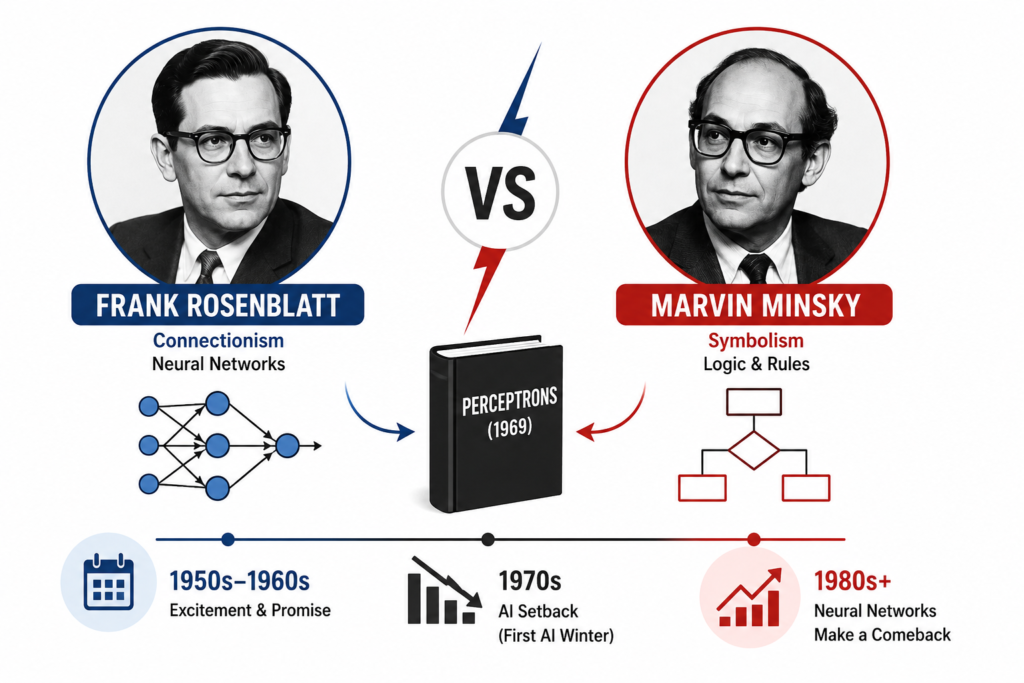
On one side stood Frank Rosenblatt, the inventor of the perceptron and a strong supporter of connectionism. Rosenblatt believed machines could learn through neural systems inspired by the human brain.
On the other side stood Marvin Minsky, one of the founders of symbolic AI and a researcher who believed intelligence should rely on logical reasoning rather than neural learning systems.
The battle between minsky vs rosenblatt became much more than a scientific disagreement. It evolved into a major conflict about the future direction of artificial intelligence itself.
This historical AI conflict eventually contributed to the collapse of neural network research during the 1970s and helped trigger the first AI winter.
In this article, we will explore the complete story of minsky vs rosenblatt, the rise of connectionism vs symbolism, the perceptron controversy, the philosophical differences between the two researchers, and how their feud shaped modern artificial intelligence.
The Early Foundations of AI (1943 – 1957)
Before the famous minsky vs rosenblatt rivalry began, artificial intelligence research was already growing rapidly.
Researchers explored:
- Machine intelligence
- Neural computation
- Symbolic logic
- Brain-inspired systems
- Computational reasoning
One of the earliest breakthroughs came from Warren McCulloch and Walter Pitts in 1943.
Their work became central to mcculloch and pitts neural network research and the birth of artificial neurons.
Donald Hebb later introduced adaptive neural learning through the hebb learning rule.
These early discoveries inspired scientists to explore whether machines could imitate human cognition.
This growing excitement helped launch the broader history of ai movement before the rise of the famous AI feud.
Frank Rosenblatt and Connectionism
The first major figure in minsky vs rosenblatt was Frank Rosenblatt.
Rosenblatt believed intelligence could emerge from networks of interconnected artificial neurons.
His ideas became part of the connectionist movement.
In 1957, Rosenblatt introduced the perceptron, one of the first machine learning systems capable of adaptive learning.
The perceptron used:
- Weighted inputs
- Binary classification
- Signal detection
- Learning algorithms
This invention became one of the biggest breakthroughs in who invented perceptron history.
Rosenblatt believed neural systems might eventually:
- Understand language
- Recognize speech
- Learn from experience
- Mimic biological cognition
His optimistic predictions made him one of the most famous AI researchers of his era.
Marvin Minsky and Symbolic AI
The second major figure in minsky vs rosenblatt was Marvin Minsky.
Minsky became one of the leading supporters of symbolic AI.
Unlike Rosenblatt, Minsky believed intelligence should rely on:
- Symbolic reasoning
- Logical rules
- Formal problem solving
- Structured knowledge systems
Minsky helped found the AI laboratory at Massachusetts Institute of Technology.
His research focused heavily on cognitive science, symbolic logic, and machine reasoning.
The conflict between connectionism vs symbolism eventually became the heart of minsky vs rosenblatt.
MIT vs Cornell Rivalry
The battle of minsky vs rosenblatt also reflected institutional competition between MIT and Cornell research communities.
Rosenblatt worked at Cornell Aeronautical Laboratory, where perceptron research expanded rapidly.
Minsky and symbolic AI researchers at MIT criticized neural learning approaches heavily.
This institutional competition intensified the scientific disagreement between the two sides.
The rivalry became one of the greatest paradigm wars in computer science history.
The Rise of the Perceptron (1957 – 1969)
During the late 1950s and 1960s, Rosenblatt’s perceptron gained enormous popularity.
The perceptron became central to:
- Pattern recognition
- Early robotics
- Neural learning
- Image classification
The success of the perceptron strongly influenced:
Media reports claimed intelligent machines might soon become reality.
Government agencies heavily funded neural research projects.
However, Minsky remained skeptical of neural network approaches.
This disagreement intensified the minsky vs rosenblatt conflict dramatically.
The Perceptrons Book (1969)
The turning point in minsky vs rosenblatt came in 1969.
Marvin Minsky and Seymour Papert published the famous book Perceptrons.
The book mathematically demonstrated major limitations of single-layer perceptrons.
One major issue involved the XOR problem.
Single-layer perceptrons could not solve certain non-linear classification tasks.
The book became the center of the perceptron controversy.
Minsky and Papert argued neural networks had severe limitations that prevented them from achieving true intelligence.
This criticism deeply damaged neural network research.
Rosenblatt’s Response to the Criticism
Frank Rosenblatt strongly disagreed with Minsky’s conclusions.
Rosenblatt argued that future multi-layer neural systems could overcome current limitations.
However, efficient multi-layer training methods had not yet been discovered.
The technology of the time lacked:
- Powerful hardware
- Large datasets
- Advanced optimization algorithms
The minsky vs rosenblatt debate became a philosophical conflict about the future of AI itself.
Sadly, Rosenblatt passed away in 1971 before neural networks eventually returned decades later.
The First AI Winter (1970 – 1980)
One of the biggest consequences of minsky vs rosenblatt was the collapse of neural network research during the 1970s.
The perceptron controversy contributed heavily to the first ai winter.
Funding agencies reduced support for connectionist research.
Researchers shifted toward symbolic AI and expert systems.
The field experienced:
- Academic disillusionment
- Funding cuts
- Institutional skepticism
- Declining neural research
The minsky vs rosenblatt conflict dramatically influenced research directions for over a decade.
Was Minsky Actually Wrong?
The debate around minsky vs rosenblatt remains controversial today.
Minsky’s mathematical critique was technically correct.
Single-layer perceptrons truly could not solve certain problems.
However, many historians argue the criticism unintentionally slowed neural network research too aggressively.
The real issue was not neural networks themselves, but the technological limitations of the era.
Multi-layer systems eventually solved many of the problems Minsky criticized.
The feud became one of the most important scientific disagreements in AI history.
The Return of Neural Networks (1980 – 2012)
Neural networks eventually returned stronger than ever after the AI winter.
Researchers developed backpropagation algorithms capable of training multi-layer neural systems efficiently.
This breakthrough strongly connected with:
Scientists such as Geoffrey Hinton revived connectionism during the 1980s.
Deep learning systems later proved neural approaches could become extremely powerful.
The return of neural networks eventually validated many of Rosenblatt’s early ideas.
The Legacy of the AI Feud
The minsky vs rosenblatt conflict left a massive intellectual legacy.
It shaped:
- AI paradigms
- Research priorities
- Funding decisions
- Scientific philosophy
- Neural network development
The feud also demonstrated how scientific disagreement can dramatically influence technological progress.
Today, both symbolic AI and neural learning approaches still contribute to modern AI systems.
The rivalry became one of the defining moments in the evolution of artificial intelligence.
Modern AI and Rosenblatt’s Vindication
Modern AI systems now rely heavily on neural architectures inspired by Rosenblatt’s original vision.
Today’s AI powers:
- Speech recognition
- Image generation
- Robotics
- Autonomous driving
- Generative AI
Even modern best free ai tools rely on deep neural systems descended from perceptron concepts.
The rise of deep learning partially vindicated Rosenblatt’s beliefs about machine learning and adaptive intelligence.
However, symbolic reasoning still remains important in many AI applications.
The legacy of minsky vs rosenblatt continues shaping AI research even today.
Frequently Asked Questions (FAQs)
What was the Minsky vs Rosenblatt feud?
It was a major conflict between symbolic AI researchers and neural network researchers during the 1960s and 1970s.
Why did Marvin Minsky criticize perceptrons?
Minsky believed single-layer perceptrons had serious mathematical limitations preventing advanced intelligence.
What was Frank Rosenblatt’s contribution to AI?
Rosenblatt invented the perceptron, one of the first machine learning systems capable of adaptive learning.
Did the feud cause the AI winter?
The perceptron controversy strongly contributed to the first AI winter and reduced neural network funding.
Who was ultimately correct?
Both researchers were partly correct. Neural networks had limitations then, but later technological advances solved many problems.
Conclusion
The story of minsky vs rosenblatt remains one of the most important conflicts in artificial intelligence history. Their rivalry represented a deeper battle between connectionism and symbolic reasoning, shaping the future direction of AI research for decades.
Marvin Minsky’s criticism of perceptrons exposed real mathematical limitations, but it also contributed to declining support for neural network research during the first AI winter. Frank Rosenblatt’s vision of adaptive neural learning systems eventually returned through deep learning and modern AI breakthroughs.
Today, the legacy of minsky vs rosenblatt continues influencing artificial intelligence research, reminding scientists that major technological revolutions often emerge from intense scientific disagreement and competing visions of the future.