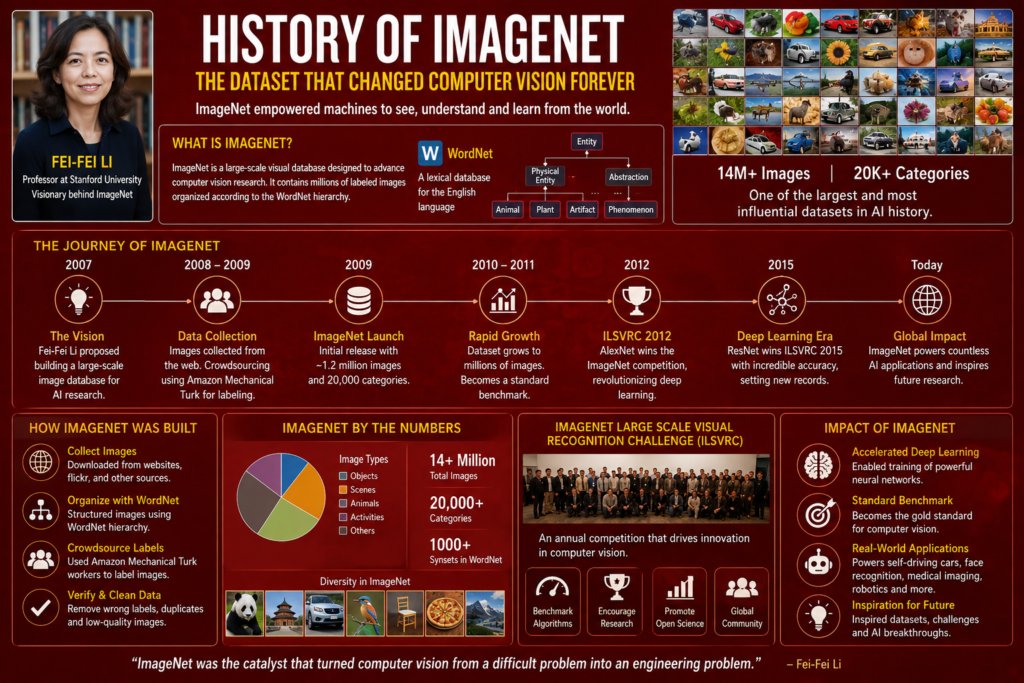
The story of history of imagenet represents one of the most important breakthroughs in artificial intelligence and computer vision history. Before ImageNet existed, neural networks struggled because researchers lacked large, organized, high-quality visual datasets.
AI systems could not learn effectively without massive amounts of labeled data.
Then everything changed.
A revolutionary dataset called ImageNet transformed deep learning forever by giving neural networks millions of labeled images for training.
The rise of history of imagenet accelerated:
- Computer vision research
- Deep learning breakthroughs
- AI competitions
- Neural network accuracy
- GPU-powered learning
Today, modern AI systems such as facial recognition, autonomous vehicles, image generators, robotics, and medical imaging all owe part of their success to ImageNet.
In this article, we will explore the complete history of imagenet, how the dataset was created, why it became revolutionary, and how it launched the modern deep learning era.
Artificial Intelligence Before ImageNet (1943 – 2008)
Before understanding history of imagenet, we must first examine earlier AI development.
The first artificial neuron model appeared in 1943 through Warren McCulloch and Walter Pitts.
Their work became foundational to:
Later, Frank Rosenblatt introduced the perceptron during the 1950s.
This breakthrough became connected to:
Although neural systems improved gradually, computer vision remained extremely difficult.
Researchers lacked:
- Large datasets
- Strong GPUs
- Massive training sets
- Organized visual databases
AI systems could not generalize effectively without huge amounts of labeled data.
The Problem With Small Datasets
One major reason behind the rise of history of imagenet involved data scarcity.
Before ImageNet, most computer vision datasets contained only small numbers of images.
This created several problems:
- Weak generalization
- Poor object detection
- Limited benchmarking
- Over-fitting
Neural networks require enormous amounts of data for effective model training.
Without sufficient data diversity, deep learning systems struggled badly.
Researchers realized:
Better datasets might become as important as better algorithms.
Fei-Fei Li and the Vision Behind ImageNet
The defining breakthrough in history of imagenet came through Fei-Fei Li.
Fei-Fei Li believed AI systems needed massive visual learning databases similar to how humans learn from real-world experiences.
Her vision involved creating:
- Millions of labeled images
- Thousands of object categories
- Scientific transparency
- Large-scale visual recognition benchmarks
This idea became revolutionary.
WordNet and the Foundation of ImageNet
One important part of history of imagenet involved WordNet.
WordNet was a large lexical database organizing words into semantic hierarchies.
Fei-Fei Li used the WordNet hierarchy to structure ImageNet categories.
This allowed ImageNet to organize visual concepts systematically.
For example:
- Animals
- Vehicles
- Objects
- Tools
- Human activities
Each category received thousands of labeled images.
The dataset became far larger than anything previously attempted.
Crowdsourcing and Data Collection (2007 – 2009)
The creation of history of imagenet required enormous data collection efforts.
Researchers gathered millions of images from the internet.
However, labeling images manually became impossible for a small research team.
The solution involved crowdsourcing using:
- Mechanical Turk
- Human annotation workers
- Distributed labeling systems
Thousands of workers helped verify image labels.
This process created one of the largest labeled image datasets in history.
The Scale of ImageNet
The size of history of imagenet shocked the AI community.
ImageNet eventually contained:
- Over 14 million images
- More than 20,000 categories
- Massive dataset diversity
The dataset became ideal for:
- Object detection
- Pattern recognition
- Computer vision benchmarking
Researchers finally had enough data to train large neural networks effectively.
The ImageNet Challenge (ILSVRC)
One of the biggest breakthroughs in history of imagenet involved the ImageNet Large Scale Visual Recognition Challenge.
This competition became known as:
- ILSVRC
Researchers worldwide competed to build the best visual recognition systems.
The challenge measured:
- Top-5 accuracy
- Classification performance
- Object detection capability
ImageNet rapidly became the most important benchmark in computer vision research.
CNNs and ImageNet
The success of history of imagenet strongly connected to convolutional neural networks.
Important breakthroughs included:
CNNs required enormous training datasets.
ImageNet finally provided enough visual data for deep convolutional learning.
This combination changed AI forever.
AlexNet and the 2012 Revolution
The defining moment in history of imagenet occurred in 2012.
Alex Krizhevsky, Geoffrey Hinton, and Ilya Sutskever introduced AlexNet.
This breakthrough became linked to:
AlexNet dramatically outperformed all competing systems during ILSVRC 2012.
The network achieved remarkable top-5 accuracy improvements.
Researchers suddenly realized deep learning truly worked at large scale.
GPU Computing and ImageNet
Another important part of history of imagenet involved GPU acceleration.
Training massive CNN systems required enormous computational power.
This progress strongly connected to:
GPUs enabled:
- Parallel computation
- Faster matrix operations
- Large-scale model training
Without GPUs, ImageNet-scale deep learning would likely have remained impossible.
ImageNet and Modern Deep Learning
The success of history of imagenet launched the modern deep learning era.
Big technology companies rapidly increased investment in:
- AI research
- Neural networks
- Computer vision
- Deep learning infrastructure
The AI industry transformed completely after the ImageNet revolution.
ImageNet and ResNet (2015)
Another major milestone in history of imagenet came through ResNet.
Researchers at Microsoft introduced residual learning architectures that dominated ILSVRC 2015.
This breakthrough became connected to:
ResNet demonstrated how extremely deep networks could achieve extraordinary accuracy using ImageNet benchmarks.
Why ImageNet Became Revolutionary
Several reasons explain the importance of history of imagenet.
Massive Data Scale
Millions of labeled images improved generalization dramatically.
Benchmarking Standard
Researchers could compare algorithms fairly.
Accelerated Innovation
Competitions encouraged rapid neural progress.
Deep Learning Validation
ImageNet proved large neural systems could outperform traditional methods.
Together, these breakthroughs transformed computer vision forever.
ImageNet and Real World Applications
The impact of history of imagenet can now be seen everywhere.
Modern systems influenced by ImageNet include:
- Facial recognition
- Medical imaging
- Robotics
- Autonomous vehicles
- Security systems
This progress strongly connects to:
ImageNet became one of the most influential datasets in scientific history.
Criticism and Ethical Concerns
Although the history of imagenet became revolutionary, the dataset later faced criticism.
Researchers raised concerns about:
- Dataset bias
- Cultural labeling issues
- Privacy concerns
- Representation imbalance
These debates encouraged the AI community to improve ethical dataset design.
The discussion helped push modern AI toward more responsible data collection practices.
ImageNet’s Legacy Today
Even though newer datasets now exist, the legacy of history of imagenet remains enormous.
ImageNet influenced:
- Deep CNN research
- AI competitions
- Transformer training
- Generative AI systems
Even modern best free ai tools often rely indirectly on breakthroughs accelerated by ImageNet.
The dataset permanently changed AI research methodology worldwide.
Frequently Asked Questions (FAQs)
What is ImageNet?
ImageNet is a massive labeled image dataset used for training computer vision systems.
Who created ImageNet?
Fei-Fei Li and her research team created ImageNet.
Why was ImageNet important?
It provided enough data for large-scale deep learning and CNN training.
What is ILSVRC?
ILSVRC stands for ImageNet Large Scale Visual Recognition Challenge.
Did ImageNet help deep learning grow?
Yes. ImageNet played a critical role in launching the modern deep learning revolution.
Conclusion
The story of history of imagenet represents one of the most important milestones in artificial intelligence history. By creating a massive, organized, and scientifically benchmarked visual recognition database, Fei-Fei Li and her team transformed computer vision research forever.
ImageNet enabled deep convolutional neural networks such as AlexNet and ResNet to achieve extraordinary breakthroughs that reshaped artificial intelligence worldwide. Its influence accelerated modern deep learning, GPU computing, object detection systems, and computer vision innovation across industries.
Today, the legacy of history of imagenet continues powering advanced AI systems, self-driving cars, medical diagnostics, robotics, and modern deep learning applications across the world.