The question who invented perceptron remains one of the most important topics in artificial intelligence history. Modern AI systems, deep learning architectures, and neural networks all trace part of their origins back to a revolutionary invention created in 1958 by Frank Rosenblatt.
The perceptron was one of the first machine learning systems capable of learning from data. At a time when computers were primitive and artificial intelligence barely existed, Rosenblatt imagined machines that could imitate human learning.
Today, the story of who invented perceptron is more important than ever because modern neural networks evolved directly from Rosenblatt’s ideas. His invention helped shape image recognition, pattern classification, speech processing, robotics, and machine intelligence.
The history surrounding who invented perceptron is also a story of scientific controversy, academic rivalry, visionary thinking, and technological limitations. Frank Rosenblatt became both celebrated and criticized during his lifetime, yet his contributions eventually changed the future of computer science forever.
In this article, we will explore the complete story of who invented perceptron, Frank Rosenblatt’s life, his groundbreaking research, the rise and fall of the perceptron era, and the lasting impact of his revolutionary ideas.
Early Life of Frank Rosenblatt (1928 – 1950)
The story of who invented perceptron begins with Frank Rosenblatt, an American psychologist and scientist fascinated by intelligence and learning.
Rosenblatt studied psychology, mathematics, and neurobiology. He became deeply interested in understanding how biological brains process information.
Unlike many researchers focused only on logical programming, Rosenblatt believed intelligence could emerge through adaptive learning systems.
His interests included:
- Experimental psychology
- Neurobiology and AI
- Cognitive learning
- Pattern recognition
- Brain-inspired computation
Rosenblatt eventually studied at Cornell University, where his research would later transform artificial intelligence history.
The question who invented perceptron cannot be answered without understanding Rosenblatt’s visionary approach to machine intelligence.
The Scientific Foundations Before the Perceptron
Before discussing who invented perceptron, it is important to understand the scientific foundations that inspired Rosenblatt.
In 1943, Warren McCulloch and Walter Pitts introduced the first mathematical artificial neuron model.
Their work became famous through mcculloch and pitts neural network research.
This early model demonstrated that artificial neurons could process binary signals mathematically.
Scientists also explored:
- Logical computation
- Neural activity
- Feedback systems
- Machine intelligence
- Adaptive behavior
These ideas strongly influenced the future neural network history and the development of learning systems.
Rosenblatt believed these concepts could evolve into machines capable of intelligent adaptation.
The Birth of the Perceptron (1958)
The major breakthrough in who invented perceptron occurred in 1958.
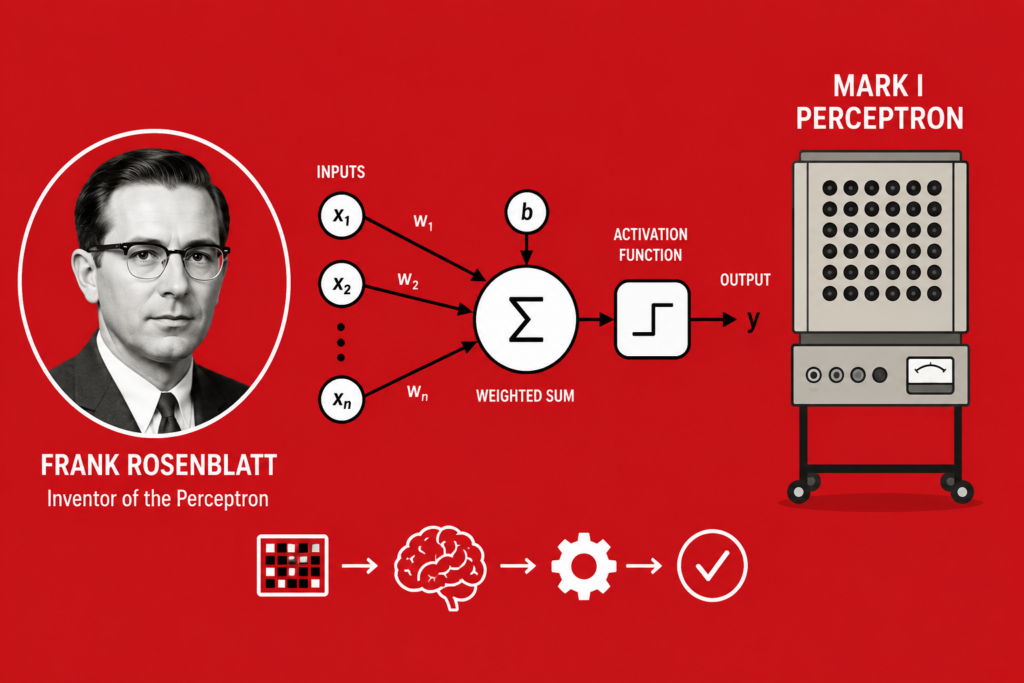
While working at Cornell Aeronautical Laboratory, Rosenblatt introduced the Perceptron.
The Perceptron became one of the first learning machines in AI history.
The Mark I Perceptron machine used:
- Optical sensors
- Weighted connections
- Signal detection
- Adaptive learning rules
- Hardware-based AI
Unlike earlier fixed systems, the perceptron could improve performance through training.
This invention became one of the earliest practical forms of machine learning.
The who invented perceptron story changed AI forever because Rosenblatt introduced the idea that machines could learn from experience rather than relying entirely on human programming.
How the Perceptron Worked
The answer to who invented perceptron also involves understanding the science behind the machine.
The perceptron functioned as a single-layer neural network.
Its mathematical equation:
Where:
- = input signals
- = weights
- = bias
- = output
The system used weight adjustments to improve classification performance.
When mistakes occurred, weights were modified during training.
This learning process became one of the earliest examples of supervised learning.
The invention answered the question who invented perceptron while simultaneously launching the foundations of modern neural learning systems.
Why the Perceptron Was Revolutionary
The invention behind who invented perceptron shocked the scientific community.
For the first time, researchers saw a machine capable of adaptive learning.
Rosenblatt predicted future AI systems might:
- Recognize speech
- Translate languages
- Understand images
- Perform reasoning tasks
At the time, these ideas sounded almost impossible.
The perceptron became one of the biggest milestones in the broader history of ai and machine intelligence development.
It also contributed heavily to the future neural network timeline.
Scientists began believing machines could eventually imitate certain aspects of human cognition.
Rosenblatt vs Minsky (1960 – 1970)
One of the most dramatic chapters in who invented perceptron history involved the rivalry between Frank Rosenblatt and Marvin Minsky.
Minsky and Seymour Papert criticized perceptrons heavily in their famous 1969 book Perceptrons.
They showed that single-layer perceptrons could not solve certain mathematical problems like XOR classification.
This criticism triggered the famous perceptron controversy.
Funding for neural network research declined dramatically.
The scientific debate between Rosenblatt and Minsky became one of the greatest academic rivalries in AI history.
This conflict strongly relates to minsky vs rosenblatt discussions in computer science history.
The First AI Winter
The controversy surrounding who invented perceptron eventually contributed to the first AI winter.
During the 1970s:
- AI funding decreased
- Neural network research slowed
- Public enthusiasm collapsed
- Researchers shifted toward symbolic AI
Many scientists believed neural systems had failed.
However, Rosenblatt’s ideas were not truly dead.
The limitations were caused partly by technological limitations and insufficient computing power.
The world simply lacked the hardware needed to fully realize Rosenblatt’s vision.
This difficult period later became connected to the first ai winter in AI history.
The Return of Neural Networks (1980 – 2012)
Although Rosenblatt passed away in 1971, the story of who invented perceptron did not end.
In the 1980s, researchers revived neural networks through backpropagation and multi-layer architectures.
This revival became strongly connected to:
Scientists such as Geoffrey Hinton helped prove that neural learning systems could become extremely powerful.
Modern deep learning eventually validated many of Rosenblatt’s original ideas.
The world finally realized how far ahead of his time he truly was.
The Perceptron’s Legacy in Modern AI
The influence of who invented perceptron can now be seen across nearly every major AI technology.
Modern systems use concepts first introduced by Rosenblatt:
- Weighted learning
- Neural adaptation
- Pattern recognition
- Classification systems
These principles now power:
- Image recognition
- Speech recognition
- Robotics
- Medical AI
- Autonomous vehicles
- Generative AI
Even modern best free ai tools rely on neural systems inspired indirectly by the perceptron.
The perceptron became one of the most important inventions in the history of computing.
Why Frank Rosenblatt Was Forgotten
One reason the story of who invented perceptron became forgotten was the harsh criticism during the AI winters.
Rosenblatt died young in 1971 during a boating accident.
As symbolic AI became more popular, neural research temporarily disappeared from mainstream attention.
However, modern AI success eventually restored Rosenblatt’s reputation.
Today, many historians recognize him as one of the greatest computer science pioneers in history.
His visionary thinking shaped modern artificial intelligence decades before the technology existed to support it fully.
Modern Recognition of Frank Rosenblatt
Today, the answer to who invented perceptron is widely recognized.
Frank Rosenblatt is now considered:
- A neural network pioneer
- An AI visionary
- A machine learning innovator
- A foundational researcher
His contributions influenced nearly every stage of modern deep learning evolution.
Without Rosenblatt, today’s neural systems might never have existed.
The legacy of his work continues shaping AI research across the world.
Frequently Asked Questions (FAQs)
Who invented the perceptron?
Frank Rosenblatt invented the perceptron in 1958 while working at Cornell Aeronautical Laboratory.
Why was the perceptron important?
The perceptron became one of the first machine learning systems capable of learning from data automatically.
What was the perceptron controversy?
Researchers Marvin Minsky and Seymour Papert criticized the limitations of single-layer perceptrons in 1969.
Did Rosenblatt influence modern AI?
Yes. Modern neural networks and deep learning systems evolved directly from perceptron concepts.
Why is Frank Rosenblatt called forgotten?
His work lost popularity during the AI winters, but modern deep learning later proved his ideas were revolutionary.
Conclusion
The story of who invented perceptron is one of the most fascinating journeys in artificial intelligence history. Frank Rosenblatt’s 1958 invention introduced the world to learning machines capable of adapting through experience, laying the foundation for neural networks and modern AI systems.
Although his work faced controversy and temporary rejection during the AI winters, Rosenblatt’s ideas survived and eventually became central to deep learning, computer vision, robotics, and generative AI. His visionary research transformed how scientists understood machine intelligence and neural computation.
Today, the legacy of Frank Rosenblatt continues powering the modern AI revolution, proving that his perceptron invention was one of the greatest breakthroughs in technological history.