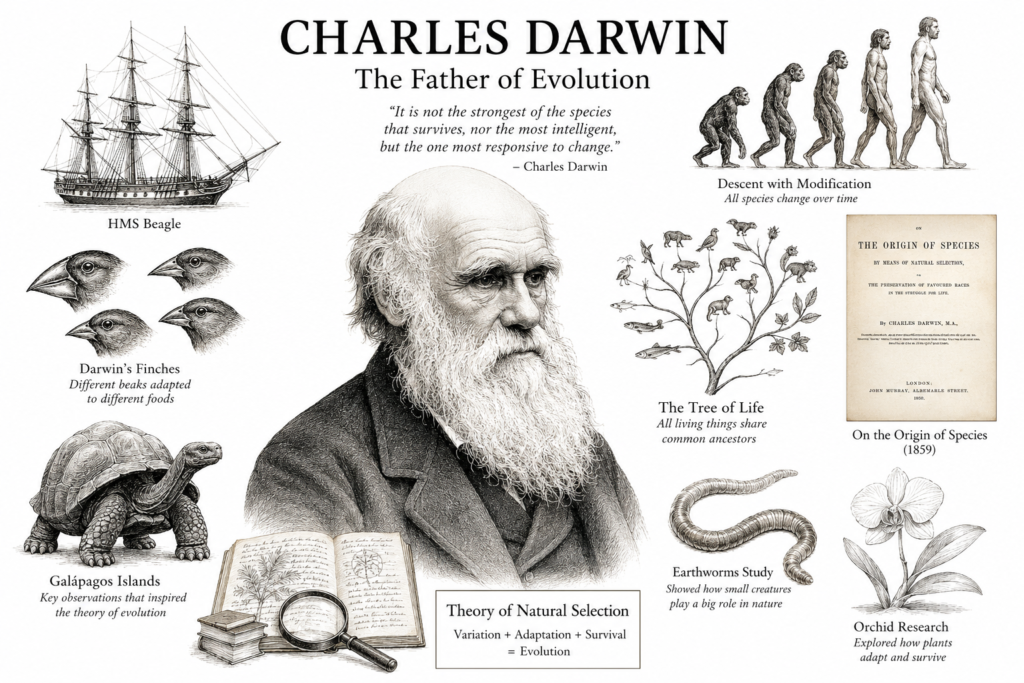
Charles Darwin was one of the most influential scientists in human history. His ideas completely changed how people understood life on Earth, the origin of species, and the relationship between humans and animals. Before Darwin, many people believed every living thing had been created exactly as it appeared. Darwin challenged that belief with evidence, observation, and decades of careful research.
Today, Charles Darwin is widely known as the father of evolution. His revolutionary work helped launch modern biology and inspired generations of scientists around the world. From tiny insects to giant mammals, Darwin studied nature with endless curiosity. His discoveries transformed science forever and influenced medicine, genetics, ecology, and anthropology.
The life of Charles Darwin was not only about science. It was also a story of courage, patience, and determination. He spent years collecting evidence before sharing his ideas because he knew his theory would shock Victorian society. Yet his work survived criticism and eventually became one of the greatest scientific theories ever created.
This Charles Darwin biography explores his childhood, education, discoveries, famous voyage, scientific struggles, and lasting legacy.
Early Life and Family Background (1809 – 1825)
Charles Robert Darwin was born on February 12, 1809, in Shrewsbury, England. He came from a wealthy and educated family. His father, Robert Darwin, was a respected doctor, while his grandfather Erasmus Darwin was a famous physician, philosopher, and naturalist.
From childhood, Darwin loved collecting shells, insects, rocks, and plants. He enjoyed observing nature more than studying traditional school subjects. Even as a young boy, he showed signs of becoming a great natural historian.
Darwin attended school in Shrewsbury, but he disliked strict classroom learning. Instead, he preferred exploring forests, rivers, and fields. His passion for nature continued growing throughout his teenage years.
The Darwin family expected him to become a doctor like his father. However, Charles Darwin struggled with medical studies because he hated seeing surgery performed without anesthesia.
Charles Darwin Education at Edinburgh and Cambridge (1825 – 1831)
In 1825, Darwin entered Edinburgh University to study medicine. Unfortunately, he quickly lost interest in becoming a physician. Instead, he spent time studying marine animals and learning taxidermy.
At Edinburgh University, Darwin met important mentors who encouraged his interest in biology and natural history. He also learned about early evolutionary ideas that questioned traditional beliefs about life.
After leaving Edinburgh, Darwin entered Cambridge University in 1828 to study theology and become a clergyman. Ironically, this decision helped shape his scientific career. At Cambridge, Darwin became close friends with botanist John Stevens Henslow, who recognized Darwin’s talent for observation and scientific thinking.
During these years, Darwin developed strong skills in geology, biology, and specimen collection. These abilities later became essential during the famous HMS beagle voyage.
The HMS Beagle Voyage That Changed Everything (1831 – 1836)
In 1831, Charles Darwin received an extraordinary opportunity. He was invited to join the HMS Beagle as a naturalist on a global scientific expedition.
The voyage lasted nearly five years and completely transformed Darwin’s understanding of nature. During the journey, he visited South America, Australia, Africa, and many islands across the world.
Darwin carefully studied fossils, plants, birds, insects, and geological formations. He noticed that species varied from one region to another. These observations planted the seeds of evolutionary theory.
One of the most important stops during the journey was the Galápagos Islands. The unique wildlife fascinated Darwin and became central to his future work.
Galápagos Islands and Evolutionary Clues (1835)
The galapagos islands and darwin story remains one of the most famous moments in scientific history. On these isolated islands, Darwin observed animals that looked similar yet showed small differences depending on the island they inhabited.
The most famous examples were the finches. These birds had different beak shapes adapted for different food sources. Some finches cracked seeds, while others fed on insects or cactus plants.
The observations of darwin finches helped Darwin realize species might gradually change over time to survive in different environments.
Darwin also studied giant tortoises, marine iguanas, and unusual plants. The islands became a living laboratory that helped him understand adaptation and natural selection.
The Theory That Changed Biology Forever
After returning to England in 1836, Darwin spent many years analyzing his observations and collecting additional evidence.
Eventually, he developed the theory of natural selection. According to this idea, organisms with helpful traits are more likely to survive and reproduce. Over many generations, these traits become more common in a population.
Darwin explained evolution using several key principles:
- Organisms produce more offspring than can survive
- Individuals vary from one another
- Some variations improve survival
- Helpful traits are passed to future generations
This process gradually changes species over time.
The concept became closely associated with the phrase survival of the fittest, although Herbert Spencer originally coined the term.
Darwin also introduced the idea of descent with modification, meaning all species share common ancestors and slowly evolve through generations.
Mathematical Understanding Behind Evolution
Darwin’s ideas were supported by population mathematics and inheritance principles. Although genetics was not fully understood during his lifetime, modern evolutionary biology uses equations to explain natural selection.
One important equation is the population growth model:
Where:
- = population size at time t
- = initial population
- = growth rate
- = exponential constant
This equation demonstrates how populations grow rapidly when resources are available.
Another important concept in evolutionary biology is allele frequency:
Where:
- = frequency of one allele
- = frequency of another allele
Natural selection changes these frequencies over generations.
Fitness in evolutionary theory is often represented mathematically as:
This equation measures reproductive success, which is central to natural selection.
Writing On the Origin of Species (1837 – 1859)
Darwin worked secretly on his theory for more than twenty years. He feared criticism from religious groups and scientists who opposed evolutionary ideas.
In 1858, another naturalist named Alfred Russel Wallace independently developed similar ideas about evolution. This pushed Darwin to publish his work sooner than planned.
In 1859, Darwin finally published on the origin of species. The book immediately created controversy but also excitement within the scientific community.
The book presented massive evidence supporting evolution and natural selection. Darwin explained how species gradually adapt through environmental pressures over long periods of time.
The first edition sold out quickly, and the scientific revolution had begun.
Darwin Versus Religious Opposition
The publication of Darwin’s theory shocked Victorian society. Many religious leaders believed evolution contradicted biblical teachings.
The debate surrounding darwin vs church became one of the most famous scientific controversies in history. Some critics accused Darwin of attacking religion, while others defended his scientific evidence.
Supporters like Thomas Henry Huxley publicly defended Darwin’s work. Huxley became known as “Darwin’s Bulldog” because of his fierce debates with opponents.
Despite criticism, Darwin remained calm and continued refining his research.
The Tree of Life and Human Connection
Darwin imagined evolution as a branching tree connecting all living organisms. This idea became known as the tree of life theory.
According to Darwin, humans, animals, plants, and microorganisms all share ancient ancestors. Life evolved gradually through countless generations.
Modern genetics strongly supports Darwin’s vision. DNA studies reveal surprising similarities between species:
- Humans share about 98.8% of DNA with chimpanzees
- Humans share roughly 60% of genes with bananas
- Mammals share many biological structures and genetic systems
These discoveries confirm Darwin’s revolutionary ideas.
Charles Darwin’s Personal Life at Down House
Darwin married Emma Wedgwood in 1839. Together they had ten children and lived at Down House in Kent, England.
Down House became Darwin’s research center. He performed experiments, wrote books, and studied plants, worms, animals, and human behavior.
Despite suffering from chronic illness for much of his life, Darwin continued working tirelessly.
His research extended far beyond evolution. He studied orchids, climbing plants, barnacles, and earthworms. His work on worms showed how tiny creatures help shape ecosystems over time.
Darwin’s home became one of the most important scientific locations in Victorian England.
Sexual Selection and Human Evolution (1871)
Darwin expanded evolutionary theory in later books. One of his most important ideas was the sexual selection theory.
He argued that some traits evolve not because they improve survival, but because they attract mates.
For example:
- Peacock feathers attract females
- Bird songs help males compete
- Deer antlers assist in mating battles
Darwin also applied evolutionary theory to humans. He proposed that humans and apes share common ancestors.
This idea created intense debate during the Victorian era but later became strongly supported by fossil and genetic evidence.
Darwin’s Lasting Scientific Legacy
Charles Darwin died on April 19, 1882. He was buried in Westminster Abbey near Isaac Newton, one of England’s greatest scientists.
Today, Darwin remains a symbol of scientific curiosity and intellectual courage.
Modern biology depends heavily on Darwin’s work. Evolution explains:
- Antibiotic resistance in bacteria
- Animal adaptation
- Human genetics
- Fossil records
- Biodiversity
- Ecology and conservation
Without Darwin’s discoveries, modern medicine and genetics would look very different.
His ideas also inspired future scientific breakthroughs, including the connection between darwin to DNA evolution in modern genetics.
Charles Darwin in Modern Science
Even after more than 160 years, Darwin’s theories continue guiding scientific research. Scientists regularly use evolutionary principles in medicine, environmental science, and artificial intelligence.
Modern DNA analysis provides overwhelming support for common ancestry and natural selection. Fossils discovered after Darwin’s death have confirmed many of his predictions.
Darwin’s work helped transform biology from simple observation into a predictive scientific theory supported by evidence and mathematics.
Today, Charles Darwin is recognized as one of the greatest historical evolutionary scientists ever to live.
FAQs About Charles Darwin
Who was Charles Darwin?
Charles Darwin was an English naturalist and biologist who developed the theory of evolution through natural selection.
Why is Charles Darwin famous?
He is famous for writing On the Origin of Species and explaining how species evolve over time.
What did Darwin discover in the Galápagos Islands?
Darwin observed finches, tortoises, and other animals showing unique adaptations on different islands, helping inspire evolutionary theory.
What is natural selection?
Natural selection is the process where organisms with beneficial traits survive and reproduce more successfully.
Did Charles Darwin invent evolution?
No. Earlier thinkers discussed evolution, but Darwin provided strong scientific evidence and a clear mechanism explaining how evolution works.
What was Darwin’s most famous book?
His most famous book was On the Origin of Species, published in 1859.
Conclusion
Charles Darwin forever changed humanity’s understanding of life on Earth. His curiosity, patience, and fearless pursuit of truth transformed biology into a modern scientific discipline. From the HMS Beagle voyage to the publication of evolutionary theory, Darwin’s journey inspired generations of scientists across the world.
Today, his discoveries continue influencing genetics, medicine, ecology, and anthropology. The story of Charles Darwin is not only about evolution but also about human curiosity and the endless search for knowledge. His work stands beside the achievements of other great thinkers who shaped civilization, including those discussed in how ancient greek scientists changed modern science.