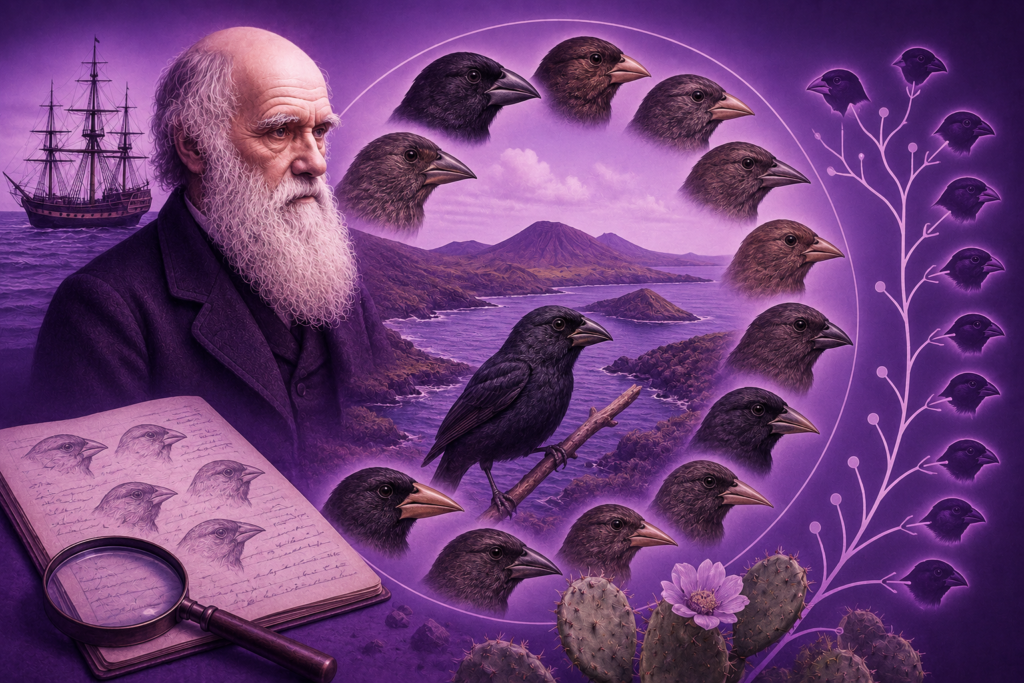
Darwin finches are among the most famous birds in scientific history. These small birds living on the Galápagos Islands helped unlock one of the greatest mysteries in biology: how species evolve over time. Their different beak shapes, feeding behaviors, and adaptations provided powerful evidence supporting evolution through natural selection.
When Charles Darwin visited the Galápagos Islands during the HMS beagle voyage, he observed birds that looked closely related yet differed from island to island. Although Darwin did not immediately realize their importance, these finches later became one of the strongest examples of adaptive radiation and evolutionary change.
Today, darwin finches remain central to evolutionary biology, ornithology, genetics, and island biogeography studies. Scientists continue researching these birds to understand how species adapt to environmental pressures and how new species emerge.
This article explores the history, science, mathematics, and evolutionary importance of darwin finches and explains why these birds changed biology forever.
The Galápagos Islands and Darwin (1835)
The Galápagos Islands are a volcanic archipelago located in the Pacific Ocean west of South America.
During the HMS beagle voyage, Darwin arrived there in 1835 and encountered unusual species found nowhere else on Earth.
The islands contained:
- Giant tortoises
- Marine iguanas
- Flightless cormorants
- Unique plants
- Different finch species
The discoveries involving galapagos islands and darwin became one of the most important moments in scientific history.
Darwin noticed that species varied slightly between islands depending on environmental conditions. These differences suggested species could gradually adapt over time.
This insight eventually helped inspire evolutionary theory.
What Are Darwin Finches?
Darwin finches are a group of approximately 13 closely related bird species native to the Galápagos Islands.
Although they resemble ordinary finches, they actually belong to the tanager family.
The birds vary mainly in:
- Beak size
- Beak shape
- Feeding behavior
- Body size
- Habitat preference
Some finches crack hard seeds, while others feed on insects, cactus flowers, or even blood from seabirds.
Despite these differences, scientists believe all darwin finches descended from a common ancestral bird that arrived on the islands millions of years ago.
Adaptive Radiation and Evolutionary Change
Darwin finches became one of the clearest examples of adaptive radiation.
Adaptive radiation occurs when one ancestral species diversifies into many related species adapted to different ecological niches.
On the Galápagos Islands:
- Different islands had different food sources
- Competition created selection pressure
- Finches evolved specialized beaks
- Populations gradually diverged genetically
Over time, natural selection produced multiple finch species.
This process strongly supports the theory of natural selection.
Beak Adaptation and Survival
The beaks of darwin finches became the most famous evidence for evolutionary adaptation.
Different beak types evolved for different feeding strategies:
Large Ground Finch
- Thick beaks crack large seeds
- Strong jaw muscles improve feeding efficiency
Warbler Finch
- Thin pointed beaks catch insects
- Agile feeding behavior aids survival
Cactus Finch
- Long beaks feed on cactus nectar and flowers
Woodpecker Finch
- Uses tools to remove insects from tree bark
These variations demonstrate how environmental conditions shape adaptation.
The relationship between adaptation and reproductive success reflects survival of the fittest in evolutionary biology.
Mathematical Understanding of Natural Selection
Modern evolutionary biology uses mathematics to study darwin finches populations and genetic adaptation.
One important equation describes population growth:
Where:
- = population size at time t
- = original population
- r = growth rate
Allele frequencies in finch populations can be represented as:
Where:
- = frequency of one allele
- = frequency of another allele
The Hardy-Weinberg equation helps scientists study evolutionary changes:
Fitness in natural selection is often represented mathematically:
These equations help researchers analyze how environmental pressure changes finch populations over generations.
Darwin’s Observations and Later Discoveries
Interestingly, Darwin initially failed to recognize the full importance of the finches during his voyage.
He collected specimens but did not carefully label which island each bird came from.
Later, ornithologist John Gould examined the birds and discovered they represented multiple distinct species.
This realization helped Darwin understand that species can diverge from common ancestors through adaptation and isolation.
The finches later became one of the strongest examples supporting evolution and descent with modification.
Drought and Natural Selection on Daphne Major (1970 – Present)
One of the most famous modern studies involving darwin finches occurred on Daphne Major Island.
Scientists Peter and Rosemary Grant spent decades studying finch populations there.
During drought periods:
- Small soft seeds became scarce
- Larger hard seeds remained available
- Finches with stronger beaks survived better
After severe droughts, scientists observed measurable increases in average beak size within the population.
This provided direct real time evidence of natural selection.
The Grants’ research became one of the greatest modern confirmations of Darwinian evolution.
Genetics and Darwin to DNA Evolution
Modern genetics strongly supports Darwin’s original ideas about finches and adaptation.
Research connecting darwin to DNA evolution revealed how specific genes influence beak development.
Scientists identified important genes including:
- BMP4 gene affecting beak depth
- ALX1 gene affecting beak shape
DNA sequencing showed that:
- Finch species remain closely related
- Hybridization sometimes occurs
- Natural selection rapidly changes gene frequencies
Modern molecular biology has transformed darwin finches into one of the best studied evolutionary systems in the world.
Speciation and Island Biogeography
Darwin finches also provide important evidence for speciation.
Speciation occurs when populations become genetically distinct enough to form separate species.
The Galápagos Islands created ideal conditions for speciation because:
- Islands isolated populations
- Different environments favored different adaptations
- Gene flow became limited
- Natural selection produced divergence
Island biogeography remains one of the most important concepts in evolutionary ecology.
Darwin finches demonstrate how geographic isolation encourages biodiversity.
Darwin Finches and Modern Evolutionary Biology
Darwin finches continue influencing modern science today.
Researchers study them to understand:
- Adaptive radiation examples
- Evolutionary ornithology
- Climate adaptation
- Population genetics
- Environmental pressure
- Avian evolution
The birds remain among the clearest demonstrations of evolution through natural selection ever observed.
Modern technology now allows scientists to track genetic changes almost generation by generation.
The Tree of Life and Common Ancestry
Darwin finches also support the tree of life theory.
The birds demonstrate how multiple species can emerge from one ancestral lineage through branching evolution.
According to evolutionary biology:
- Species share common ancestors
- Adaptation creates divergence
- New branches emerge over time
- Biodiversity expands gradually
Darwin finches visually demonstrate this branching process.
Their evolutionary relationships resemble branches growing from one ancestral root.
Why Darwin Finches Still Matter Today
Even after nearly two centuries, darwin finches remain scientifically important.
They help scientists understand:
- Evolutionary adaptation
- Environmental change
- Natural selection
- Speciation
- Biodiversity conservation
Climate shifts and environmental disruptions continue affecting finch populations today, making them valuable for studying ecological resilience.
Darwin finches also remain powerful educational tools helping students understand evolution visually and scientifically.
FAQs About Darwin Finches
What are darwin finches?
Darwin finches are 13 closely related bird species living mainly on the Galápagos Islands.
Why are darwin finches important?
They provided evidence supporting evolution and natural selection through adaptation.
What did Darwin discover about the finches?
Darwin observed different beak shapes adapted to different food sources and environments.
What is adaptive radiation?
Adaptive radiation occurs when one ancestral species evolves into many specialized species.
Who studied darwin finches in modern times?
Peter and Rosemary Grant conducted major long term studies on finch evolution.
How do darwin finches support evolution?
They demonstrate adaptation, natural selection, speciation, and common ancestry in real populations.
Conclusion
Darwin finches became one of the greatest scientific discoveries in evolutionary history. These small birds from the Galápagos Islands revealed how natural selection shapes species through adaptation, environmental pressure, and inherited variation.
From beak evolution to genetic research, darwin finches continue confirming the principles of evolution first proposed by Charles Darwin. Their story remains one of the clearest demonstrations of how biodiversity develops through common ancestry and natural selection across generations.
The scientific importance of darwin finches stands beside the discoveries of many great thinkers whose ideas transformed civilization, including those explored in how ancient greek scientists changed modern science.