History of java is one of the most fascinating stories in modern technology. Very few programming languages have survived for decades while continuing to dominate enterprise software, cloud systems, Android applications, and large scale computing. Java achieved something extraordinary by adapting to changing technologies without losing its core identity.
From a secret experiment inside Sun Microsystems to becoming a global software standard, Java transformed programming forever. The language introduced portability, security, reliability, and scalability at a time when developers desperately needed better tools.
Today, billions of devices run Java based software. Banks, governments, cloud platforms, enterprise systems, and Android applications still rely heavily on Java technology. Understanding the history of Java helps developers appreciate why the language remains powerful even after more than thirty years.
In this article, you will discover the complete evolution of Java, its biggest milestones, important version changes, major industry impacts, and why Java survived while many other languages disappeared.
The Computing World Before Java (1980 – 1990)
Before Java existed, software development was complicated and fragmented. Programs often worked only on specific hardware systems and operating systems.
Developers had to rewrite applications for different platforms. This process wasted enormous time and money.
Programming languages like C and C++ were powerful but difficult to manage for large distributed systems. Memory management problems frequently caused crashes and security issues.
At the same time, the internet was slowly growing, and companies needed software capable of running across multiple systems.
This environment created the perfect opportunity for a revolutionary language focused on portability and safety.
The future of software engineering needed a new direction.
The Green Team Project Begins (1991 – 1992)
The real history of java started in 1991 inside Sun Microsystems.
A small group of Sun Microsystems engineers called the Green Team began working on an experimental project. Their goal was not originally web development. Instead, they wanted software for interactive consumer electronics and interactive television project systems.
The Green Team included James Gosling, Mike Sheridan, and Patrick Naughton.
Their challenge was creating software capable of running on different electronic devices without constant rewriting.
James Gosling designed a new programming language for the project.
Initially, the language was called Oak programming language because an oak tree stood outside Gosling’s office.
Oak focused on:
- Platform independence
- Security
- Simplicity
- Reliability
- Object oriented design
These ideas later became the foundation of Java’s global success.
Why Java Was Renamed
The original name Oak could not be officially trademarked because another company already used it.
The development team searched for alternative names during brainstorming sessions.
The answer to why java is named java came from coffee culture inside the office. Team members frequently drank Java coffee while discussing ideas.
Eventually, the language officially became Java.
The simple name helped make the language memorable worldwide.
Java’s Revolutionary Philosophy
Java introduced one of the most important ideas in programming history:
Write once run anywhere (WORA).
This philosophy meant developers could compile a Java program once and run it on different operating systems using the Java Virtual Machine.
Instead of compiling directly into machine code, Java used bytecode compilation.
The process looked like this:
public class HelloWorld {
    public static void main(String[] args) {
        System.out.println("Welcome to Java History!");
    }
}
Compilation Flow:
Source Code → Bytecode → Java Virtual Machine → Any PlatformThis approach solved one of the biggest problems in software development.
The concept of backward compatibility also became a major strength in Java’s success.
Official Launch of Java (1995)
Sun Microsystems officially launched Java in 1995.
The timing was perfect because the internet was rapidly expanding.
Web developers needed secure and portable software solutions.
Java immediately gained attention because developers could build applications that worked across multiple systems.
During this period, Java Applets became extremely popular.
The Applets era allowed small Java applications to run directly inside web browsers.
Although Applets eventually disappeared, they played a huge role in Java development history timeline.
Java quickly became associated with modern internet software.
Many companies began exploring enterprise computing shift strategies using Java technologies.
Java 1.0 and Early Growth (1995 – 1997)
Java 1.0 introduced important features such as:
- Object oriented programming
- Automatic garbage collection
- Platform independence
- Threading support
- Security architecture
Developers loved Java because it reduced memory related programming errors common in C++.
The language also simplified networking operations.
During these early years, many developers began comparing Java with other languages.
Topics like java vs javascript explained became common because beginners often confused the two technologies.
Despite similar names, Java and JavaScript served completely different purposes.
Java Enterprise Expansion (1998 – 2004)
As businesses embraced internet technologies, Java expanded rapidly into enterprise computing.
Java 2 introduced major improvements including:
- Swing GUI toolkit
- Collections Framework
- Enterprise APIs
- JDBC database connectivity
The rise of enterprise servers helped Java dominate large business applications.
Banks, insurance companies, and governments adopted Java because of its stability and scalability.
This period became one of the most important milestones in Java history.
The language also introduced stronger software development methodology practices for large teams.
Developers searching for java arrays & collections guide often discovered how powerful Java’s data handling capabilities had become during this era.
Java and Android Revolution (2005 – 2010)
Another major chapter in the history of java started with Android.
Google selected Java based technologies for Android application development.
This decision massively increased Java’s popularity worldwide.
Millions of mobile developers entered programming through Java.
The rise of smartphones pushed Java into consumer technology at an unprecedented scale.
The phrase java for android development became extremely popular among beginner programmers.
At the same time, Java improved enterprise frameworks and multithreading capabilities.
Example of Java multithreading:
class MyThread extends Thread {
    public void run() {
        System.out.println("Thread running");
    }

    public static void main(String[] args) {
        MyThread t = new MyThread();
        t.start();
    }
}
Modern developers still study java multithreading explained because concurrency remains important in enterprise systems.
Oracle Acquires Sun Microsystems (2010)
One of the biggest events in Java release history happened in 2010.
Oracle purchased Sun Microsystems acquisition by Oracle for billions of dollars.
This acquisition created uncertainty inside the developer community.
Many programmers worried Oracle might restrict Java development.
However, Oracle continued supporting Java while introducing new commercial strategies.
The open-source JDK ecosystem remained active and helped preserve community trust.
The Java Community Process (JCP) also continued guiding future improvements.
Despite criticism, Java survived this transition successfully.
Java 8 Changes Everything (2014)
Java 8 became one of the most important releases in Java version differences history.
Oracle introduced revolutionary features including:
- Lambda expressions
- Stream API
- Functional programming support
- Improved Date and Time API
Example of Lambda Expressions:
List<String> names = Arrays.asList("Java", "Python", "C++");

names.forEach(name -> System.out.println(name));
This update modernized Java significantly.
Many developers consider Java 8 the most influential version ever released.
Discussions around advanced java concepts guide became increasingly popular after Java adopted functional programming features.
The Modern Java Era (2017 – Today)
Oracle later introduced a feature-driven release cycle.
Instead of waiting years between updates, Java began receiving regular releases every six months.
This strategy allowed faster innovation.
The concept of LTS releases (Long Term Support) became extremely important for enterprise users.
Important LTS releases include:
- Java 8
- Java 11
- Java 17
- Java 21
These versions provide long term stability for businesses.
The Oracle Java roadmap now focuses heavily on:
- Performance improvements
- Cloud optimization
- Security updates
- Container support
- Developer productivity
Modern Java continues evolving while maintaining backward compatibility.
That balance is one reason why Java survived for so long.
Why Java Survived While Others Failed
Many programming languages became popular briefly and disappeared.
Java remained dominant because of several reasons:
Strong Enterprise Adoption
Large corporations invested heavily in Java infrastructure.
Stability and Reliability
Java applications became trusted for mission critical systems.
Massive Ecosystem
Java developed huge libraries, frameworks, and developer communities.
Backward Compatibility
Older Java applications continued working even after major updates.
Continuous Evolution
Java adapted to modern technologies instead of remaining stagnant.
These strengths helped preserve the legacy of Java programming.
Java Versus Modern Languages
Today, developers compare Java with newer technologies like Python, Go, and Rust.
Discussions around java vs python: which to learn remain extremely common.
Python dominates AI and data science, while Java remains powerful in enterprise systems and large scale backend development.
Java also competes strongly because of mature frameworks and tooling.
Developers researching best java frameworks compared often discover powerful technologies like:
- Spring Boot
- Hibernate
- Jakarta EE
- Micronaut
- Quarkus
These frameworks continue keeping Java relevant in modern cloud environments.
Java in Cloud Computing and AI
Modern Java supports:
- Cloud native applications
- Microservices
- Big data systems
- AI infrastructure
- Enterprise APIs
- Financial systems
Java now powers massive cloud platforms worldwide.
Large companies continue depending on Java because of scalability and performance.
The language remains central to modern software engineering.
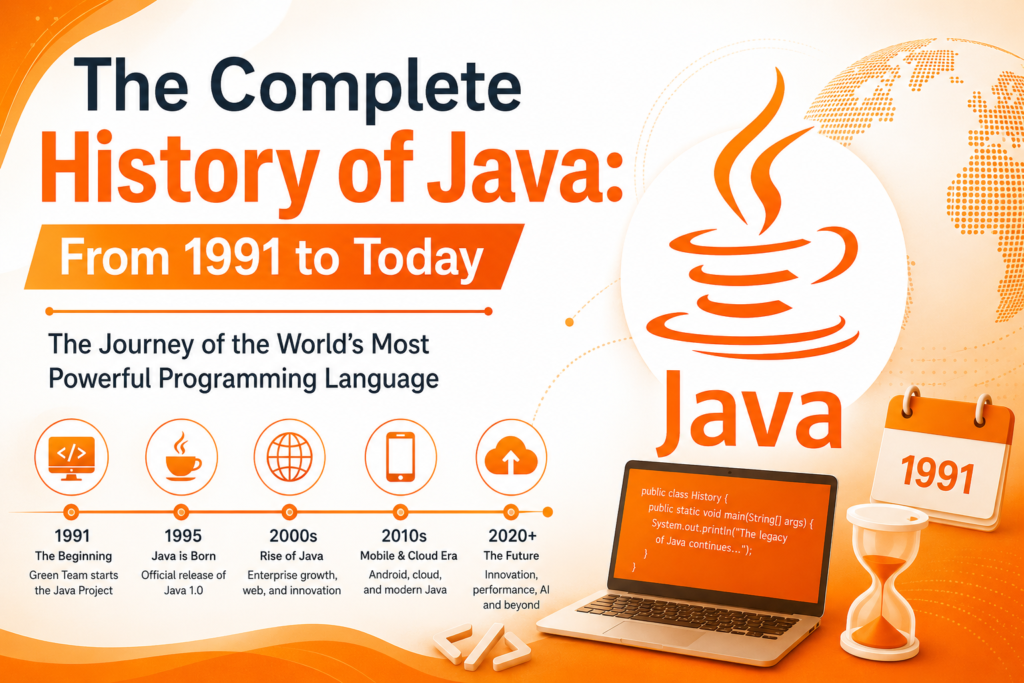
Timeline of Major Java Versions
Java 1.0 (1995)
Initial public release.
Java 2 (1998)
Enterprise features and Swing toolkit introduced.
Java 5 (2004)
Generics and annotations added.
Java 8 (2014)
Lambda expressions transformed Java programming.
Java 11 (2018)
Major LTS release with performance improvements.
Java 17 (2021)
Strong modernization and long term support.
Java 21 (2023)
Virtual threads and advanced scalability improvements.
This timeline of Java versions demonstrates how consistently the language evolved.
Java’s Global Impact
The impact of Java on technology is enormous.
Java influenced:
- Enterprise computing
- Mobile applications
- Banking software
- Cloud systems
- Education
- Open source communities
Millions of developers still start learning java today because of its career opportunities and stability.
Java remains one of the most important inventions in computing history.
The language also influenced many newer programming technologies.
The Future of Java
Java continues evolving aggressively.
Developers closely follow future of java & what’s coming because Oracle keeps modernizing the platform.
Future improvements focus on:
- Faster startup performance
- Lightweight cloud deployment
- AI integrations
- Better memory optimization
- Improved concurrency systems
Java’s adaptability strongly suggests the language will remain important for decades.
The evolution of Java proves that strong engineering principles can survive technological changes.
Frequently Asked Questions (FAQs)
Who created Java?
Java was created by James Gosling and the Green Team at Sun Microsystems in 1991.
How old is Java?
Java officially launched in 1995, making it more than 30 years old from its original development phase.
Why did Java become popular?
Java became popular because of portability, security, object oriented programming, and its write once run anywhere philosophy.
Is Java still relevant today?
Yes. Java remains widely used in enterprise software, Android development, cloud computing, and financial systems.
What was Java originally called?
Java was originally named Oak programming language before being renamed.
Why has Java survived for so long?
Java survived because of backward compatibility, strong enterprise support, continuous updates, and a massive ecosystem.
Conclusion
The complete history of java is a story of innovation, adaptability, and engineering brilliance. What started as a small Green Team experiment inside Sun Microsystems eventually transformed into one of the most successful programming languages ever created.
From the Applets era to cloud computing and AI infrastructure, Java continuously evolved to meet industry demands. Its portability, reliability, and massive ecosystem helped it dominate enterprise computing for decades.
Even today, Java remains a critical part of global software infrastructure. The language continues improving through modern release cycles, cloud optimization, and enterprise innovation, shaping the future of software engineering in powerful ways.
The evolution of Java proves that great software technologies survive by adapting to change while preserving their core strengths. That is exactly why Java remains one of the most respected programming languages in the world today.