Introduction
The gpt-3 history is the story of a moment when the AI world collectively stopped and asked itself whether something genuinely new had just arrived. When OpenAI released GPT-3 in May 2020, the reaction from researchers, developers, and the public was unlike anything the field had seen before. Developers were writing essays about feeling like they were touching something from the future. Technologists were debating whether it represented a step toward artificial general intelligence. Critics were raising urgent questions about misuse and safety.
What made gpt-3 history so significant was not just the sheer size of the model. It was what that size appeared to unlock. GPT-3 could write coherent essays, answer factual questions, generate working code in Python and CSS, translate between languages, and complete creative writing tasks, often from just a short description in plain English. No fine-tuning required. No labeled examples beyond a handful in the prompt. The era of in-context learning had arrived, and the implications were enormous.
This article traces the complete gpt-3 history from the ideas and research that made it possible, through its development and controversial release, to the lasting commercial and cultural impact it continues to have on AI development today.
The Research Path That Led to GPT-3 (2017 – 2019)
To understand gpt-3 history, you need to start a few years before the model itself appeared. The intellectual foundations were laid between 2017 and 2019 through a series of breakthroughs that, in hindsight, were all pointing toward the same destination.
The transformer architecture history begins with the 2017 Google paper “Attention Is All You Need,” which replaced recurrent networks with self-attention mechanisms and made massive parallelization during training practical for the first time. OpenAI researchers recognized that the decoder portion of this architecture was ideally suited for autoregressive language modeling, where the goal is simply to predict the next token given all previous tokens.
GPT-1 in 2018 demonstrated that pre-training a transformer decoder on large amounts of text and then fine-tuning it on specific tasks could produce strong performance across a wide range of language benchmarks. GPT-2 in 2019 scaled this approach significantly, with 1.5 billion parameters trained on web text, and showed that larger models produced qualitatively better outputs. The pattern was becoming clear. Massive scale pre-training on diverse text data kept producing improvements, and there was no obvious ceiling in sight.
OpenAI researchers were also studying what would later be formalized as scaling laws in AI, the observation that model performance improves predictably as you increase model size, dataset size, and compute in a coordinated way. These laws suggested that a much larger model trained on much more data would not just be incrementally better. It would be transformatively better. GPT-3 was the experiment designed to test that prediction.
Building GPT-3: Scale, Data, and Architecture (2019 – 2020)
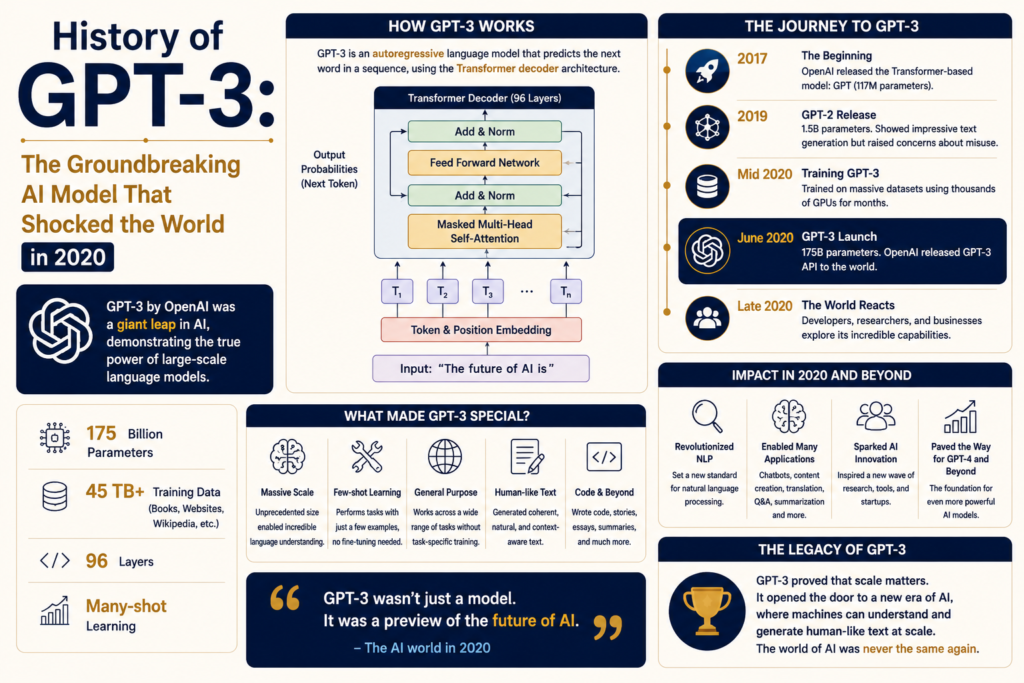
The development phase of gpt-3 history involved engineering and data challenges at a scale that very few organizations in the world could have attempted. The final model contained 175 billion parameters, making it roughly 100 times larger than GPT-2 and by a wide margin the largest language model publicly known to exist at the time of the OpenAI 2020 release.
The training data was assembled from multiple large-scale sources. The primary source was Common Crawl filtered data, a massive web scrape that required extensive cleaning and fuzzy deduplication to remove near-duplicate documents that could distort the model’s learning. Without careful deduplication and quality filtering, the sheer size of web text would introduce significant noise. OpenAI supplemented this with curated high-quality sources including WebText2, a refined collection of web content filtered by human approval signals, as well as books and Wikipedia.
The architecture remained a transformer decoder innovation building directly on the designs used in GPT-1 and GPT-2, but scaled substantially in terms of the number of layers, attention heads, and the dimension of the internal representations. The model used byte-pair encoding (BPE) for tokenization, breaking text into subword units that could handle both common words and rare vocabulary efficiently.
Training GPT-3 required enormous compute, estimated at roughly 3.14 times ten to the twenty-three floating point operations. This represented a level of investment that signaled OpenAI’s transformation from a purely academic research organization into one that needed substantial commercial revenue to sustain its work. Model latency and inference costs at this scale also became real engineering concerns that would shape how the model was deployed.
The Release and the World’s Reaction (May 2020)
The gpt-3 history at the moment of release is a story of carefully managed access and immediate public fascination. OpenAI did not release GPT-3 as open-source. Instead, in May 2020 the company published the research paper and began offering access through a private beta of the GPT-3 API, inviting a limited number of developers to build applications and explore the model’s capabilities.
The reactions that came back from that developer community were extraordinary. People shared examples of GPT-3 writing convincing op-eds, generating functional code from plain English descriptions, composing poetry, answering medical questions, completing legal clauses, and producing creative fiction that maintained a consistent voice across many paragraphs. The human-like coherence of the outputs was unlike anything that had been publicly demonstrated before at this scale.
The openai history at this moment captures an organization that had made a calculated bet on scale paying off, and watching that bet be confirmed in real time. The few-shot and one-shot performance of GPT-3 was particularly striking. You could show the model a handful of examples of a task formatted in the prompt and it would generalize to new instances of that task without any weight updates whatsoever. This zero-shot generalization to tasks that had never been explicitly trained on suggested the model had developed something like a general understanding of instructions, not just pattern matching.
Prompt engineering origins can be traced directly to this moment. Developers quickly discovered that the way you phrased your input to GPT-3 had a dramatic effect on the quality and relevance of the output. A whole informal discipline of crafting effective prompts emerged almost immediately, one that would later become a formal field of study and a sought-after professional skill.
What GPT-3 Could Actually Do
A significant part of gpt-3 history is the catalog of capabilities that the model demonstrated across months of developer exploration following its release. Autocompletion and text generation were the most obvious, but the range extended far beyond that.
GPT-3 showed impressive coding capabilities in CSS and Python, generating functional scripts and web styling code from natural language descriptions. It could summarize long documents, convert bullet points into flowing prose, generate product descriptions, answer trivia questions, and produce dialogue. It could perform basic arithmetic when the numbers were small, though it failed reliably on more complex calculations. It could translate between languages with reasonable quality even though translation was never an explicit training objective.
The model also showed clear limitations that became equally important parts of the gpt-3 history. It would hallucinate facts with complete confidence, presenting invented statistics or fictional citations as if they were real. It had no memory between conversations. Its reasoning on multi-step logical problems was inconsistent. And without content moderation tools in place, it would readily produce harmful, biased, or offensive content if prompted in certain ways.
These limitations shaped how OpenAI approached deployment and would directly influence the research program that eventually produced InstructGPT and then ChatGPT.
GPT-3 API, Commercial Impact, and Developer Ecosystem (2020 – 2021)
The decision to release GPT-3 through a commercial API rather than as open-source weights was one of the most consequential business decisions in the gpt-3 history. It allowed OpenAI to generate revenue to fund ongoing research while maintaining control over how the model was used and preventing the most dangerous applications.
The GPT-3 API developer access opened more broadly in late 2020 and quickly attracted a wave of startups and developers building applications on top of the model. Writing assistants, code generation tools, customer service chatbots, content creation platforms, and search enhancement tools all emerged within months. Dozens of companies raised venture capital specifically to build GPT-3-powered products.
This commercial language model impact changed the conversation around AI from a purely academic and research concern to a business and product concern. Investors began understanding that large language models could be the foundation for an entirely new category of software. The era of foundation model research as a commercial enterprise had begun in earnest.
For a broader view of how this fits into the sweep of AI development, the llm timeline shows GPT-3 as the inflection point where language models crossed from impressive demos to real commercial deployment at scale.
InstructGPT and the Alignment Upgrade (2022)
The gpt-3 history does not end with the original model. One of the most important developments that grew directly from GPT-3 was InstructGPT, released by OpenAI in early 2022. The core problem InstructGPT addressed was that raw GPT-3, while powerful, was not reliably helpful or safe. It would complete prompts in ways that were technically coherent but often misaligned with what users actually wanted, and it could produce harmful content when pushed.
InstructGPT applied what is rlhf, which stands for Reinforcement Learning from Human Feedback. Human raters compared pairs of model outputs and indicated which they preferred. These preferences were used to train a reward model, which then guided further fine-tuning of GPT-3 to produce outputs that were more helpful, honest, and harmless. The InstructGPT alignment work showed that a smaller, carefully aligned model could outperform the larger raw model on practical tasks despite having fewer parameters.
This work directly seeded the development of ChatGPT, which launched in November 2022 and changed the public perception of AI overnight. The chatgpt history is in many ways the most visible downstream consequence of gpt-3 history, the moment when the technology reached ordinary people who had never interacted with a language model before.
GPT-3’s Place in the Broader AI Arms Race
The gpt-3 history accelerated the competitive dynamics of the entire AI industry in ways that are still playing out today. Google, which had invented the transformer architecture, was caught off guard by how quickly OpenAI had turned research into a deployed product. Meta began investing more heavily in open-source language models. Anthropic, founded by former OpenAI researchers, launched with a safety-focused approach to large language models. Dozens of startups emerged with competing models and products.
The ai scaling laws that GPT-3 so powerfully validated gave every well-funded organization a clear roadmap: gather more data, buy more compute, build bigger models. This triggered massive capital investment across the industry and set the stage for the even larger and more capable models that followed in GPT-4 and beyond.
The sparse vs dense architecture debate also intensified after GPT-3. Some researchers argued that mixture-of-experts approaches, where only a portion of model parameters are activated for any given input, could achieve GPT-3-level performance at a fraction of the inference cost. This question of efficiency versus raw scale became a defining tension in post-GPT-3 AI research.
The future of AI continues to be shaped by the template that gpt-3 history established: large-scale pre-training on diverse internet data, followed by alignment techniques that make the model actually useful and safe for real users.
Frequently Asked Questions (FAQs)
When was GPT-3 released and who built it?
GPT-3 was released by OpenAI in May 2020. The research paper was authored by Tom Brown, Benjamin Mann, Nick Ryder, Melanie Subbiah, and many other OpenAI researchers. The model had 175 billion parameters and was trained on a filtered combination of Common Crawl web data, books, and Wikipedia.
What made GPT-3 so different from previous language models?
GPT-3 was different primarily because of its scale and the emergent capabilities that scale produced. Unlike previous models that required fine-tuning for each specific task, GPT-3 could perform many tasks from just a few examples provided in the prompt, a capability called few-shot learning. This in-context learning ability had not been observed at this level in any prior model.
Why did OpenAI not release GPT-3 as open-source?
OpenAI chose to release GPT-3 through a controlled API rather than releasing the weights publicly. The organization cited concerns about potential misuse, including generation of disinformation, spam, and harmful content at scale. The API approach also allowed OpenAI to generate commercial revenue to fund continued research and to build content moderation tools to reduce harmful outputs.
How did GPT-3 lead to ChatGPT?
GPT-3 was the base model that OpenAI refined through a process called Reinforcement Learning from Human Feedback to create InstructGPT. ChatGPT was built on a further refined version of this process applied to GPT-3.5, a more capable successor to the original GPT-3. The alignment techniques developed to make GPT-3 more helpful and safe were the direct technical bridge to ChatGPT.
What were the main limitations of GPT-3?
GPT-3 hallucinated facts confidently, had no memory between conversations, performed inconsistently on multi-step reasoning tasks, and would produce harmful content without appropriate safeguards. Its outputs, while impressively coherent on average, could be confidently wrong in ways that were difficult for non-experts to detect. These limitations drove the subsequent research into alignment and factual grounding that defined the post-GPT-3 era.
Conclusion
The gpt-3 history is a chapter in AI development that genuinely deserves the word historic. A model trained on filtered web text, books, and Wikipedia, using a transformer decoder scaled to 175 billion parameters, crossed a capability threshold that made the entire world pay attention to large language models in a way it never had before.
GPT-3 history marks the moment when in-context learning became real, when prompt engineering became a discipline, when foundation models became a commercial product category, and when the question of AI alignment shifted from philosophical speculation to urgent practical priority. Every major AI development that followed, from ChatGPT to GPT-4 to the wave of competing models from Google, Anthropic, Meta, and others, owes something fundamental to what GPT-3 demonstrated in the summer of 2020.
Understanding this history is essential for anyone who wants to understand not just where AI has been, but where it is headed next.