For thousands of years, humanity looked at the passing of traits from parents to children as an impenetrable mystery. Children looked like their parents, but no one could say exactly why or how. This chaotic biological puzzle changed forever when a brilliant Augustinian friar named Gregor Mendel stepped into his quiet monastery garden in Brno. By applying rigorous mathematical logic to simple pea plants, he single-handedly mapped the three laws of inheritance, providing the foundational framework that completely revolutionized modern biological science.
His monumental discovery showed that biological inheritance history is not a messy blending of parental fluids, but a beautiful, highly orderly system governed by precise mathematical formulas. Today, these principles stand as the pillars of transmission genetics, showing us how every living thing inherits its unique features. To fully appreciate this triumphant breakthrough, we must dive into the specific mechanics of how he cracked the code of life itself.
The Masterpiece of Early Plant Breeding Experiments (1856 – 1863)
Before he could establish the three laws of inheritance, Mendel had to break away from the unscientific theories of his era. The popular belief at the time was the blending theory of inheritance, which argued that traits mixed together smoothly like paint. To test this assumption, he carefully designed the mendel pea plant experiments, using the common garden pea plant, Pisum sativum, as his primary tool.
Pure Tall (TT)  x  Pure Short (tt)
                │
                ▼
       All Offspring Tall (Tt)
He specifically tracked seven pairs of monogenic traits, which are clear characteristics that appear in only two distinct forms, such as smooth versus wrinkled seeds or green versus yellow pods. This careful selection allowed him to avoid complex, continuous variations and focus on absolute, easily countable outcomes. Over nearly a decade, he hand-pollinated thousands of flowers, protected his plants from stray pollen, and tracked the physical traits of thousands of individual seeds. His deep understanding of botany and physics enabled him to gather clean experimental data that revealed clear, undeniable patterns hidden within generational traits.
Deconstructing the First Pillar: The Universal Law of Dominance
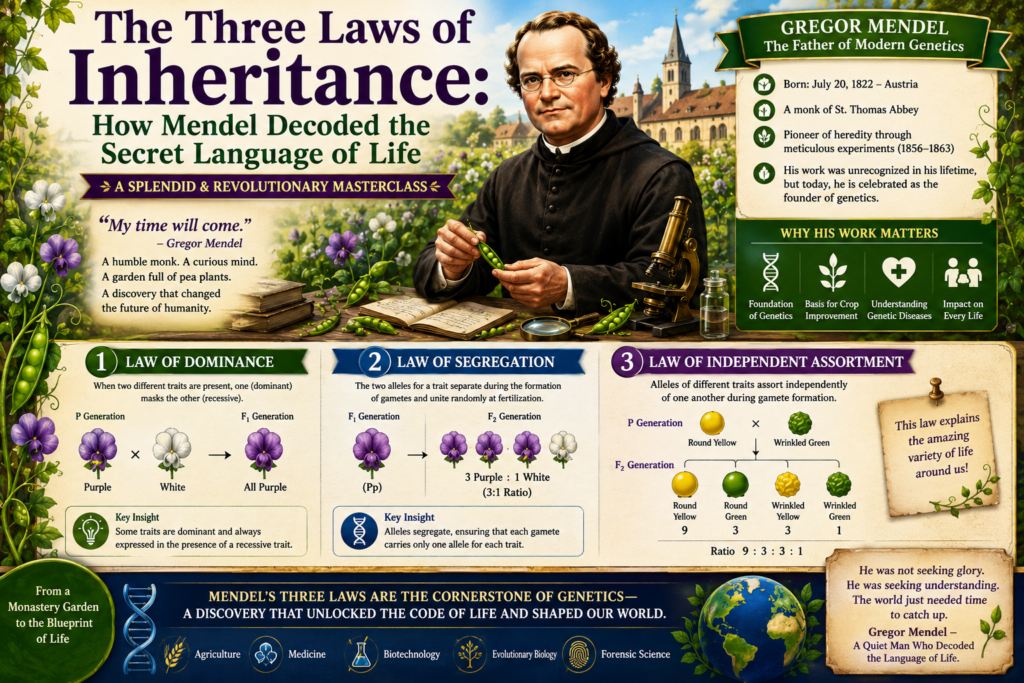
The first breakthrough came when Mendel crossed pure-breeding plants with contrasting features. In a classic monohybrid cross, he transferred pollen from a pure-breeding tall plant to a pure-breeding short plant. Under the old blending theory, the offspring should have grown to a medium height. Instead, every single plant grew completely tall.
To explain why the short trait completely vanished, he introduced the concepts of dominant and recessive traits. He realized that the physical features of an organism, known as its phenotypes, are determined by internal hereditary units, which we now know as alleles. Some alleles are dominant and can completely overpower other alleles, while others are recessive and remain hidden when a dominant allele is present. This profound insight led directly to the formulation of his first major principle.
       [ Dominant Allele: T ]  +  [ Recessive Allele: t ]
                                  │
                                  ▼
                     [ Phenotype: Visually Tall ]
This phenomenon is known as the law of dominance, which states that in a heterozygous organism, where two different alleles for a trait are present, one allele will completely mask the expression of the other. The visible allele is dominant, while the masked allele is recessive. This principle explained why the first hybrid generation looked identical to only one parent, establishing a foundational rule for how phenotypic expression rules function across all complex living systems.
Unlocking the Second Pillar: The Mathematical Law of Segregation
Mendel did not stop his experiment after the first generation. He allowed those hybrid tall plants to self-pollinate and raise a second generation. When he examined the resulting offspring, the short trait, which had completely disappeared, returned perfectly intact. The hidden ancestral traits were not destroyed or blended; they were simply waiting to reappear.
To understand this behavior, he analyzed the exact mathematics of heredity. He noticed that when he counted the plants, the relationship between the dominant phenotype and the recessive phenotype was always incredibly close to a 3:1 ratio.
3:1
To explain this mathematical consistency, he proposed the law of segregation. This principle states that every individual organism carries two distinct alleles for each characteristic. During the biological process of gamete formation, which occurs through meiosis, these two alleles separate, or segregate, completely from each other. As a result, each individual reproductive cell receives only one allele.
We can model this behavior using clear algebraic notation. Let T represent the dominant allele for tall height, and let t represent the recessive allele for short height. When two hybrid tall parents (Tt) are crossed, their reproductive cells combine randomly. This interaction can be written as a simple polynomial distribution:
(T+t)(T+t)=T2+2Tt+t2
This algebraic equation reflects the distribution of underlying genotypes inside the plants:
- 1 TT (Homozygous Dominant): Visually tall plant
- 2 Tt (Heterozygous): Visually tall plant, carrying the hidden short allele
- 1 tt (Homozygous Recessive): Visually short plant
This elegant genetic breakdown creates the classic mendel 3 to 1 ratio in physical appearance, while maintaining a underlying genetic ratio of 1:2:1. It proved that alleles remain clean, individual units that never mix or break apart, ensuring that genetic variation passes perfectly down through generations.
                  Parent 1 (Tt)
                  +-----+-----+
                  |  T  |  t  |
            +-----+-----+-----+
            |  T  | TT  | Tt  |
  Parent 2  +-----+-----+-----+
    (Tt)    |  t  | Tt  | tt  |
            +-----+-----+-----+
Expanding to Two Traits: The Law of Independent Assortment
After mastering single traits, Mendel wanted to see if different characteristics influenced one another during inheritance. He designed a dihybrid cross, tracking two separate traits at the same time, such as seed shape (round versus wrinkled) and seed color (yellow versus green).
He crossed a plant with pure round, yellow seeds (RRYY) with a plant with pure wrinkled, green seeds (rryy). The first generation produced only round, yellow seeds, confirming the rules of dominance. He then allowed these double-hybrid plants (RrYy) to self-pollinate. If the traits were permanently linked together, they would only reappear in their original parental combinations. However, the resulting generation produced entirely new combinations, such as round green seeds and wrinkled yellow seeds.
This discovery led to the law of independent assortment, which states that the alleles for different traits separate completely independently of one another during the creation of reproductive cells. The inheritance of seed color has absolutely no connection to the inheritance of seed shape.
Mathematically, because the two traits separate independently, we can find the combined outcome by multiplying the individual 3:1 probabilities for each trait together:
(3+1)(3+1)=9+3+3+1
This multiplication yields the classic dihybrid phenotypic ratio of 9:3:3:1:
- 9 parts: Round, yellow seeds (both traits dominant)
- 3 parts: Round, green seeds (one dominant, one recessive)
- 3 parts: Wrinkled, yellow seeds (one recessive, one dominant)
- 1 part: Wrinkled, green seeds (both traits recessive)
This independent separation creates immense genetic variation, serving as a primary driver for evolutionary biology basics by constantly shuffling alleles into new combinations.
The Historical Timeline of Genetic Discovery (1865 – 1900)
When Mendel published his work under the title Versuche über Pflanzen-Hybriden in 1866, the scientific world was completely unprepared for his genius. For over thirty-five years, the three laws of inheritance were entirely ignored, buried in an obscure journal.
   1866: Mendel Publishes Laws  ──► [ 34 Years of Silence ]
                                             │
   1900: Independent Rediscovery  ◄──────────┘
The biological community of the 19th century was highly descriptive and lacked the statistical training required to understand his mathematical models. It was not until the year 1900 that three independent botanists rediscovered his paper, realizing he had solved the riddle of inheritance decades prior. This dramatic transition from obscurity to fame triggered the birth of classic genetics, forever changing our understanding of the natural world.
Frequently Asked Questions (FAQs)
What are the three laws of inheritance?
The three principles are the law of dominance, the law of segregation, and the law of independent assortment. Together, they explain how alleles interact, separate during reproduction, and combine independently to create variation.
How does the law of segregation differ from the law of independent assortment?
The law of segregation focuses on how two alleles for a single gene separate into individual reproductive cells. The law of independent assortment describes how alleles for different genes separate without influencing each other.
Why do some traits appear to skip a generation?
Traits appear to skip a generation due to the rule of dominance. A recessive allele can be completely masked by a dominant allele in parents, remaining hidden until two recessive alleles combine in an offspring.
Are there any exceptions to Mendel’s original laws?
Yes, modern genetics recognizes several exceptions, including codominance, incomplete dominance, and gene linkage, where genes located close together on the same chromosome do not assort independently.
The Timeless Triumph of Mendelian Genetics
The rediscovery of Mendel’s work in 1900 laid the foundation for the chromosome theory of inheritance, beautifully connecting his mathematical laws with the physical movement of chromosomes during cell division. This massive step forward eventually led to the modern synthesis, uniting the principles of genetic transmission with natural selection. By showing that the passing of traits is governed by beautiful, predictable rules, Gregor Mendel predicted modern genetics with astonishing accuracy. His brilliant insights continue to guide every facet of genomic science, agricultural development, and biotechnology, securing his place as one of the greatest scientists in human history.