For nearly fifty years, computer vision researchers built systems by hand. They designed mathematical filters to detect edges, engineered features to describe shapes, and wrote rules to combine those features into classifications. Progress was real but slow, measured in fractions of a percentage point of accuracy gained per year. Then, in the span of just a few years, everything changed. The story of how deep learning transformed computer vision is one of the most dramatic shifts in the history of any scientific field, a transformation so complete that an entire generation of carefully engineered techniques was largely set aside in favor of a fundamentally different approach.
This article explains exactly how that transformation happened, why it took so long to arrive, and why its effects are still unfolding today.
The World Before Deep Learning
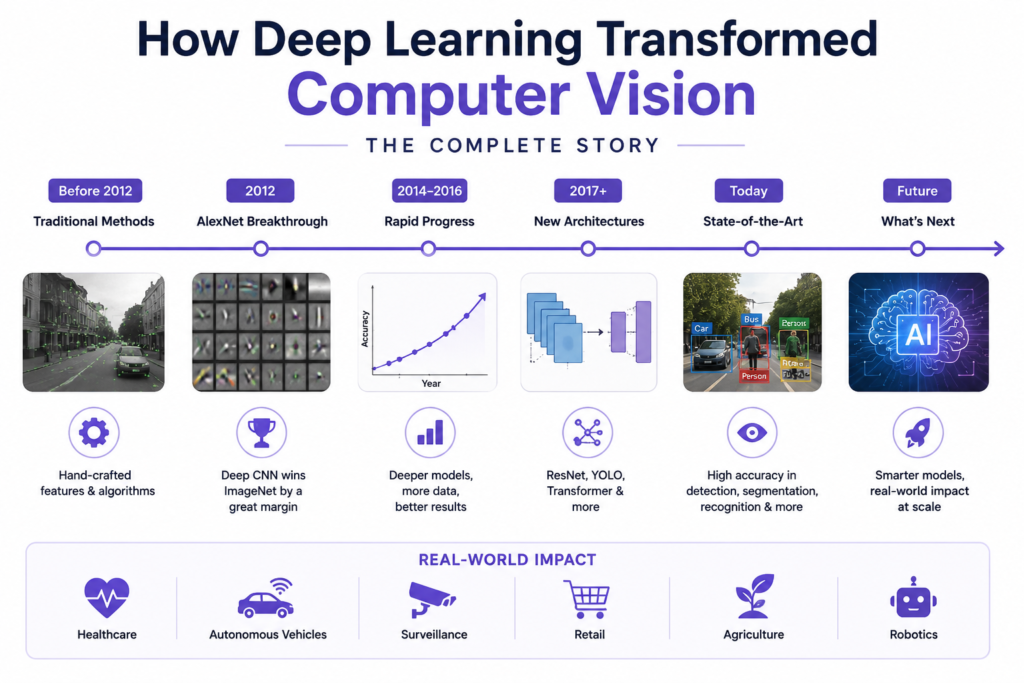
To appreciate how dramatically deep learning transformed computer vision, you need to understand what computer vision looked like before 2012. The dominant approach was built around feature extraction automation, except the automation was only partial. Researchers manually designed algorithms to detect specific kinds of patterns in images, edges, corners, textures, and then used machine learning classifiers to combine these hand-designed features into final predictions.
Scale Invariant Feature Transform (SIFT), introduced by David Lowe in the late 1990s, was one of the most successful examples of this approach. SIFT identified distinctive keypoints in an image that remained recognizable even when the image was rotated, scaled, or viewed from a different angle. Histogram of Oriented Gradients (HOG), introduced in 2005, captured the distribution of edge directions within regions of an image, proving particularly effective for tasks like pedestrian detection.
These methods, combined with classifiers like support vector machines, represented the state of the art for years. They worked, but they had a fundamental limitation: every new task required a human expert to design new features, or at least carefully tune existing ones. Progress depended on human ingenuity in feature design, a bottleneck that limited how quickly the field could advance.
The Theoretical Pieces Were Already There (1980 – 2006)
One of the most striking aspects of how deep learning transformed computer vision is that the core mathematical ideas behind deep learning were not new in 2012. Convolutional Neural Networks (CNN) had been described in detail by Yann LeCun in the late 1980s, building on Kunihiko Fukushima’s neocognitron from 1980. Backpropagation, the algorithm used to train these networks, had been understood since the mid-1980s.
The history of the neocognitron and LeCun’s subsequent work on LeNet demonstrated, as early as the early 1990s, that convolutional architectures trained with backpropagation could achieve excellent results on tasks like handwritten digit recognition. Yet for nearly two decades, these ideas remained on the margins of mainstream computer vision research.
Two ingredients were missing: data and computation. Backpropagation scaling to deep networks required training on datasets far larger than anything readily available before the mid-2000s. And training deep networks on such datasets required computational power that simply did not exist in affordable form. Without these two ingredients, the theoretically sound ideas behind deep learning remained interesting but largely impractical for real-world computer vision problems.
ImageNet and the GPU: The Missing Pieces Arrive (2006 – 2012)
The first missing piece arrived in 2006, when Fei-Fei Li at Princeton, later Stanford, began assembling ImageNet, a dataset that would eventually contain over 14 million labeled images spanning more than 20,000 categories. The history of ImageNet provided, for the first time, a dataset large enough to potentially train deep networks without immediately overfitting.
The second missing piece came from an unexpected direction: gaming hardware. GPU hardware acceleration, originally developed to render graphics for video games, turned out to be remarkably well suited to the matrix multiplication operations at the heart of neural network training. Researchers discovered that operations which took weeks on standard processors could be completed in days or even hours on GPUs.
By the late 2000s and early 2010s, both pieces were in place: a dataset large enough to support deep learning, and hardware fast enough to make training deep networks on that dataset practical. The stage was set, though almost nobody outside a small group of researchers, including Geoffrey Hinton and his students, anticipated just how dramatic the resulting shift would be.
The Moment Everything Changed (2012)
In 2012, the moment that defines how deep learning transformed computer vision arrived at the ImageNet Large Scale Visual Recognition Challenge. AlexNet, developed by Alex Krizhevsky, Ilya Sutskever, and Geoffrey Hinton, achieved a top-5 error rate of roughly 15 percent, compared to around 26 percent for the next best entry, which used traditional feature engineering approaches.
The history of AlexNet is now legendary precisely because the margin of improvement was so large that it could not be explained away as a minor refinement. AlexNet used a deep convolutional architecture, rectified linear unit activations that trained much faster than previous activation functions, dropout regularization to reduce overfitting, and was trained using gradient descent optimization across two GPUs working in parallel.
The result sent shockwaves through the research community. Researchers who had spent careers refining hand-crafted features watched a system that learned its own features directly from raw pixels outperform their best efforts by a margin nobody thought possible. Within roughly two years, the overwhelming majority of computer vision research had shifted toward deep learning approaches.
End to End Learning Replaces Pipelines (2012 – 2016)
One of the most profound ways deep learning transformed computer vision was by changing the basic structure of how vision systems were built. Traditional systems were pipelines: a feature extraction stage, followed by a feature selection stage, followed by a classification stage, each designed and tuned somewhat independently.
End-to-end differentiable models replaced this pipeline approach with a single network trained as a whole, from raw pixels directly to the final output, with every component learned jointly through gradient descent optimization. This rise of end to end visual learning meant that the network could discover, on its own, which intermediate representations were most useful for the final task, rather than relying on representations designed by humans for general-purpose use.
Architectures that followed AlexNet pushed this idea further. The history of VGGNet in 2014 demonstrated that simply making networks deeper, while keeping individual layers simple, could substantially improve performance. The history of GoogLeNet, also from 2014, introduced more efficient module designs that allowed very deep networks without an explosion in computational cost. The history of ResNet in 2015 solved the vanishing gradient problem for extremely deep networks using residual connections, enabling architectures with over 100 layers that surpassed average human accuracy on ImageNet.
Each of these architectures represented points within high dimensional vector spaces of possible network designs, and the rapid pace of improvement showed just how much room for progress existed once researchers stopped relying on hand-designed features and let networks learn their own representations through representation learning.
Beyond Classification: Detection and Segmentation (2013 – 2018)
Once deep learning transformed computer vision for image classification, researchers quickly applied the same principles to more complex tasks. The history of object detection moved from R-CNN in 2013 through Faster R-CNN in 2015 to YOLO, which reframed detection as a single end-to-end regression problem rather than a multi-stage pipeline.
The history of image segmentation similarly moved from traditional techniques based on edge detection and region growing toward fully convolutional networks that could produce pixel-precise segmentation masks directly. Transfer learning in computer vision became a standard practice during this period, with networks pretrained on ImageNet serving as a starting point for a vast range of specialized tasks, from medical imaging ai to satellite image analysis, often requiring only a small amount of task-specific training data to achieve strong results.
This period also saw deep learning applied to facial recognition, with the history of DeepFace in 2014 achieving near-human accuracy on face verification benchmarks, and to generative tasks, with neural style transfer in 2015 showing that networks could separate and recombine the content and style of images.
The Transformation Reaches New Domains (2015 – 2024)
The impact of how deep learning transformed computer vision extended far beyond academic benchmarks into nearly every industry that relies on visual information. Self-driving cars and computer vision became deeply intertwined, with deep learning models processing camera, lidar, and radar data to detect pedestrians, vehicles, and road features in real time.
Medical imaging ai, computer vision in manufacturing, and computer vision in sports all adopted deep learning approaches that consistently outperformed the hand-engineered systems that had preceded them. Drones and computer vision combined to enable applications in agriculture, construction, and search and rescue that would have been impractical with earlier technology.
The history of ai image generation also flourished during this period, with generative adversarial networks, and later diffusion models behind the history of Stable Diffusion and the history of Midjourney, demonstrating that the same deep learning principles that transformed image understanding could also transform image creation.
Vision Transformers and What Comes Next (2020 – 2026)
The most recent chapter in how deep learning transformed computer vision involves a partial departure from convolutional architectures altogether. Vision transformers, introduced in 2020, replaced convolutional layers with self-attention mechanisms borrowed from language models, achieving competitive or superior results on many benchmarks.
The history of multimodal AI represents perhaps the most significant ongoing transformation, with models that combine vision and language, allowing systems to not just classify or detect objects but to describe, reason about, and answer questions regarding visual content. Video understanding in ai has similarly benefited, with models capable of processing temporal sequences of frames to understand motion, action, and narrative structure within video.
Throughout all of these developments, the core lesson of how deep learning transformed computer vision remains consistent: systems that learn their own representations from data, given sufficient data and computational power, consistently outperform systems built around hand-designed features, often by a wide and growing margin.
Frequently Asked Questions
When did deep learning transform computer vision?
The pivotal moment is widely considered to be 2012, when AlexNet won the ImageNet Large Scale Visual Recognition Challenge by a dramatic margin over methods using hand-crafted features like SIFT and HOG. While the underlying ideas existed earlier, 2012 marks the point when deep learning transformed computer vision from a niche approach into the dominant paradigm.
What is the difference between deep learning and traditional computer vision?
Traditional computer vision relies on hand-designed features and multi-stage pipelines, where humans decide what kinds of patterns the system should look for. Deep learning, particularly through convolutional neural networks, learns its own features directly from data through end-to-end training, often discovering useful representations that humans would not have thought to design manually.
Why did it take until 2012 for deep learning to transform computer vision?
The core algorithms behind deep learning, including convolutional neural networks and backpropagation, existed since the late 1980s. What was missing was sufficient training data, provided by datasets like ImageNet starting in 2006, and sufficient computational power, provided by GPU hardware acceleration that became practical for training neural networks in the late 2000s. Both pieces needed to be in place before deep learning could outperform traditional methods.
Did deep learning completely replace traditional computer vision techniques?
Not entirely. While deep learning dominates most high-level computer vision tasks like classification, detection, and segmentation, traditional image processing techniques remain widely used as preprocessing steps and in applications where computational efficiency, interpretability, or the absence of training data make classical methods preferable.
What industries were most affected by deep learning in computer vision?
Industries including healthcare, through medical imaging ai, automotive, through self-driving cars and computer vision, manufacturing, through automated quality inspection, and security, through facial recognition and surveillance technology, were all dramatically affected. The improvements in accuracy and the reduction in the need for manual feature engineering made computer vision practical for applications that had previously been too unreliable for real-world deployment.
Conclusion
The story of how deep learning transformed computer vision is, in many ways, a story about patience finally being rewarded. The core ideas, convolutional architectures, backpropagation, and hierarchical feature learning, had existed for decades, quietly waiting for the data and computational power needed to demonstrate their full potential. When those pieces arrived around 2012, the resulting transformation was so rapid and so complete that it reshaped not just academic research but entire industries within a few short years.
Today, virtually every application built on computer vision technology, from the camera in your phone to the diagnostic systems used in hospitals, depends on the deep learning revolution that began with AlexNet and continues to evolve through vision transformers, multimodal models, and generative systems. Understanding how deep learning transformed computer vision is understanding the foundation of one of the most consequential technological shifts of the twenty-first century.