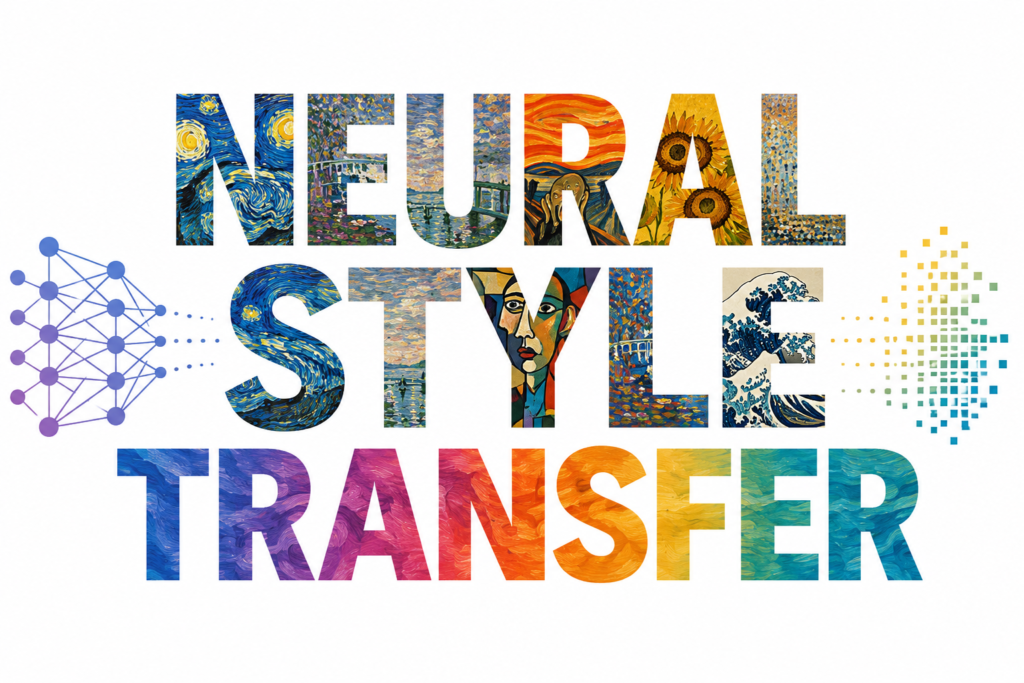
In 2015, researchers discovered something nobody had specifically set out to find: a neural network trained to recognize objects in photographs could, with the right mathematical approach, be repurposed to repaint any photograph in the style of a famous painting. Neural style transfer became one of the earliest and most visually striking demonstrations that deep learning systems contained capabilities far beyond their original training purposes. This article traces the complete history of neural style transfer, from the mathematical insight that made it possible to the real-time applications that brought it to millions of users.
The Unexpected Discovery
History of neural style transfer begins not with a goal of creating art, but with researchers studying how convolutional neural networks represent visual information internally. Networks trained for image classification, as part of the broader deep learning transformed computer vision narrative following the history of AlexNet in 2012, had proven remarkably effective at recognizing objects. But what exactly were these networks learning to represent internally, and could that internal representation be useful for anything beyond classification?
This question led to one of the more delightful discoveries in the history of ai image generation: the internal representations learned by these classification networks could be separated into two distinct components, one capturing what was depicted in an image, its content, and another capturing how it was depicted, its style, the textures, colors, and brushwork-like patterns that define an artistic look.
Leon Gatys and the Foundational Paper (2015)
Leon Gatys neural style transfer paper 2015, titled “A Neural Algorithm of Artistic Style,” published by Leon Gatys and collaborators, formally introduced the technique that would become known as neural style transfer. The paper demonstrated that a convolutional neural network, specifically one originally trained for image classification, could be used to combine the content of one image with the artistic style of another, producing a new image that depicted the same scene as the content image but rendered in the visual style of the style image.
This was a genuinely surprising result. The network used had not been trained for anything related to art or style transfer. It had been trained on the history of imagenet dataset to classify photographs into object categories. Yet buried within its layers was exactly the kind of representation needed to separate content from style, an emergent capability nobody had specifically designed for.
How Neural Style Transfer Works Step by Step
How neural style transfer works step by step begins with VGG16 feature extraction layers, the convolutional layers of the VGG16 architecture, part of the broader history of VGGNet lineage, pretrained on ImageNet. Rather than using this network to classify images, neural style transfer uses it purely as a feature extractor, passing images through the network and examining the activations at various layers.
The process starts with three images: a content image, providing the scene or subject matter to be preserved, a style image, providing the artistic style to be applied, and a generated image, which begins as random noise or a copy of the content image and is gradually modified throughout the process.
Gradient descent image reconstruction drives the entire process. Rather than training the network’s weights, which remain fixed throughout, gradient descent is used to adjust the pixel values of the generated image itself, gradually changing it so that it simultaneously matches the content of the content image and the style of the style image, according to specific mathematical measures of each.
Content Reconstruction vs Style Reconstruction
Content reconstruction vs style reconstruction represents the central conceptual insight of the history of neural style transfer. Content is measured by comparing the feature map activations of the generated image and the content image at certain layers of the network, layers that tend to capture what objects and arrangements are present in an image, regardless of fine textural details.
Style, by contrast, is measured very differently. Gram matrix calculation is the key technique here. A Gram matrix captures Feature map correlations, essentially measuring how different features within a layer tend to co-occur across an image, regardless of where in the image they appear. Two images with similar Gram matrices at a given layer tend to share similar textures, color distributions, and recurring visual patterns, even if the actual content of the images is completely different.
By comparing the Gram matrices of the generated image and the style image at multiple layers, the algorithm could measure how similar their styles were, independent of content. This separation, content measured one way through direct feature comparisons, style measured an entirely different way through Gram matrix correlations, was the key mathematical insight that made neural style transfer possible.
Loss Function Balancing and Optimization
History of style loss and content loss optimization describes how these two measurements, content similarity and style similarity, are combined into a single objective that the optimization process tries to minimize. A content loss term penalizes the generated image for differing from the content image in terms of its feature representations. A style loss term penalizes the generated image for having different Gram matrices than the style image.
Loss function balancing involves weighting these two terms relative to each other. If the content loss is weighted much more heavily, the result will closely preserve the original scene but apply only subtle stylistic touches. If the style loss is weighted much more heavily, the result will strongly reflect the artistic style, sometimes to the point where the original content becomes difficult to recognize. Finding an appropriate balance between these terms became an important practical consideration for producing visually pleasing results.
Texture synthesis optimization connects this work to an older area of computer graphics research focused on generating realistic textures, though neural style transfer’s approach of using a pretrained classification network for this purpose was novel. Pixel intensity optimization loops describe the iterative nature of the original approach: the generated image’s pixel values were repeatedly adjusted, often over hundreds of iterations, gradually reducing the combined content and style loss until the result satisfactorily balanced both objectives.
The Speed Problem: From Minutes to Milliseconds
The original neural style transfer approach, while visually striking, had a significant practical limitation. Because it required an iterative optimization process for every single image, repeatedly running the network forward and backward to gradually adjust pixel values, generating a single stylized image could take minutes, even on capable hardware of the time.
Real time neural style transfer history addresses this limitation directly. Researchers recognized that rather than performing this optimization process for every new image, a separate neural network could be trained to directly produce stylized images in a single forward pass, having learned, during a separate training process, how to apply a particular style to any input image.
Feed-forward style networks represented this solution. Instead of optimizing pixel values directly for each new image, a feed-forward network was trained, often using perceptual loss networks, networks similar to the original VGG-based approach but used during training rather than at generation time, to learn a direct mapping from input images to stylized output images for a specific style. Once trained, this feed-forward network could stylize new images in milliseconds rather than minutes, since it required only a single pass through the network rather than hundreds of optimization iterations.
Arbitrary Style Transfer: One Network, Any Style
Arbitrary neural style transfer algorithm evolution represents a further refinement. Early feed-forward approaches typically required training a separate network for each specific artistic style, useful but limiting if a user wanted to apply many different styles. Later research developed approaches capable of applying arbitrary styles, styles the network had never specifically been trained on, using a single trained model.
These approaches generally worked by separating the process into a feature extraction stage, capturing both content and style information using techniques related to the original Gatys approach, and a stylization stage that could combine these features for any style image provided at generation time, rather than requiring style-specific training in advance. This made neural style transfer dramatically more flexible, allowing users to apply essentially any image as a style reference to any content image, all using a single general-purpose model.
Neural Style Transfer Applications in Photography and Beyond
Neural style transfer applications in photography became one of the most visible practical uses of this technology. Mobile applications brought real-time neural style transfer to smartphone cameras, allowing users to apply artistic filters that went far beyond traditional color adjustments, transforming photographs into images that genuinely resembled paintings in various artistic styles, all processed in real time on consumer devices.
This work connects to the broader history of ai image generation in an important way. Neural style transfer demonstrated, years before the history of dall·e and the history of stable diffusion brought text-to-image generation to mainstream attention, that neural networks trained for one purpose, image classification, could be creatively repurposed for entirely different applications, foreshadowing the much broader exploration of generative capabilities within neural networks that would follow.
Artistic style representation, as developed through neural style transfer research, also influenced thinking about how visual style more generally could be represented and manipulated computationally, ideas that would echo through later generative architectures, including approaches used in vision transformers and modern diffusion-based image generation systems.
Frequently Asked Questions
Who invented neural style transfer?
Neural style transfer was introduced by Leon Gatys and collaborators in a 2015 paper titled “A Neural Algorithm of Artistic Style.” The technique used a convolutional neural network originally trained for image classification, repurposed to separate and recombine the content of one image with the artistic style of another.
How does neural style transfer separate content and style?
Content is measured by comparing feature map activations between images at certain network layers, capturing what is depicted in an image. Style is measured using Gram matrices, which capture correlations between features within a layer regardless of their spatial location, capturing textures and patterns characteristic of an artistic style independent of the specific content.
Why was the original neural style transfer slow?
The original approach required an iterative optimization process for each new image, repeatedly adjusting pixel values over many iterations to minimize a combined content and style loss. This process could take minutes per image, since it required many forward and backward passes through the network for every single output.
What is the difference between feed-forward style transfer and arbitrary style transfer?
Feed-forward style transfer trains a separate network to apply one specific style quickly, in a single pass, but requires retraining for each new style. Arbitrary style transfer uses a single trained network that can apply any style image provided at generation time, without requiring style-specific training, offering much greater flexibility at the cost of some additional architectural complexity.
How is neural style transfer related to modern AI image generation?
Neural style transfer was an early demonstration that neural networks trained for one purpose, like image classification, could be repurposed for creative generation. This insight foreshadowed the much broader exploration of generative capabilities that led to GANs, diffusion models, and text-to-image systems like DALL-E and Stable Diffusion, all part of the broader history of ai image generation.
Conclusion
The history of neural style transfer is a story about discovering hidden capabilities within systems built for entirely different purposes. Leon Gatys and his collaborators showed in 2015 that a network trained to classify photographs contained, within its layers, exactly the kind of representations needed to separate and recombine content and style, producing images that looked like photographs reimagined by famous painters.
From the original, computationally expensive optimization approach to the real-time, arbitrary-style feed-forward networks that followed, neural style transfer evolved quickly into a technology millions of people use through their smartphones. Within the broader story of computer vision technology, neural style transfer stands as an early and influential example of how creative applications can emerge unexpectedly from systems originally designed for recognition and understanding rather than generation.