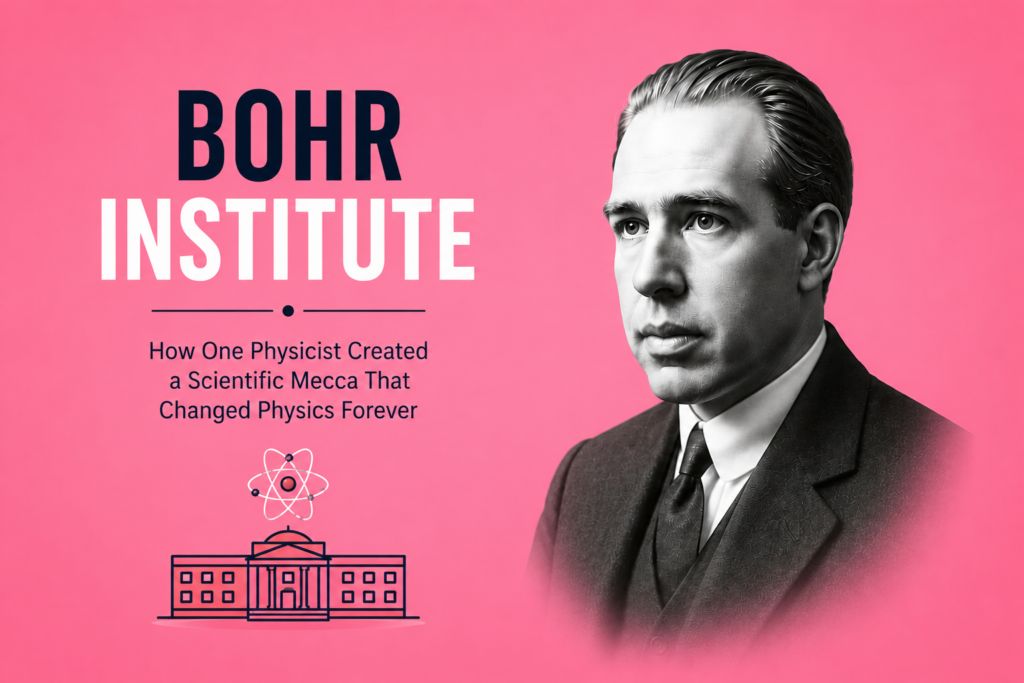
In a modest building in Copenhagen, some of the greatest scientific minds of the twentieth century gathered to argue, debate, and ultimately reshape humanity’s understanding of reality itself. The Bohr Institute became far more than a simple research facility. It transformed into a genuine scientific mecca, a place where the strange new rules of quantum mechanics were hammered out through intense collaboration, friendly rivalry, and countless late-night discussions between some of physics’ most brilliant figures.
Understanding how the Bohr Institute became such a legendary center of scientific achievement means tracing how Niels Bohr‘s personal vision for collaborative research created an environment unlike anything physics had previously experienced, one that would permanently shape the trajectory of modern science.
The Founding Vision (1921)
The Niels Bohr Institute, officially established as the Copenhagen Institute for Theoretical Physics, opened its doors in 1921, funded partly through Bohr’s Nobel Prize winnings and partly through Danish government and private support. Bohr envisioned something genuinely different from traditional academic institutions, a place specifically designed to foster open, collaborative scientific discussion rather than isolated individual research.
This vision for a Danish scientific institute reflected Bohr’s own personality and intellectual style. Rather than working alone in isolated contemplation, Bohr thrived through vigorous discussion and debate, believing that quantum mechanics’ genuinely strange implications could only be properly understood through sustained collaborative effort among multiple brilliant minds working together.
Creating the Copenhagen Spirit
What made the Bohr Institute genuinely unique was something researchers eventually called the Copenhagen spirit, an informal, collegial atmosphere encouraging young physicists to challenge established ideas, engage in spirited debate, and pursue genuinely novel theoretical directions without excessive concern for traditional academic hierarchy or deference to seniority.
This atmosphere proved remarkably productive precisely because quantum mechanics itself demanded such intellectual flexibility. The bizarre, counterintuitive nature of atomic behavior required researchers willing to abandon comfortable classical assumptions entirely, and the collaborative, questioning environment Bohr cultivated provided exactly the intellectual space needed for such radical theoretical development.
Heisenberg’s Transformative Stay (1924 – 1927)
Among the most significant visitors to the institute was Werner Heisenberg stay, beginning in 1924 and continuing through several crucial years of quantum theory development. It was during his time working closely alongside Bohr that Heisenberg developed his groundbreaking matrix mechanics formulation and famous uncertainty principle, breakthroughs that fundamentally shaped modern quantum mechanics.
The intense theoretical discussions between Bohr and Heisenberg during this period proved genuinely transformative for both physicists. Heisenberg later credited these Copenhagen conversations as essential to refining his own understanding of quantum measurement and uncertainty, insights that would eventually combine with Bohr’s own developing complementarity principle into the broader copenhagen interpretation framework.
Pauli’s Contributions and Critical Eye (1920s)
Wolfgang Pauli stay at the institute similarly proved intellectually significant throughout the 1920s. Pauli, known for his sharp critical mind and exacting theoretical standards, provided essential rigorous scrutiny for emerging quantum theories being developed at the institute, helping ensure that new theoretical proposals could withstand serious mathematical and conceptual challenges before gaining broader acceptance.
Pauli’s famous exclusion principle, developed partly through his time working within this collaborative Copenhagen environment, became another essential building block underlying modern atomic theory and electron orbits and energy levels understanding.
An International Gathering Point
Beyond Heisenberg and Pauli, the Bohr Institute attracted numerous other significant physicists throughout the 1920s and beyond, including Soviet physicist Lev Landau Copenhagen visits, among many other brilliant international scientists drawn to this genuinely unique research environment. This international physicists hub reputation meant that virtually every significant contributor to early quantum mechanics spent meaningful time working, discussing, or debating theoretical physics within the institute’s walls.
This constant flow of visiting researchers created a genuinely unprecedented scientific collaboration hub, where ideas could be tested, refined, and challenged through direct personal interaction rather than solely through slower, more formal academic publication processes.
Building Toward the Copenhagen Interpretation (1927)
Much of the theoretical framework eventually known as the copenhagen interpretation emerged directly through these ongoing institutional discussions throughout the 1920s. Bohr’s quantum contributions during this period increasingly synthesized his own atomic model insights with newer mathematical developments contributed by Heisenberg, Schrödinger, and other visiting researchers, gradually crystallizing into the coherent philosophical framework that would eventually bear the institute’s namesake.
This quantum mechanics birthplace designation reflects genuine historical accuracy, since so much of the foundational theoretical work establishing modern quantum mechanics literally occurred through discussions and debates happening within this specific physical location.
Weathering Historical Storms
The Bohr Institute faced significant challenges throughout its history, particularly during the tumultuous period surrounding World War II. As Nazi Germany’s influence expanded throughout Europe, the institute’s international, collaborative character came under increasing threat, and Bohr himself eventually needed to flee occupied Denmark in 1943 due to his partial Jewish heritage.
Despite this dramatic wartime interruption, the institute’s underlying scientific legacy proved remarkably resilient, continuing its research mission following the war’s conclusion and Bohr’s eventual return to Denmark, cementing its lasting reputation as a permanent theoretical physics research center.
Confronting Einstein’s Challenges
The Bohr Institute also served as an important intellectual base throughout the historic Einstein–Bohr debate, providing Bohr the theoretical grounding and collaborative support needed to formulate his careful, sophisticated responses to Einstein’s persistent challenges. When Einstein proposed the EPR paradox in 1935, Bohr’s response drew directly upon years of accumulated theoretical development achieved through countless discussions occurring at his own institute.
This ongoing Niels Bohr vs Einstein intellectual rivalry, playing out partly through correspondence and partly through direct confrontation at various physics conferences, benefited significantly from the institute’s established theoretical framework, allowing Bohr to defend quantum mechanics’ foundations with considerable philosophical sophistication and rigor.
A Legacy of Nobel Laureates
The Bohr Institute’s remarkable intellectual productivity produced an extraordinary concentration of scientific talent, with numerous Bohr institute Nobel laureates emerging from researchers who spent significant time working within its collaborative environment. This pattern reflects the genuine intellectual value provided through sustained, focused collaboration among brilliant researchers working toward shared theoretical goals.
Physics Genius Gathering Continues Today
Remarkably, the institute Bohr founded continues operating as an active theoretical physics research center even today, maintaining its historical reputation as a genuine physics intellectual center attracting researchers from around the world. This continuity demonstrates the lasting institutional value Bohr created, establishing not merely a temporary historical curiosity, but a permanently valuable scientific research institution.
Why This Institution Still Matters
Understanding the Bohr Institute’s historical significance extends beyond mere nostalgic appreciation for physics history. This institution demonstrated something genuinely important about how scientific progress actually occurs, often through sustained, collaborative discussion among brilliant minds working together rather than through purely isolated individual genius.
Bohr’s philosophical legacy regarding scientific collaboration itself, established through this institutional model, continues influencing how modern research institutions organize themselves, emphasizing open discussion, interdisciplinary collaboration, and intellectual environments where junior researchers feel genuinely empowered to challenge established ideas.
Frequently Asked Questions
When was the Bohr Institute founded?
Niels Bohr founded the institute, officially known as the Copenhagen Institute for Theoretical Physics, in 1921, using partial funding from his Nobel Prize winnings.
Which famous physicists worked at the Bohr Institute?
Notable visitors included Werner Heisenberg, who developed his uncertainty principle there, Wolfgang Pauli, and numerous other significant physicists throughout the 1920s and beyond.
What was the Copenhagen spirit at the Bohr Institute?
This refers to the collaborative, informal atmosphere Bohr cultivated, encouraging vigorous debate and intellectual flexibility regardless of traditional academic hierarchy.
How did World War II affect the Bohr Institute?
Bohr fled Nazi-occupied Denmark in 1943 due to his Jewish heritage, though the institute resumed its research mission following the war’s conclusion.
Does the Bohr Institute still exist today?
Yes, the institute continues operating as an active theoretical physics research center, maintaining its historical reputation for attracting talented researchers worldwide.
Conclusion
The Bohr Institute stands as one of history’s most remarkable examples of how a single physicist’s vision for collaborative scientific research can permanently transform an entire field of study. Through the Copenhagen spirit Bohr cultivated, this modest Danish institution became the genuine birthplace of quantum mechanics, hosting the intellectual discussions and debates that ultimately produced the theoretical framework underlying modern physics. More than a century after its founding, the Bohr Institute’s legacy continues influencing both scientific research and our broader understanding of how genuine intellectual breakthroughs emerge through sustained, collaborative human effort.