Sometimes a single thought experiment can reshape all of physics. That is exactly what happened in 1907, when Albert Einstein experienced what he later called the happiest thought of his life, an insight that would eventually become the foundation of his entire theory of gravity. Today, physicists call this insight the equivalence principle explained, a deceptively simple idea stating that gravity and acceleration are, in a very real sense, exactly the same thing.
Understanding the equivalence principle explained means grasping one of the most elegant and foundational ideas in modern physics, a concept that transformed gravity from a mysterious force into a natural consequence of geometry itself.
Einstein’s Happiest Thought (1907)
The story of the equivalence principle explained begins with a simple mental exercise Einstein performed while still working through the implications of his earlier 1905 breakthrough involving special relativity explained. He imagined a person falling freely, perhaps inside a falling elevator, and realized something remarkable. That person would feel completely weightless, experiencing zero gravity simulation identical to floating freely in empty space, far from any gravitational influence whatsoever.
This Einstein 1907 insight became the seed for an entirely new way of thinking about gravity, one that would take Einstein nearly a decade to fully develop into his complete theory of general relativity.
The Elevator Thought Experiment Explained
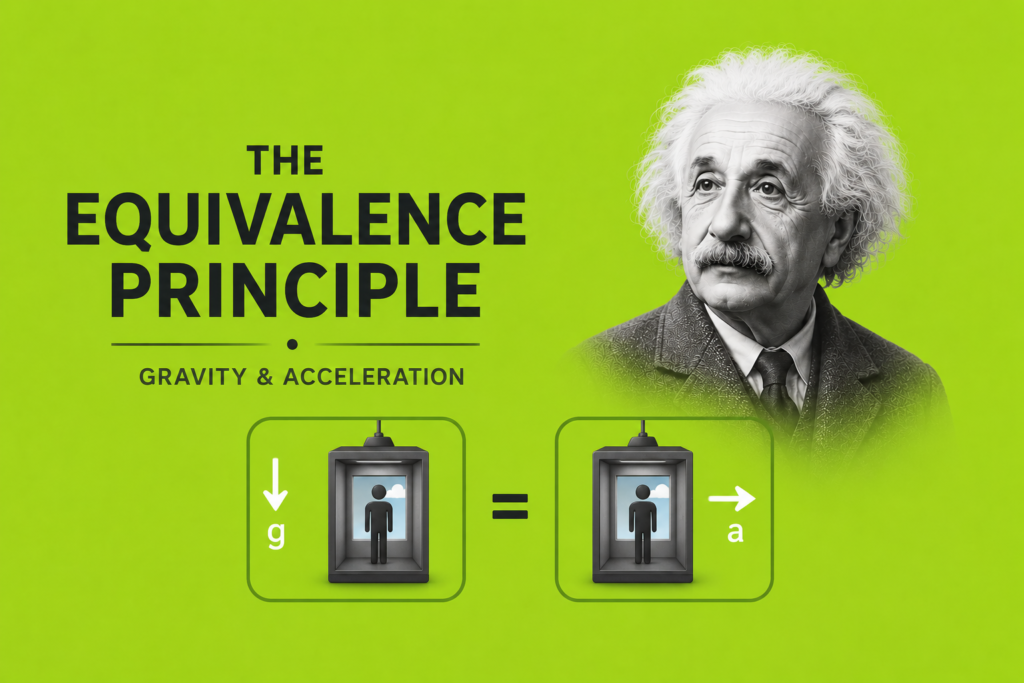
To understand the equivalence principle explained clearly, consider the famous elevator thought experiment Einstein used to illustrate his idea. Imagine you are standing inside a sealed elevator with no windows, completely unable to see outside. If the elevator sits stationary on Earth’s surface, you feel your normal weight, pressing down against the floor due to Earth’s gravitational pull.
Now imagine instead that this same elevator is floating in deep space, far from any planet or star, but being pulled upward by a rope at a uniform acceleration field exactly matching Earth’s gravitational acceleration. Remarkably, you would feel completely identical sensations in both scenarios. There is no experiment you could perform inside the sealed elevator capable of distinguishing between genuine gravity and simple acceleration.
The Free Falling Elevator Scenario
The equivalence principle explained becomes even more striking when considering the opposite scenario. Imagine instead that your elevator’s cable snaps, sending you into free fall toward the ground. Inside this free falling elevator, you would suddenly feel completely weightless, just as an astronaut experiences aboard the International Space Station.
This closed elevator thought experiment reveals something profound. Free fall and the complete absence of gravity produce identical physical sensations. According to the local inertial frame you occupy while falling, gravity has essentially disappeared entirely, replaced by the sensation of floating freely, exactly matching the universality of free fall regardless of an object’s mass or composition.
Weak Equivalence Principle: Inertial Mass Equals Gravitational Mass
The foundational version of this idea, known as the weak equivalence principle, addresses a curious coincidence that had puzzled physicists since Newton’s time. Physics distinguishes between inertial mass m_i, which measures an object’s resistance to acceleration, and gravitational mass m_g, which measures how strongly gravity affects that object.
Remarkably, extensive experimental testing, including the historically significant Eötvös experiment conducted decades before Einstein’s work, confirmed that m_i equals m_g with extraordinary precision. This gravitational mass equality seemed like a strange coincidence within Newtonian physics, yet Einstein recognized it as a profound clue pointing toward something deeper about the fundamental nature of gravity itself.
Strong Equivalence Principle: Extending the Insight
Beyond the weak equivalence principle, Einstein developed what became known as the strong equivalence principle, extending this idea beyond simple mechanical experiments to include all physical laws, including electromagnetism and light propagation itself. This stronger version proposes that within any sufficiently small region of spacetime, called locally flat spacetime or spacetime locally Minkowskian, the effects of gravity become indistinguishable from acceleration for absolutely any physical experiment imaginable, not merely mechanical ones.
This extension proved crucial for developing general relativity explained, since it suggested that light itself should bend within a gravitational field, exactly as it would appear to bend when observed from an accelerating reference frame.
Light Bending Inside the Elevator
One particularly elegant consequence of the equivalence principle explained involves light path bending in elevator scenarios. Imagine a beam of light entering one side of an accelerating elevator in deep space. Because the elevator is accelerating upward, the light beam would appear to follow a slightly curved path relative to the elevator’s frame, simply due to the elevator’s own motion during the time light takes to cross it.
According to the equivalence principle, this exact same curved light path should occur within a genuine gravitational field of equivalent strength, predicting that gravity itself should bend the path of light, a genuinely radical idea within physics at the time. This prediction was later spectacularly confirmed through the famous 1919 eclipse observations, providing dramatic experimental validation for Einstein’s theoretical insight.
Mathematical Foundation: Connecting Acceleration and Curvature
The mathematical language behind the equivalence principle explained eventually led Einstein toward describing gravity is curved spacetime, rather than a traditional force. Within any local inertial frame, physics equations describing acceleration and physics equations describing gravity become mathematically identical, expressed through Einstein’s later field equations relating spacetime curvature directly to mass and energy distribution:
G_μν = 8πG/c⁴ × T_μν
Here, G_μν represents spacetime curvature, T_μν represents mass and energy distribution, G is the gravitational constant, and c is the speed of light constant. This elegant mathematical relationship traces its conceptual origin directly back to Einstein’s original equivalence principle insight from 1907.
Gravitational Redshift: Another Consequence
The equivalence principle explained also predicts gravitational redshift derivation, the phenomenon where light loses energy while escaping a strong gravitational field, shifting toward longer, redder wavelengths. This effect connects directly to time dilation explained, since equivalent acceleration effects predict that time itself should pass differently depending on gravitational strength, a prediction later confirmed through precise atomic clock experiments conducted at varying altitudes.
From Thought Experiment to Black Holes
The equivalence principle explained ultimately provided the essential conceptual foundation enabling Einstein to develop his complete theory describing extreme gravitational phenomena, including research into einstein and black holes physics. Near these extraordinarily dense objects, the weak field limit assumptions used in everyday physics break down entirely, yet the fundamental equivalence between gravity and acceleration remains mathematically consistent even under these extreme conditions.
Why the Equivalence Principle Still Matters
Beyond pure theoretical physics, the equivalence principle explained continues serving as the fundamental basis of general relativity, underlying modern gravitational wave detection, precise satellite positioning systems, and ongoing astrophysics research exploring extreme gravitational environments throughout the universe. The Albert Einstein legacy surrounding this single, elegant thought experiment demonstrates how a simple mental exercise, imagining a falling elevator, could ultimately reshape humanity’s entire understanding of gravity itself.
Frequently Asked Questions
What is the equivalence principle explained simply?
The equivalence principle states that gravity and acceleration produce physically identical effects, meaning there is no experiment capable of distinguishing between genuine gravity and equivalent acceleration within a sealed environment.
What is the difference between weak and strong equivalence principle?
The weak equivalence principle addresses the equality between inertial and gravitational mass, while the strong equivalence principle extends this idea to include all physical laws, including light and electromagnetism.
How did Einstein discover the equivalence principle?
Einstein developed this insight in 1907 through a thought experiment imagining a person falling freely inside an elevator, realizing they would feel completely weightless, identical to floating in gravity-free space.
Why is the equivalence principle important for general relativity?
This principle provided the essential conceptual foundation allowing Einstein to develop general relativity, connecting gravity directly to spacetime curvature rather than treating it as a traditional force.
How was the equivalence principle experimentally confirmed?
The 1919 eclipse observations confirmed predictions that gravity bends light, exactly as the equivalence principle suggested, providing dramatic experimental validation for Einstein’s theoretical insight.
Conclusion
The equivalence principle explained stands as one of the most elegant and foundational insights in the history of physics, born from a simple thought experiment about falling elevators that Einstein once called the happiest thought of his life. This single idea, connecting gravity and acceleration into a unified concept, ultimately provided the essential foundation for general relativity, reshaping humanity’s understanding of gravity, light, and spacetime itself. More than a century later, this remarkably simple insight continues underlying modern astrophysics research, proving that sometimes the most profound scientific revolutions begin with nothing more than a carefully imagined thought experiment.