What is the shape of the universe? Is it flat like a sheet of paper, curved like a sphere, or warped like a saddle? For thousands of years, humans assumed space was flat. Euclid’s geometry, the geometry you learned in high school, seemed to be the absolute truth. But in the 1820s, a German mathematician made a shocking discovery. He proved that curvature is not an illusion imposed from outside. It is an intrinsic property that can be measured from within. His name was carl friedrich gauss, the prince of mathematics, and his idea was gaussian curvature. This single concept, born from mapping the Earth, would lie dormant for nearly a century. Then a young physicist named Albert Einstein picked it up and used it to rewrite the laws of gravity. This is the story of how gaussian curvature went from a mathematical curiosity to the foundation of modern cosmology.
The Problem of Curved Surfaces
Imagine you are a flat ant living on the surface of a wrinkled leaf. Can you tell the leaf is wrinkled just by walking on it? If the leaf is crumpled, you might feel that the paths curve. But if the leaf is simply bent without stretching (like rolling a flat paper into a cylinder), the ant might not notice any difference. Gauss asked a profound question: what properties of a curved surface can be measured by an inhabitant who cannot leave the surface? This is the problem of intrinsic curvature. Before Gauss, mathematicians thought about curves as objects embedded in a higher dimensional space. A sphere curves because it sits inside three dimensional space. But Gauss realized that the sphere has its own internal geometry. The angles of a triangle on a sphere add up to more than 180 degrees. The circumference of a circle is less than times its radius. These are intrinsic measurements. The concept of gaussian curvature captures this intrinsic geometry.
The Remarkable Theorem
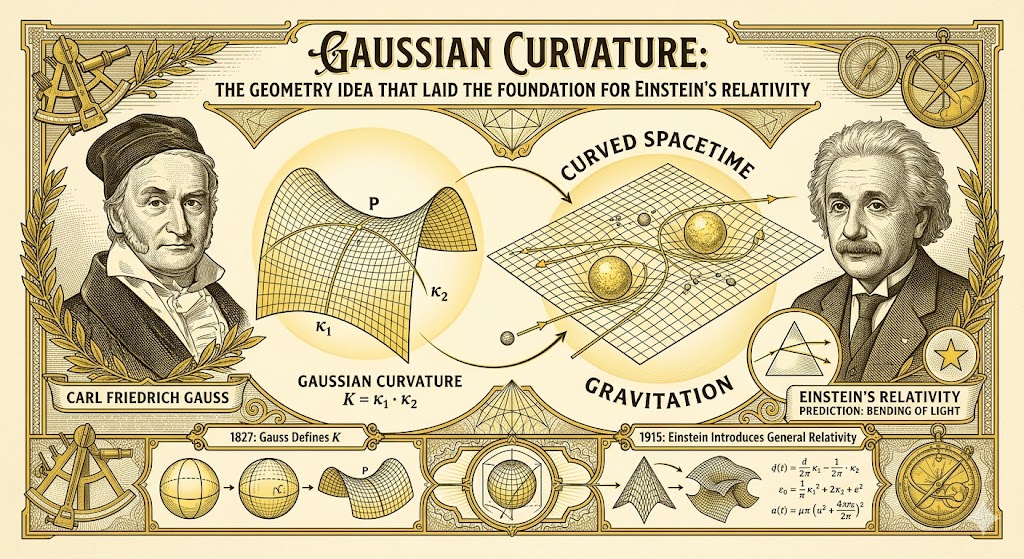
In 1827, Gauss published his masterpiece on curved surfaces, Disquisitiones Generales Circa Superficies Curvas (General Investigations of Curved Surfaces). In it, he proved the Theorema Egregium, Latin for “Remarkable Theorem.” The theorem states that gaussian curvature depends only on measurements made within the surface. It does not depend on how the surface is embedded in space. This was a revolutionary idea. To calculate gaussian curvature, denoted , Gauss showed that you need only the metric of the surface (the rule for measuring distances). For a surface parameterized by coordinates and , the gaussian curvature is given by:
Here, are the coefficients of the first fundamental form (which measures distances), and are the coefficients of the second fundamental form (which measures curvature). The fraction is entirely determined by the intrinsic geometry. Gauss was so proud of this result that he called it “remarkable.” For the first time, mathematicians understood that curvature is not a ghost; it is a real, measurable property of the surface itself.
Positive, Negative, and Zero Curvature
What does gaussian curvature actually tell us about a surface? The value of can be positive, negative, or zero. If , the surface is locally like a sphere. At a point on a sphere, any direction you move curves downward. A classic example is the top of a mountain. If , the surface is flat, like a sheet of paper or a cylinder (a cylinder is curved in one direction but flat in the other, so the product of the two curvatures is zero). If , the surface is a saddle shape. At a saddle point, the surface curves upward in one direction and downward in another. Think of a Pringles potato chip. This classification of curved manifolds into positive, negative, and zero curvature is fundamental to Riemannian geometry. It also has profound implications for spacetime geometry because Einstein would later show that gravity is the curvature of spacetime.
From Geodesy to Geometry
The birth of gaussian curvature was not an abstract exercise. It came directly from gauss geodesy, his massive survey of the Kingdom of Hanover. While measuring triangles across mountains and valleys, Gauss needed to account for the Earth’s curvature. He realized that the geometry of the Earth’s surface is not Euclidean. The sum of the angles of a large triangle is slightly more than 180 degrees because the Earth is a sphere. The spherical excess (the amount over 180 degrees) is directly related to the area of the triangle and the gaussian curvature of the sphere. For a sphere of radius , the gaussian curvature is constant and equal to . For the Earth, is about 6371 kilometers, so is very small. This is why we do not notice the curvature in daily life. But for Gauss, this small curvature was a mathematical reality. His work on gauss geodesy forced him to develop the mathematics of gaussian curvature. Practical surveying gave birth to abstract geometry.
The Genius Student: Bernhard Riemann
Gauss did not keep his ideas to himself. He shared them with his brilliant student, Bernhard Riemann. In 1854, Riemann gave a lecture titled “On the Hypotheses Which Lie at the Foundations of Geometry.” Gauss was in the audience, reportedly mesmerized. Riemann generalized Gauss’s work from two dimensional surfaces to any number of dimensions. He introduced the concept of a manifold, a space that looks flat locally but may be curved globally. He defined the metric tensor, which tells you how to measure distances in a curved space. Riemann also introduced the concept of Riemannian curvature, a generalization of gaussian curvature to higher dimensions. This work laid the foundation for tensor calculus, the mathematical language Einstein would need for general relativity. Riemann died young in 1866, but his ideas lived on. When Einstein searched for a mathematical framework for gravity, he turned to Riemann’s geometry. And Riemann had learned it from gaussian curvature.
The Mathematics of Curved Surfaces
Let us go deeper into the mathematics of gaussian curvature. For a surface defined by a function , the gaussian curvature can be calculated using partial derivatives. If the surface is very flat, the formula simplifies. For a sphere of radius , the gaussian curvature is constant: . For a cylinder of radius , one principal curvature is (around the circle) and the other is (along the length), so . For a saddle surface like , the two principal curvatures have opposite signs, producing negative gaussian curvature. The importance of gaussian curvature in differential geometry cannot be overstated. It is the simplest complete measure of curvature for two dimensional surfaces. In higher dimensions, the Riemann curvature tensor is more complex, but it is built on the same foundational ideas. Every student of manifold theory and geometric topology learns gaussian curvature as their first example.
Einstein and the Curvature of Spacetime
Now we come to the most dramatic part of the story. In 1907, Albert Einstein had a beautiful idea: a person falling off a roof feels weightless. This led him to the equivalence principle: gravity and acceleration are locally indistinguishable. Over the next eight years, Einstein struggled to turn this insight into a mathematical theory. He realized that gravity is not a force pulling objects through space. Instead, massive objects like the Sun warp or curve the fabric of spacetime itself. Planets follow the straightest possible paths (called geodesics) in this curved spacetime. But what geometry describes curved spacetime? Einstein needed a mathematical framework that could handle four dimensions (three of space, one of time) and variable curvature. He found it in Riemannian geometry, the direct descendant of gaussian curvature. In 1915, Einstein published his field equations:
On the left side, is the Einstein tensor, which describes the curvature of spacetime. It is built from the Riemann curvature tensor, which is a higher dimensional generalization of gaussian curvature. On the right side, is the stress energy tensor, which describes the distribution of matter and energy. The equation says: curvature equals mass and energy. Gauss’s idea about the curvature of a two dimensional surface had become the law of the entire universe.
Testing General Relativity
If gaussian curvature and its generalization were correct, Einstein’s theory made bold predictions. Light should bend when passing near a massive object. The orbit of Mercury should slowly rotate (precess) in a way that Newton’s gravity could not explain. Clocks should run slower in stronger gravity. In 1919, a British expedition led by Arthur Eddington observed a solar eclipse. They measured the positions of stars near the Sun. The light from those stars was bent by the Sun’s gravity exactly as Einstein predicted. The news made Einstein a global celebrity. Gravitational lensing, the bending of light by gravity, is now a standard tool in astronomy. It is used to detect dark matter and to see the most distant galaxies. All of this traces back to the mathematical foundations laid by gaussian curvature. Without Gauss and Riemann, Einstein would have had no language to describe his revolutionary vision.
Gaussian Curvature in Modern Science
Today, gaussian curvature appears in fields far beyond pure mathematics and physics. In biology, the shapes of cell membranes and viruses are studied using gaussian curvature. In materials science, the stiffness of curved sheets depends on their gaussian curvature. In computer graphics, algorithms for rendering smooth surfaces rely on curvature calculations. In cosmology, the shape of the entire universe is described by its gaussian curvature (on large scales). Observations suggest the universe is remarkably flat, with very close to zero. But tiny deviations from flatness would tell us about the earliest moments after the Big Bang. The prince of mathematics could not have imagined that his abstract idea about curved surfaces would one day be used to map the cosmos.
Frequently Asked Questions (FAQs)
What is Gaussian curvature in simple terms?
Gaussian curvature is a number that describes how a surface bends at any given point. If the surface curves like a sphere (curving the same way in all directions), the gaussian curvature is positive. If it curves like a saddle (curving up in one direction and down in another), the curvature is negative. If it is flat like a sheet of paper, the curvature is zero. It is called “Gaussian” because carl friedrich gauss discovered that this curvature can be measured from within the surface without looking at the surrounding space.
What is the Theorema Egregium?
The Theorema Egregium (Latin for “Remarkable Theorem”) is Gauss’s proof that gaussian curvature is an intrinsic curvature property. This means that the curvature can be calculated solely from distances measured within the surface. You do not need to see how the surface sits in space. This was a revolutionary idea because it implies that curved surfaces have their own internal geometry. The Theorema Egregium is the most important result in gauss geodesy and differential geometry.
How did Gaussian curvature lead to Einstein’s relativity?
Einstein needed a mathematical language to describe how matter and energy warp spacetime. He found that language in Riemannian geometry, which generalizes gaussian curvature to higher dimensions. In general relativity, the presence of mass and energy causes spacetime to curve. The amount of curvature is given by the Einstein field equations. The Riemann curvature tensor, a higher dimensional version of gaussian curvature, describes how the paths of light and particles are bent by gravity.
What is the difference between positive and negative Gaussian curvature?
Positive gaussian curvature means the surface curves like a sphere. Triangles on a positively curved surface have angles that sum to more than 180 degrees, and parallel lines eventually meet. Negative gaussian curvature means the surface curves like a saddle. Triangles on a negatively curved surface have angles that sum to less than 180 degrees, and parallel lines diverge. The flat geometry you learned in school (Euclidean geometry) has zero gaussian curvature.
Why is Gaussian curvature important in modern science?
Gaussian curvature is important because it is the simplest example of intrinsic curvature, the idea that space can be curved without being embedded in a higher dimensional space. This concept is essential to general relativity, cosmology, Riemannian geometry, and manifold theory. It also appears in biology (cell membranes), materials science (buckling of sheets), and computer graphics (smooth surface rendering). It is one of the most influential ideas in the history of mathematics.
Conclusion
The journey from a German surveyor measuring mountains to an astronaut orbiting Earth is a journey through gaussian curvature. Carl friedrich gauss, the prince of mathematics, discovered that curvature is not a decoration added from outside. It is a deep, intrinsic property of space itself. His Theorema Egregium proved that ants living on a curved surface can discover their own curvature without ever looking up. A century later, Albert Einstein used that same insight to revolutionize physics. Gravity is not a mysterious force. It is the gaussian curvature of spacetime. From the gauss normal distribution in statistics to the gauss-weber telegraph in communication, Gauss’s fingerprints are everywhere. But gaussian curvature stands above them all as his most profound contribution to our understanding of reality. In many ways, how ancient greek scientists changed modern science by proving the Earth was round, Carl Friedrich Gauss gave us the mathematics to prove that space itself can bend. Every time you see a photograph of a distant galaxy bent by gravitational lensing, you are seeing the ghost of Gauss. The universe is curved, and the prince of mathematics showed us how to measure it.