Before smartphones, before radio, before the internet, there was a wire. A single copper wire stretched between two buildings in a small German university town. In 1833, that wire carried the first meaningful electromagnetic signals in history. The men behind this revolutionary device were the prince of mathematics, carl friedrich gauss, and his brilliant young collaborator, Wilhelm Weber. Together, they built the gauss-weber telegraph, a machine that could send messages over a kilometer using the invisible power of magnetism. This was not a laboratory curiosity. It was a working communication system, used daily for scientific coordination. It was the direct ancestor of every telephone, every email, and every text message ever sent. This is the electrifying story of the gauss-weber telegraph and how two German scientists launched the telecommunications history revolution.
The Magnetic Partnership
To understand the gauss-weber telegraph, you must first understand the extraordinary partnership that created it. In 1831, the young physicist Wilhelm Weber arrived at the University of Göttingen. He was 27 years old, energetic, and a master of experimental physics. Gauss was 54, famous, and arguably the greatest mathematician alive. Together, they formed a perfect team. Gauss provided the mathematical theory and the grand vision. Weber built the instruments and performed the experiments. Their first project was measuring the Earth’s magnetic field. They established a Magnetic Observatory, free from all iron and steel, where they could make precise measurements. This work on gauss electromagnetism laid the foundation for their greatest practical achievement: the gauss-weber telegraph. The partnership was so productive that Gauss later said, “Weber and I are one soul in two bodies.”
The Need for Instant Communication
Why did Gauss and Weber need a telegraph? They were conducting simultaneous measurements of the Earth’s magnetic field from different locations. Gauss was at the Magnetic Observatory, watching a magnetometer. Weber was in the physics laboratory, about one kilometer away. They needed to coordinate their observations to the exact same moment. If Gauss saw a sudden fluctuation, he wanted Weber to note the same fluctuation at the same time. Shouting was impossible over a kilometer. Running back and forth was inefficient. They needed a way to send a signal instantly. This practical problem drove the invention of the gauss-weber telegraph. Gauss, who had already revolutionized gauss and ceres orbit determination and gauss geodesy, now turned his mathematical mind to the problem of sending electric signals through wires.
How the Telegraph Worked
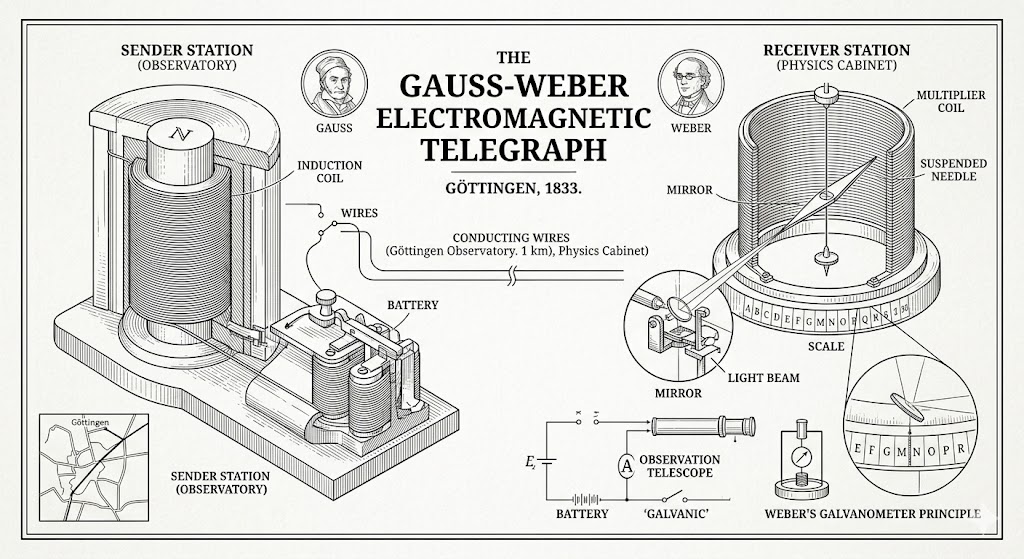
The gauss-weber telegraph was elegantly simple. Gauss and Weber strung a two wire cable between the Magnetic Observatory and the physics laboratory, a distance of about 1.5 kilometers. They used a battery to generate an electric current. At the sending end, they had a switch (a “key”) that could reverse the direction of the current. At the receiving end, they had a galvanometer: a device with a magnetic needle that deflected left or right depending on the direction of the current. The galvanometer was essentially a sensitive current detector. When Gauss pressed the key one way, the needle at Weber’s end swung left. When Gauss pressed the key the other way, the needle swung right. By assigning a code to these deflections (left for “dot,” right for “dash”), they could send any message. This binary system (two states) was a direct precursor to modern digital communication.
The Mathematics Deflection
The physics behind the gauss-weber telegraph is described by the Lorentz force law, which relates electric currents to magnetic fields. When an electric current Iflows through a wire of length in a magnetic field , the force on the wire is:
In the galvanometer, the current flows through a coil. The coil creates a magnetic field that interacts with the permanent magnet of the needle. The torque (twisting force) on the needle is proportional to the current. By carefully calibrating the galvanometer, Gauss and Weber could measure the strength of the current. But for the telegraph, they only needed direction. Left meant one signal, right meant the other. The simplicity of this design was its genius. It required no complex decoding. Any observer could read the needle. The gauss-weber telegraph was the first device to convert electromagnetic induction into practical, long distance communication.
The Code They Used
The gauss-weber telegraph used a binary code, but it was not Morse code. Samuel Morse would not invent his famous code until the 1840s. Gauss and Weber developed their own telegraphic code. They assigned sequences of left and right deflections to letters of the alphabet. For example, a single left deflection might mean “A,” a single right deflection “B,” left left “C,” and so on. They also had special signals for “start,” “stop,” and “repeat.” With this code, they could send entire sentences. The first messages sent on the gauss-weber telegraph were simple: “Start measuring,” “Stop,” “Record now.” But the principle was proven. Electricity could carry meaning. The telegraphic code of Gauss and Weber was a direct ancestor of all digital encoding systems, from ASCII to Unicode.
Daily Use and Scientific Impact
From 1833 to 1836, the gauss-weber telegraph was used regularly for scientific coordination. Every day, Gauss and Weber would synchronize their magnetic measurements. When Gauss saw a “magnetic storm” (a sudden fluctuation in the Earth’s field), he would tap out a signal. Weber would note the exact time in his log. This allowed them to correlate magnetic disturbances across the two locations. They discovered that magnetic fluctuations were not local; they occurred simultaneously over large areas. This was early evidence of what we now call “space weather.” The gauss-weber telegraph was not just a communication tool; it was a scientific instrument that enabled new discoveries about the Earth’s magnetic field. The Göttingen experiments became famous across Europe. Visitors came to see the miraculous device that sent messages without visible wires.
Why It Was Not Commercialized
Given the brilliance of the gauss-weber telegraph, why did it not become a commercial product? Why do we credit Samuel Morse and not Gauss with the telegraph revolution? There are several reasons. First, Gauss was a pure scientist, not an entrepreneur. He had no interest in patents or profits. Second, the range of their telegraph was limited to about 1.5 kilometers. To send messages across a country, you need stronger currents and signal amplifiers (relays). Gauss and Weber did not develop those. Third, Gauss was already famous and busy with other work: gauss number theory, gauss geodesy, and gauss normal distribution. He saw the telegraph as a tool for his magnetic research, not as a product to sell. Finally, in 1837, Weber was dismissed from the university for political reasons (he was one of the “Göttingen Seven” who protested the king’s abolition of the constitution). The partnership ended. The gauss-weber telegraph was dismantled. The world had to wait for Morse.
The Connection to Modern Communication
Despite its limited range, the gauss-weber telegraph was the first working system that used electromagnetic signals for long distance communication. Every principle they demonstrated is still used today. The binary code (two states) is the foundation of digital computing. The conversion of electric current into a magnetic deflection is the principle behind every ammeter and voltmeter. The idea of a sender, a transmission line, and a receiver is the architecture of the entire internet. When you send a text message, your phone converts your words into binary (0s and 1s), transmits those bits as electrical signals, and a receiver converts them back. The gauss-weber telegraph did exactly the same thing, just more slowly and over a shorter distance. Gauss, the prince of mathematics, had invented not just a telegraph but a paradigm.
Gauss’s Other Communication Legacy
The gauss-weber telegraph was not Gauss’s only contribution to communication. His gauss normal distribution is used today to model noise in communication channels. His gauss fast fourier transform is used to compress and decompress audio and video signals. His work on gaussian curvature and gauss non euclidean geometry informs the mathematics of signal processing on curved spaces (like satellites orbiting a curved Earth). His method of least squares is used to filter noise out of received signals. Even his early work as a gauss child prodigy trained his mind to see patterns in data. For Gauss, communication was just another application of mathematics. The gauss-weber telegraph was the first step on a long road that leads to your smartphone.
The Forgotten Pioneer
Why is the gauss-weber telegraph not as famous as Morse’s telegraph? History often rewards the person who brings an invention to market, not the person who first invents it. Morse’s telegraph had longer range, better code, and aggressive commercialization. But the priority of invention belongs to Gauss and Weber. In 1833, they were sending messages. Morse built his first working telegraph in 1835. Gauss and Weber were first. Some historians argue that the gauss-weber telegraph should be recognized as the true first electric telegraph. Others point to earlier, cruder experiments. What is beyond dispute is that Gauss and Weber built the first system that was practical, reliable, and used daily for real work. The prince of mathematics was also a pioneer of the information age.
Frequently Asked Questions (FAQs)
What was the Gauss Weber telegraph?
The gauss-weber telegraph was the first functional electromagnetic telegraph, built in 1833 by carl friedrich gauss and Wilhelm Weber in Göttingen, Germany. It used a copper wire stretched about 1.5 kilometers between the Magnetic Observatory and the physics laboratory. A battery sent an electric current that deflected a galvanometer needle left or right. By assigning a binary code to these deflections, they sent messages. It was a working communication system used daily for scientific coordination.
How did the Gauss Weber telegraph work?
The gauss-weber telegraph worked by converting electric current into magnetic motion. At the sending end, a switch (key) controlled the direction of the current. At the receiving end, a galvanometer contained a magnetic needle. When current flowed one way, the needle swung left. When current flowed the opposite way, the needle swung right. By using a binary code (left for “dot,” right for “dash”), Gauss and Weber encoded letters and words. This is the same principle used in all digital communication.
Did Gauss invent the telegraph before Morse?
Yes. The gauss-weber telegraph was built in 1833 and used regularly from 1833 to 1836. Samuel Morse built his first working telegraph in 1835 and filed his patent in 1837. However, Morse’s system was more practical for long distances because he developed signal relays (repeaters). Gauss and Weber’s system was limited to about 1.5 kilometers. While Gauss and Weber were first, Morse commercialized the technology and made it world changing.
Why is the Gauss Weber telegraph not more famous?
There are several reasons. First, Gauss was a pure mathematician, not an entrepreneur. He did not patent or commercialize his invention. Second, the gauss-weber telegraph was dismantled in 1837 when Weber was dismissed from the university for political reasons. Third, Gauss himself did not promote his priority. He was more interested in gauss number theory, gauss geodesy, and gauss electromagnetism than in telegraphy. As a result, history often credits Morse, who aggressively marketed his invention.
What is the legacy of the Gauss Weber telegraph?
The legacy of the gauss-weber telegraph is enormous. It proved that electromagnetic signals could be used for long distance communication. It established the binary code principle that underlies all digital computing. It inspired later inventors, including Samuel Morse. And it demonstrated the power of interdisciplinary collaboration between mathematics (Gauss) and experimental physics (Weber). Every text message, email, and phone call is a descendant of the gauss-weber telegraph.
Conclusion
The gauss-weber telegraph was a quiet revolution. It did not make headlines. It did not make anyone rich. But it changed the world. A mathematician who had already conquered gauss and ceres, gauss number theory, and gauss geodesy teamed up with a physicist to master gauss electromagnetism. Together, they built the first device that could send meaningful messages using the invisible force of electricity. The prince of mathematics was also a prince of communication. The gauss-weber telegraph was the first step on a journey that leads to the internet, to social media, to the global village. In many ways, how ancient greek scientists changed modern science by inventing the first mechanical computers (the Antikythera mechanism) and the first theories of light, Gauss and Weber completed that journey by harnessing electricity to send thought across a wire. The next time you send a text message, pause for a moment. Remember the two men in Göttingen, the copper wire, and the swinging needle. Remember the gauss-weber telegraph. The information age began with them.