Every time you use a compass, an electric motor, or an MRI machine, you are touching the legacy of a quiet German genius. His name is carl friedrich gauss, and he did not just master numbers; he tamed invisible forces. Most people know him as the prince of mathematics, but in the 1830s, he turned his fierce intellect toward a mysterious phenomenon: magnetism. At that time, electricity and magnetism were party tricks. Scientists could make frogs’ legs twitch or needles spin, but no one had a unified theory. Gauss changed everything. He created the first absolute measurements of magnetic field strength, invented a unit of measurement that still bears his name, and built the world’s first working telegraph with his partner Wilhelm Weber. This is the electrifying story of gauss electromagnetism, the hidden force behind modern technology.
The Mystery of Magnetism in the 19th Century
Before Gauss entered the field, magnetism laws were a mess. Scientists knew that magnets had north and south poles. They knew that the Earth itself was a giant magnet. But they could not measure magnetic field strength with any precision. Different laboratories used different rules, different instruments, and different units. One scientist’s “strong magnet” was another scientist’s “weak magnet.” Physics needed a standard. It needed absolute measurements based on fundamental units of mass, length, and time. This was the challenge that gauss electromagnetism would solve. Gauss realized that the same mathematical rigor he applied to gauss number theory and gauss geodesy could be applied to invisible fields. He would not just describe magnetism; he would quantify it with the precision of a master surveyor.
The Gauss Weber Partnership
No story of gauss electromagnetism is complete without Wilhelm Weber. In 1831, Gauss met the young physicist Weber, who had just proven that sound waves travel through solids at predictable speeds. Gauss was 54 years old, famous, and often intimidating. Weber was 27, energetic, and experimental. They formed one of the most productive collaborations in scientific history. Gauss provided the mathematical theory; Weber built the instruments. Together, they transformed the University of Göttingen into the world capital of electromagnetism history. They established the Magnetic Observatory, a laboratory free from iron and steel, where they could measure the Earth’s magnetic field without interference. Gauss designed the theoretical framework. Weber built the fluxmeter and other surveying instruments to test the theory. Their friendship and collaboration lasted until Weber was dismissed for political reasons in 1837. But in those six short years, they changed physics forever.
Measuring the Invisible: The Gauss Unit
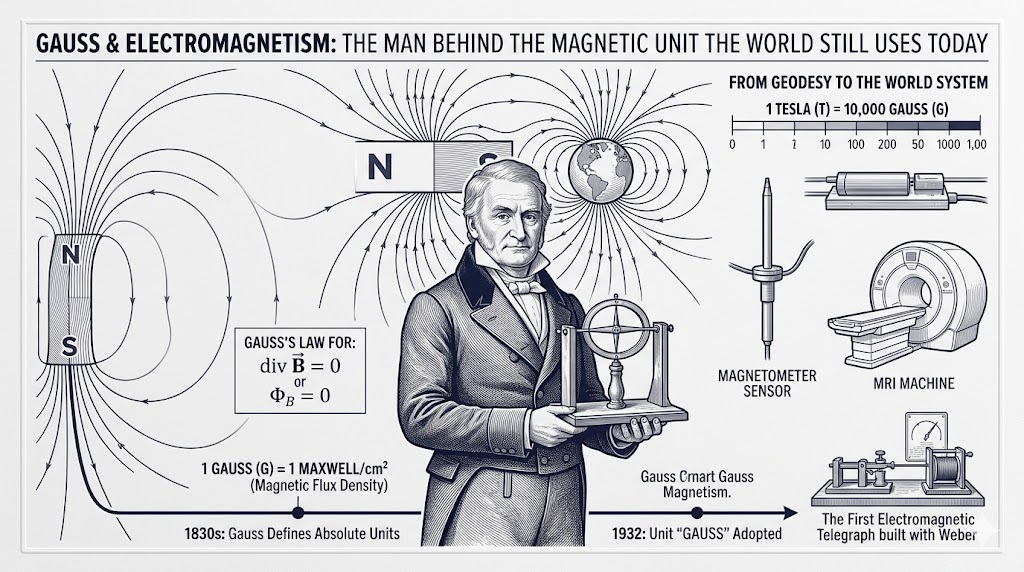
The most important achievement of gauss electromagnetism was the creation of an absolute system of measurement for magnetic field strength. Before Gauss, you might say a magnet was “strong” or “weak.” After Gauss, you could say it was exactly 100 Gauss units. Gauss defined the unit now called the Gauss unit (G) based on the fundamental mechanical units of mass (gram), length (centimeter), and time (second). This was the birth of the CGS system (centimeter gram second). One Gauss is defined as one Maxwell (the unit of magnetic flux) per square centimeter. More intuitively, the Earth’s magnetic field at the surface is about 0.5 Gauss. A typical refrigerator magnet is about 50 Gauss. An MRI machine generates up to 30,000 Gauss (or 3 Tesla, since 1 Tesla = 10,000 Gauss). The Gauss unit (G) is still used today, especially in geology and engineering. When you read about Tesla vs Gauss in physics textbooks, you are reading a direct descendant of gauss electromagnetism.
The Mathematical Description of Magnetic Fields
Gauss brought mathematical rigor to magnetic field strength by describing it using vector fields. A vector field assigns a direction and a magnitude to every point in space. For a magnetic field, the direction is the direction a compass needle points, and the magnitude is the strength of the push. Gauss proved that magnetic fields have no sources or sinks (no magnetic monopoles, meaning you cannot isolate a north pole from a south pole). In mathematical language, this means the divergence of the magnetic field is zero:
Furthermore, Gauss studied the magnetic induction around currents and dipoles. He derived that the magnetic dipole moment of a current loop is the product of the current and the area of the loop: . These equations were later incorporated into Maxwell’s equations, the four equations that describe all of classical electromagnetism. James Clerk Maxwell himself acknowledged that his work rested on the foundations laid by gauss electromagnetism. Without Gauss’s insistence on absolute measurement and vector mathematics, Maxwell might never have unified electricity and magnetism.
The First Electromagnetic Telegraph
While measuring the Earth’s magnetic field, Gauss and Weber had a brilliant idea. They strung a wire between the Magnetic Observatory and Weber’s physics laboratory, a distance of about one kilometer. They used a battery to send an electric current through the wire. At the receiving end, the current deflected a magnetic needle. By coding the deflections (left for one signal, right for another), they could send messages. This was the gauss-weber telegraph, built in 1833. It was the first functional electromagnetic telegraph in the world. They used it to coordinate observations. Gauss would send a signal from the observatory: “Start measuring.” Weber would start his stopwatch. This was the birth of instant long distance communication. Although Samuel Morse later built a more practical commercial system, the principle was identical to gauss electromagnetism. Every text message, email, and phone call today traces its lineage back to that wire in Göttingen.
The Mathematics of the Telegraph
How did the gauss-weber telegraph work mathematically? The key equation is the Lorentz force law, which describes the force on a charged particle moving in a magnetic field. For a wire carrying a current I in a magnetic field B, the force on the wire is:
Here, is the length of the wire in the field, and is the angle between the wire and the field. Gauss and Weber did not have this equation in its final form (that came later with Lorentz), but they understood the principle. The current from the battery created a magnetic field around the wire. That field interacted with the magnet at the receiving end, causing it to twist. By controlling the direction of the current (using a switch), they controlled the direction of the twist. Left twist meant “dot,” right twist meant “dash.” This binary code was the ancestor of Morse code and, ultimately, of digital computing. The gauss-weber telegraph proved that gauss electromagnetism had practical, world changing applications.
The Magnetic Observatory and Global Science
Gauss’s work on magnetic field strength was not just theoretical. He wanted to understand the Earth’s magnetism as a global phenomenon. He established the Magnetic Observatory in Göttingen, a building free of all ferromagnetic metals (even the nails were brass). Inside, he placed a magnetometer, a device that continuously recorded the direction and strength of the Earth’s magnetic field. He then organized the “Göttingen Magnetic Union,” a network of observatories around the world that used identical instruments and standardized protocols. For the first time in history, scientists could compare magnetic induction measurements from London to Saint Petersburg to Washington. This global collaboration revealed that the Earth’s magnetic field fluctuates daily and is periodically disturbed by solar activity (auroras). This was the birth of space weather science. Gauss electromagnetism had gone global.
The Connection to Gauss’s Other Genius
The story of gauss electromagnetism is deeply connected to every other aspect of Gauss’s work. His method of least squares was essential for processing the noisy data from the magnetometer. His gauss normal distribution described the random errors in magnetic measurements. His gauss and ceres orbit determination gave him the confidence to tackle complex inverse problems (deducing the Earth’s interior from surface measurements). His gauss geodesy taught him how to measure the shape of large objects (like the Earth) from a distance. And his secret gauss non euclidean geometry informed his understanding of curved magnetic field lines. The prince of mathematics did not have separate compartments for different sciences. He saw one unified universe governed by mathematical laws. Gauss electromagnetism was just one expression of his lifelong quest to read the mind of God through numbers.
The Legacy of the Gauss Unit Today
Although the SI unit of magnetic field strength is the Tesla (named after Nikola Tesla), the Gauss unit (G) remains widely used. Geologists measure the strength of ancient magnetic fields trapped in rocks using Gauss. Engineers designing small motors and speakers often use Gauss because the numbers are more convenient (a typical speaker magnet is 100 Gauss, which is 0.01 Tesla). Medical physicists describe the strength of MRI magnets in both Teslas and Gauss. The Earth’s magnetic field strength is about 0.5 Gauss. A magnetic induction of 1 Gauss means that one Maxwell of magnetic flux passes through one square centimeter. The Gauss unit (G) is part of the CGS system, which is still preferred in many branches of physics, especially electromagnetism history and astrophysics. When you see a “Gauss meter” or “fluxmeter” for sale, you are seeing a direct descendant of gauss electromagnetism.
Frequently Asked Questions (FAQs)
What is the Gauss unit of magnetism?
The Gauss unit (G) is the unit of magnetic field strength or magnetic induction in the CGS (centimeter gram second) system of units. One Gauss equals one Maxwell (unit of magnetic flux) per square centimeter. For comparison, the Earth’s magnetic field at the surface is approximately 0.5 Gauss, and a typical refrigerator magnet is about 50 Gauss. The SI unit of magnetic field is the Tesla, where 1 Tesla equals 10,000 Gauss.
What was the Gauss Weber telegraph?
The gauss-weber telegraph was the first functional electromagnetic telegraph, built in 1833 by carl friedrich gauss and Wilhelm Weber in Göttingen, Germany. They strung a wire about one kilometer long between the Magnetic Observatory and the physics laboratory. By sending electric currents through the wire, they deflected a magnetic needle at the receiving end, creating a binary code for communication. It was the direct predecessor of all modern electronic communication.
How did Gauss measure magnetic fields?
Gauss measured magnetic field strength using a magnetometer, a device that measures the torque (twisting force) on a suspended magnet. He developed an absolute method that linked magnetic field strength to fundamental mechanical units of mass, length, and time. He built a fluxmeter and established a Magnetic Observatory free of ferromagnetic interference. His measurements were so precise that they became the international standard.
What is the difference between Gauss and Tesla?
The Tesla vs Gauss difference is purely a matter of scale and system of units. The Tesla is the SI (International System) unit of magnetic field, named after Nikola Tesla. The Gauss is the CGS (centimeter gram second) unit, named after carl friedrich gauss. The conversion is: 1 Tesla = 10,000 Gauss. So a 1.5 Tesla MRI machine generates 15,000 Gauss. Both units are still actively used in different scientific communities.
How did Gauss contribute to Maxwell’s equations?
Gauss contributed several foundational ideas that were later incorporated into Maxwell’s equations. Most famously, Gauss’s law for magnetism states that the divergence of the magnetic field is zero (), which mathematically expresses that there are no magnetic monopoles (isolated north or south poles). Gauss also developed the mathematical language of vector fields and absolute measurements that Maxwell relied upon.
Conclusion
The story of gauss electromagnetism is a story of turning invisible forces into measurable science. Before Gauss, magnetism was a mystery wrapped in a riddle. After Gauss, it was a precise, mathematical, and engineering reality. The prince of mathematics gave us the Gauss unit (G) , the gauss-weber telegraph, and the absolute measurement of magnetic field strength. His collaboration with Wilhelm Weber set the standard for interdisciplinary science. His global Magnetic Union created the first international scientific network. From the gauss normal distribution in statistics to the gaussian curvature in relativity, Gauss’s fingerprints are everywhere. But in gauss electromagnetism, we see him at his most practical, building devices and organizing observatories to understand the very ground beneath our feet. In many ways, how ancient greek scientists changed modern science by discovering that amber rubbed with fur attracts dust (the first observation of static electricity), Carl Friedrich Gauss completed their journey by measuring those forces with absolute precision. Today, every MRI scan, every compass reading, and every text message carries a silent tribute to the man who tamed the magnetic field.