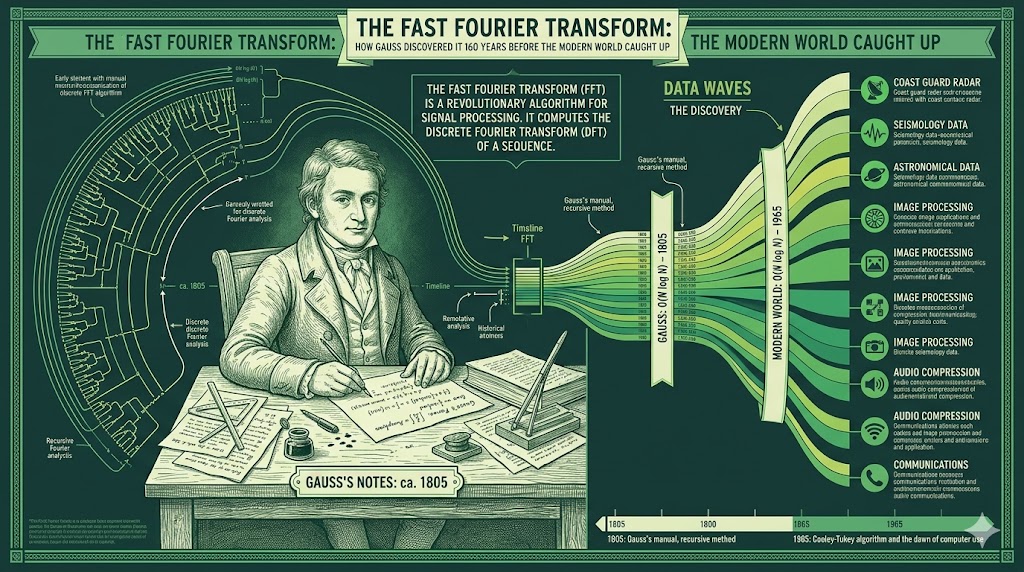
Every time you listen to an MP3, watch a Netflix movie, or take an MRI scan, you are using a mathematical algorithm that was invented in 1805. The man who wrote it down was a 28 year old German mathematician. He did not publish it. He buried it in a private notebook, where it gathered dust for over a century. When the world finally rediscovered this algorithm in 1965, it triggered a revolution in computing, communications, and science. That algorithm is the gauss fast fourier transform. It is the hidden engine of the digital age. Without it, your smartphone could not compress images, your GPS could not lock onto satellites, and astronomers could not see distant stars. This is the astonishing story of how carl friedrich gauss, the prince of mathematics, invented one of the most important algorithms of the 20th century in the 19th century. The world just was not ready for him.
What Is a Fourier Transform?
Before we can understand the gauss fast fourier transform, we must understand the ordinary Fourier transform. Named after the French mathematician Joseph Fourier, the Fourier transform is a mathematical tool that decomposes a signal (like a sound wave or an image) into its constituent frequencies. Imagine listening to a musical chord. Your ear hears one sound, but it is actually a mixture of several pure tones. The Fourier transform separates that mixture into individual notes. In mathematical terms, any periodic function can be expressed as a sum of sine and cosine waves of different frequencies. For a continuous function , the Fourier transform is given by:
But in the real world, we do not have continuous functions. We have digital samples: measurements taken at discrete times. For digital signals, we use the discrete Fourier transform (DFT), which converts a sequence of numbers into another sequence of numbers representing frequencies. The problem is that a naive calculation of the DFT requires about operations. For a signal with 1,000 samples, that is 1,000,000 multiplications. For a high definition image with millions of pixels, the calculation is impossibly slow. This is where the gauss fast fourier transform comes to the rescue.
The Problem of Slow Computation
In the early 1800s, Gauss was not thinking about digital music or JPEG images. He was thinking about astronomy. Specifically, he was studying the orbits of asteroids and the motion of celestial bodies. To predict where a planet would be, he needed to calculate the orbit from observational data. This required solving a complex problem in harmonic analysis: finding the coefficients of a trigonometric series that fit the data. The straightforward method required thousands of tedious multiplications. Gauss, as always, was looking for a shortcut. While working on gauss and ceres and his method of least squares, he realized that the standard calculation of the discrete Fourier transform was full of redundancy. He found a clever way to reuse intermediate results, dramatically reducing the number of operations.
Gauss’s 1805 Breakthrough
In 1805, Gauss wrote down his algorithm in his scientific diary. He was working on a problem involving the interpolation of asteroid orbits. He needed to compute the coefficients of a trigonometric polynomial. The standard method required operations. Gauss discovered a method that required only about operations. For , this is the difference between 1,000,000 operations and about 10,000 operations. For large N, the savings are astronomical. The algorithm complexity reduction from to is the heart of the gauss fast fourier transform. In modern notation, the FFT works by recursively breaking down a DFT of size into two DFTs of size , then combining the results using a “butterfly” structure. The recurrence relation is:
Solving this recurrence gives . This is the same principle used in every FFT library today. Gauss had discovered this principle in 1805. But he did not publish it. He scribbled it in his diary and moved on to his next obsession, gauss number theory.
The Cooley Tukey Rediscovery
For 160 years, Gauss’s algorithm sat in his unpublished papers. The world of signal processing struggled with slow DFT calculations. In 1965, two American mathematicians, James Cooley and John Tukey, published a paper titled “An Algorithm for the Machine Calculation of Complex Fourier Series.” They described a method to compute the DFT quickly using a divide and conquer strategy. This became known as the Cooley Tukey algorithm. The computational world exploded with excitement. Suddenly, tasks that took hours could be done in seconds. Digital frequency analysis became practical. When researchers later dug through Gauss’s collected works, they found the exact same algorithm, written in 1805. The gauss fast fourier transform had been hiding in plain sight for over a century and a half. Gauss was not just the prince of mathematics; he was also the grandfather of digital signal processing.
How the FFT Works Mathematically
Let us look at the mathematics behind the gauss fast fourier transform. The discrete Fourier transform (DFT) for a sequence is defined as:
If you compute each directly, you need multiplications for each of the outputs, total . The FFT exploits the fact that the exponential factors have many symmetries and periodicities. For even, you can split the sum into even indices and odd indices:
The first sum is the DFT of the even indexed points of length . The second sum is the DFT of the odd indexed points, multiplied by a “twiddle factor” . By recursively applying this splitting, the total work drops to . This recursive structure is the essence of the gauss fast fourier transform. Every time you stream a video, your device is performing millions of these recursive splits per second.
The Impact on Signal Processing
The rediscovery of the gauss fast fourier transform in 1965 transformed signal processing overnight. Before the FFT, digital spectrum analysis was painfully slow. Engineers would build analog circuits to analyze frequencies because digital computers were too slow. After the FFT, digital methods became faster, cheaper, and more accurate. The frequency analysis of digital signals could now be done in real time. This enabled digital audio recording (the CD player), digital image compression (JPEG), and digital video (MPEG). Radar systems could process return signals faster. Seismologists could analyze earthquake waves. Medical imaging, particularly MRI, relies on the FFT to reconstruct images from raw data. Without the gauss fast fourier transform, the modern world of digital media would simply not exist.
The Role in Data Compression
One of the most important applications of the gauss fast fourier transform is data compression. When you compress an image into a JPEG file, the algorithm performs an FFT (specifically, a discrete cosine transform, which is a close relative) on small blocks of the image. It then discards the high frequency components that the human eye cannot see. This reduces the file size dramatically while preserving visual quality. MP3 audio compression works the same way: transform the sound into frequencies, remove the frequencies that human ears cannot hear, and store the rest. When you stream a song on Spotify, the gauss fast fourier transform is running on your phone, decompressing the audio in real time. Every streaming service, every digital photo, and every video call depends on the speed of the FFT. The prince of mathematics gave us the ability to shrink data without losing meaning.
The FFT in Science and Engineering
Beyond consumer electronics, the gauss fast fourier transform is an indispensable tool in scientific research. Astronomers use it to analyze light from distant stars, separating the spectrum into frequencies to determine chemical composition. Physicists use it to study quantum mechanics, where wavefunctions are naturally described in frequency space. Engineers use it to analyze vibrations in bridges and buildings, detecting dangerous resonances before they cause failure. Economists use it to find cycles in financial time series. The FFT is also used in digital signal processor (DSP) chips, which are found in everything from hearing aids to autonomous vehicles. The computational speed of the FFT means that problems that would have taken weeks on 1960s computers now take milliseconds on a smartphone. All because Gauss saw a pattern in 1805.
The Connection to Gauss’s Other Work
The gauss fast fourier transform is not an isolated discovery. It is deeply connected to every other area of Gauss’s genius. His work on gauss number theory gave him a deep understanding of roots of unity (the complex numbers ), which are the building blocks of the FFT. His gauss normal distribution describes the noise that FFTs help to filter out. His gauss and ceres orbit determination required the kind of harmonic analysis that the FFT accelerates. His gauss geodesy taught him to think about periodic variations in the Earth’s shape. His gauss non euclidean geometry involved curved spaces that can be analyzed using Fourier methods. Even the gauss-weber telegraph was a communication system that sent signals that could be decomposed by an FFT. For Gauss, everything was connected. The prince of mathematics saw a unified mathematical universe, and the FFT was one of his tools.
Frequently Asked Questions (FAQs)
What is the Fast Fourier Transform?
The Fast Fourier Transform (FFT) is an algorithm that computes the discrete Fourier transform (DFT) quickly. Instead of requiring operations, the gauss fast fourier transform requires only operations. This speedup makes real time frequency analysis of digital signals possible. The FFT is used in audio compression, image processing, medical imaging, radar, and countless other applications.
Did Gauss really invent the FFT before Cooley and Tukey?
Yes. Historical research has confirmed that carl friedrich gauss described the exact same algorithm in 1805, 160 years before Cooley and Tukey. Gauss wrote it down in his scientific diary while working on an astronomy problem. He did not publish it, so the world had to wait until 1965 for the rediscovery. The algorithm is now properly called the gauss fast fourier transform to acknowledge his priority.
How does the FFT achieve its speed?
The FFT achieves its speed by exploiting symmetries and periodicities in the exponentials used in the DFT. It recursively breaks a large DFT into smaller DFTs, reusing intermediate results. This divide and conquer approach reduces the algorithm complexity from to . For large , such as millions of samples, the difference is enormous.
What is the difference between FFT and DFT?
The DFT (discrete Fourier transform) is the mathematical transformation itself: converting a sequence of samples into a sequence of frequencies. The FFT (Fast Fourier Transform) is a specific algorithm for computing the DFT efficiently. The result of an FFT is exactly the same as a DFT computed slowly. The gauss fast fourier transform does not approximate; it computes the exact DFT in much less time.
Why is the FFT important for digital media?
The gauss fast fourier transform is essential for data compression standards like JPEG (images) and MP3 (audio). These formats transform the data into the frequency domain, discard imperceptible high frequency details, and then store the result. The FFT makes this transformation fast enough to happen in real time on consumer devices. Without the FFT, streaming video and music would be impossibly slow.
Conclusion
The story of the gauss fast fourier transform is a story of genius ahead of its time. Carl friedrich gauss, the prince of mathematics, looked at a tedious calculation and saw a shortcut. He wrote down an algorithm that would not be needed for 160 years. He could not have imagined smartphones, streaming video, or MRI machines. But his abstract mathematics became the foundation of the digital age. The gauss fast fourier transform powers every image you share, every song you stream, and every call you make. From the method of least squares to gauss and ceres, from the gauss normal distribution to gauss non euclidean geometry, Gauss’s ideas continue to shape our world. In many ways, how ancient greek scientists changed modern science by discovering the mathematical harmonies of music and the cosmos, Carl Friedrich Gauss gave us the tool to decompose any wave into its pure notes. The universe is full of signals, and the prince of mathematics gave us the key to listen.