History of neural networks in medicine represents one of the most important revolutions in healthcare technology. For decades, doctors relied mainly on human expertise, laboratory testing, and medical imaging to diagnose diseases. While these methods saved countless lives, they also faced limitations involving speed, accuracy, workload, and access to specialists.
Artificial intelligence changed this landscape dramatically.
Today, neural networks can analyze X-rays, detect cancer, identify neurological disorders, predict patient outcomes, and even help discover new drugs. What once seemed impossible is now becoming part of everyday healthcare systems worldwide.
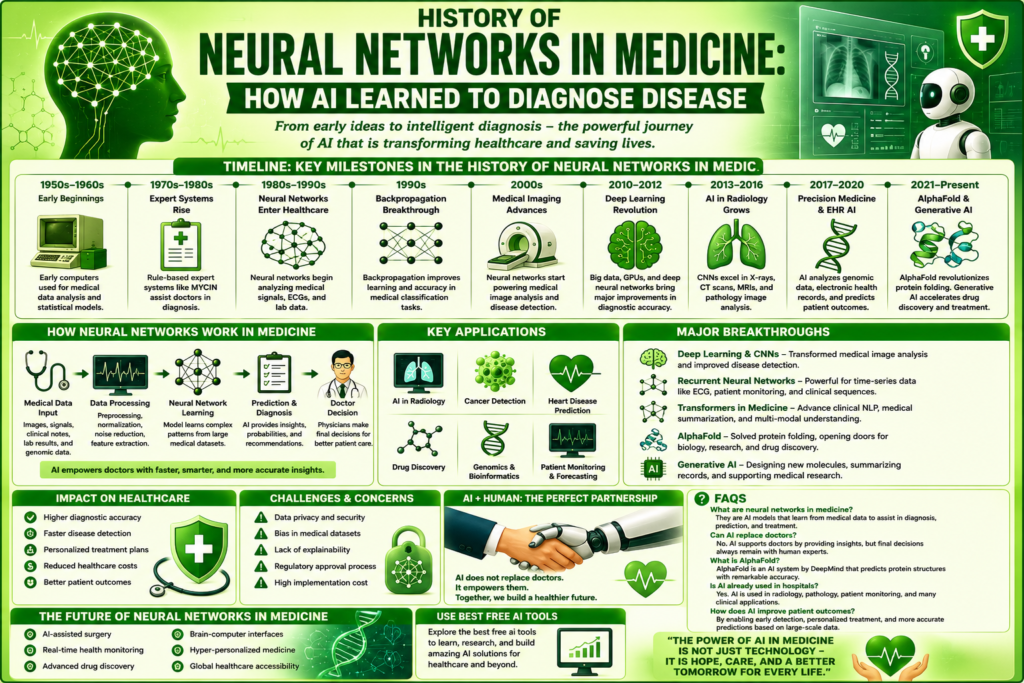
The rise of history of neural networks in medicine transformed medical image analysis, bioinformatics, disease diagnosis, and personalized medicine. From early pattern recognition systems to advanced deep learning and AlphaFold, AI became one of the most powerful tools in modern healthcare.
The journey of neural networks in medicine continues reshaping how humans understand disease and treatment.
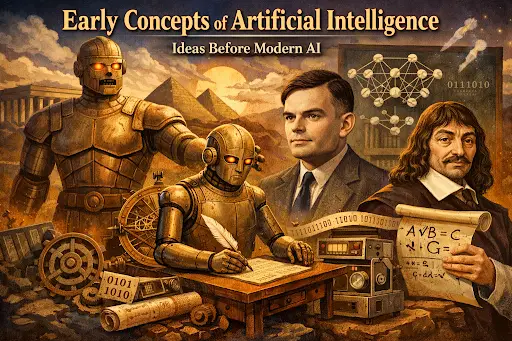
Early Medical Computing and AI Dreams (1950 – 1980)
The roots of the history of neural networks in medicine began during the early years of artificial intelligence research.
Scientists dreamed about machines capable of assisting doctors in medical diagnosis and patient analysis.
At the same time, researchers explored artificial neural computation.
The famous mcculloch and pitts neural network model became one of the earliest inspirations for machine intelligence systems.
Researchers believed neural structures might eventually imitate biological reasoning and decision-making.
Early medical AI systems focused mainly on:
- Rule-based diagnosis
- Statistical predictions
- Medical databases
- Pattern recognition
However, computing hardware remained extremely limited.
Medical datasets were also difficult to digitize.
As a result, early healthcare AI systems struggled to achieve practical success.
Expert Systems and Early Medical AI (1970 – 1990)
The history of neural networks in medicine expanded during the rise of expert systems.
Expert systems attempted to simulate physician decision-making using manually programmed medical rules.
One famous example was MYCIN, developed during the 1970s.
MYCIN diagnosed bacterial infections using logical reasoning rules.
Although effective in some situations, expert systems had major limitations:
- Hardcoded knowledge
- Poor adaptability
- Limited scalability
- Weak pattern recognition
Researchers soon realized medicine required systems capable of learning directly from clinical data.
This challenge pushed scientists toward neural networks and machine learning.
Neural Networks Enter Healthcare Research
The history of neural networks in medicine accelerated as neural networks improved during the 1980s and 1990s.
Researchers discussing history of ai often identify medicine as one of the earliest practical AI application areas.
Neural networks became attractive because they could learn patterns automatically instead of relying entirely on manually written rules.
Medical neural systems began analyzing:
- ECG signals
- Medical scans
- Laboratory values
- Patient records
- Disease indicators
Researchers discovered that neural models could identify hidden patterns difficult for humans to detect.
This became a major turning point in healthcare technology.
Backpropagation and Medical Pattern Recognition
The rise of backpropagation transformed the history of neural networks in medicine dramatically.
Researchers discussing history of backpropagation often connect it with medical classification breakthroughs.
Backpropagation allowed neural networks to improve through error correction.
The weight update process looked like:
Where:
- = neural weight
- = learning rate
- = error function
This training process improved diagnostic accuracy significantly.
Neural systems became capable of identifying subtle disease patterns across large datasets.
Medical Imaging and Convolutional Neural Networks
One of the biggest revolutions in the history of neural networks in medicine arrived through convolutional neural networks.
Researchers studying history of cnn often identify healthcare imaging as one of CNNs’ most important applications.
CNN systems became highly effective for medical image analysis because they could recognize visual structures automatically.
Applications included:
- Tumor detection
- Lung disease analysis
- MRI interpretation
- CT scan classification
- Retinal disease detection
CNNs improved computer-assisted diagnosis dramatically.
This transformed AI in radiology forever.
Deep Learning Revolution in Medicine (2010 – Present)
The modern history of neural networks in medicine accelerated rapidly after the deep learning revolution.
Researchers discussing history of deep learning often highlight healthcare as one of the greatest beneficiaries of deep AI systems.
Several breakthroughs drove rapid progress:
- GPU acceleration
- Large medical datasets
- Improved neural architectures
- Cloud computing
- Electronic health records
Deep learning systems achieved human-level or even superhuman performance in some medical tasks.
Hospitals and research institutions increasingly adopted AI tools.
Neural Networks in Radiology
The rise of AI in radiology became one of the most important chapters in the history of neural networks in medicine.
Radiology produces enormous amounts of imaging data daily.
Neural networks now assist doctors by analyzing:
- Chest X-rays
- Mammograms
- Brain scans
- Ultrasounds
- Pathology slides
AI systems can detect abnormalities rapidly and improve screening tools for early disease diagnosis.
Researchers found that neural systems sometimes identify patterns invisible to human eyes.
This dramatically improved patient outcomes in many areas.
Disease Diagnosis Through Deep Learning
The history of neural networks in medicine became revolutionary because AI systems learned to diagnose diseases directly from medical data.
Neural networks now help detect:
- Cancer
- Diabetes
- Alzheimer’s disease
- Heart disease
- Skin disorders
- Neurological conditions
For example, deep learning systems analyze retinal scans to identify diabetic retinopathy with extremely high accuracy.
These systems improve diagnostic speed and reduce physician workload.
Recurrent Neural Networks in Healthcare
The history of neural networks in medicine also expanded through recurrent neural networks.
Researchers studying history of rnn discovered that sequential neural systems could analyze time-dependent medical data effectively.
Applications included:
- ECG analysis
- Patient monitoring
- Health forecasting
- Clinical sequence prediction
Medical records often contain chronological information, making sequential modeling highly valuable.
Transformers and Modern Healthcare AI
The rise of transformers transformed the history of neural networks in medicine once again.
Researchers discussing transformer neural networks often identify healthcare as a major future application area.
Transformers improved:
- Clinical language analysis
- Medical summarization
- Research automation
- Multi-modal healthcare systems
Transformer architectures can process:
- Medical text
- Images
- Genomic sequences
- Audio records
This created highly flexible healthcare AI systems.
AlphaFold and Protein Folding Revolution
One of the greatest breakthroughs in the history of neural networks in medicine arrived through AlphaFold.
Developed by DeepMind, AlphaFold solved one of biology’s biggest challenges: protein folding prediction.
Proteins determine biological structure and function.
Predicting protein structures manually required enormous scientific effort.
AlphaFold used deep neural networks to predict protein folding with remarkable accuracy.
Researchers discussing history of alphago often compare AlphaFold’s scientific impact with AlphaGo’s game-playing revolution.
AlphaFold transformed:
- Drug discovery
- Molecular biology
- Bioinformatics
- Disease research
Many scientists consider it one of the most important scientific AI breakthroughs ever achieved.
Personalized Medicine and AI
The history of neural networks in medicine continues evolving through personalized medicine.
AI systems now analyze:
- Genetic data
- Lifestyle information
- Medical history
- Biomarker patterns
This helps doctors design individualized treatments for patients.
Neural systems improve:
- Treatment optimization
- Risk prediction
- Precision therapies
- Clinical recommendations
Personalized medicine may become one of healthcare’s biggest transformations.
Electronic Health Records and Clinical Data
Modern healthcare generates enormous quantities of clinical data.
Neural networks help process:
- Electronic health records
- Laboratory reports
- Doctor notes
- Prescription histories
AI systems identify hidden relationships across patient populations.
This improves hospital efficiency and healthcare planning significantly.
Neural Networks in Drug Discovery
The history of neural networks in medicine also transformed pharmaceutical research.
Drug discovery traditionally required years of laboratory experimentation.
Neural systems now help predict:
- Molecular interactions
- Drug effectiveness
- Toxicity risks
- Chemical structures
Generative AI models even design entirely new molecules.
Researchers discussing generative neural networks increasingly connect these systems with future pharmaceutical innovation.
Medical Ethics and AI Challenges
Despite major progress, the history of neural networks in medicine includes serious ethical concerns.
These include:
- Patient privacy
- Dataset bias
- Regulatory approval
- AI transparency
- Clinical accountability
Healthcare AI systems must achieve extremely high reliability because medical errors can affect human lives directly.
Researchers continue improving explainable AI and safe clinical deployment systems.
AI Doctors vs Human Doctors
The rise of medical AI sparked debates about whether machines could replace physicians.
Most experts believe AI will augment doctors rather than fully replace them.
Neural networks excel at:
- Pattern recognition
- Large-scale analysis
- Data processing
Human doctors remain essential for:
- Emotional understanding
- Ethical judgment
- Complex decision-making
- Patient communication
The future likely involves human-AI collaboration.
OpenAI, DeepMind, and Healthcare Research
Major AI labs accelerated medical AI research dramatically.
Researchers discussing deepmind vs openai often compare their healthcare initiatives.
DeepMind contributed heavily through:
- AlphaFold
- Medical imaging research
- Clinical prediction systems
OpenAI explored:
- Generative medical AI
- Multi-modal reasoning
- Conversational healthcare systems
These advances continue pushing medical AI forward rapidly.
Neural Networks and the Future of Medicine
The future of history of neural networks in medicine looks incredibly promising.
Researchers are now exploring:
- AI-assisted surgery
- Real-time diagnostics
- Brain-computer interfaces
- Fully personalized treatments
- Predictive healthcare systems
Many of today’s best free ai tools already assist researchers, students, and healthcare professionals with medical analysis and productivity.
Healthcare AI may eventually become one of humanity’s greatest technological achievements.
The Lasting Legacy of Medical Neural Networks
The history of neural networks in medicine represents one of the greatest partnerships between technology and healthcare.
From early rule-based systems to modern deep learning and AlphaFold, neural networks transformed how diseases are diagnosed and treated.
The combination of:
- Deep learning
- Medical image analysis
- Clinical prediction
- Bioinformatics
- Personalized medicine
created powerful healthcare systems capable of improving millions of lives worldwide.The medical AI revolution continues accelerating rapidly.
FAQs About Neural Networks in Medicine
What are neural networks in medicine?
Neural networks in medicine are AI systems used for disease diagnosis, medical imaging, drug discovery, and healthcare prediction.
How do neural networks diagnose disease?
Neural networks analyze medical data patterns such as scans, laboratory results, and patient histories to identify diseases.
What is AI in radiology?
AI in radiology uses deep learning systems to analyze medical images like X-rays, MRIs, and CT scans.
What is AlphaFold?
AlphaFold is an AI system developed by DeepMind that predicts protein structures with extremely high accuracy.
Can AI replace doctors?
Most experts believe AI will assist doctors rather than fully replace them.
Why is healthcare AI important?
Healthcare AI improves diagnostic accuracy, patient outcomes, medical research, and treatment efficiency.
Conclusion
The story of history of neural networks in medicine represents one of the most important revolutions in healthcare history. From early expert systems to deep learning radiology tools and AlphaFold, neural networks transformed medicine into a data-driven intelligent science.
The rise of medical AI became deeply connected to history of deep learning, history of cnn, history of rnn, transformer neural networks, and history of alphago research.
Today, neural networks help diagnose diseases, accelerate drug discovery, improve patient outcomes, and support healthcare professionals worldwide.
As artificial intelligence continues evolving, neural networks in medicine will remain one of humanity’s most powerful tools for improving health and saving lives.