The story of history of rnn represents one of the most important breakthroughs in artificial intelligence and machine learning history. Before recurrent neural networks existed, most neural systems could only process fixed inputs without memory.
They could recognize patterns, but they could not remember sequences.
That limitation created a huge problem.
Human language, speech, music, and time-series information all depend heavily on memory and temporal relationships.
Then recurrent neural networks changed everything.
The rise of history of rnn allowed artificial intelligence systems to process sequential data and learn from previous information over time.
This breakthrough transformed:
- Natural language processing
- Speech recognition
- Text generation
- Time-series prediction
- Machine translation
- AI memory systems
Today, recurrent neural networks continue influencing modern artificial intelligence technologies worldwide.
In this article, we will explore the complete history of rnn, how recurrent neural networks learned to remember, and why sequence modeling became revolutionary.
Neural Networks Before RNNs (1943 – 1980)
Before understanding history of rnn, we must first examine earlier neural network development.
The first artificial neuron model appeared in 1943 through Warren McCulloch and Walter Pitts.
Their work became foundational to:
Later, Frank Rosenblatt introduced the perceptron during the 1950s.
This breakthrough became linked to:
Although early neural systems could classify patterns, they lacked memory.
Traditional feedforward neural networks processed information only once.
They could not remember previous inputs.
This limitation became a major challenge for AI researchers.
Why Memory Matters in Artificial Intelligence
One important reason behind history of rnn involved sequential information.
Many real-world problems require memory.
Examples include:
- Human language
- Speech signals
- Music generation
- Video understanding
- Weather forecasting
Words in a sentence depend heavily on previous words.
Speech depends on earlier sound patterns.
Time-series prediction depends on historical data dependencies.
Researchers realized AI systems needed memory-like behavior.
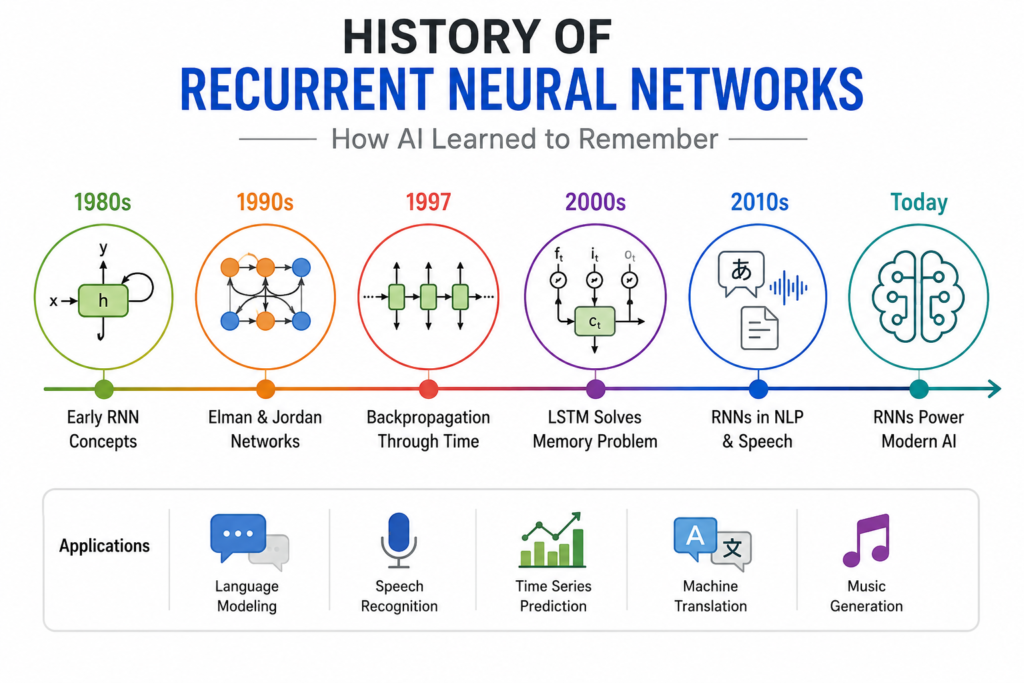
Early Sequence Learning Research (1980 – 1990)
The foundations of history of rnn emerged during the 1980s.
Researchers explored neural architectures capable of feedback loops and temporal processing.
Important early systems included:
- Elman Networks
- Jordan Networks
These architectures introduced recurrent connections allowing information to persist over time.
This became revolutionary for sequential data processing.
Elman Networks and Hidden State Memory
One major milestone in history of rnn came from Jeffrey Elman.
Elman Networks introduced hidden state memory.
The system stored information from previous inputs and reused it later.
This allowed neural networks to develop primitive memory capabilities.
The architecture processed sequences step-by-step.
For example:
Where:
- = current hidden state
- = previous hidden state
- = current input
This became one of the defining ideas in history of rnn.
Jordan Networks and Feedback Loops
Another important development in history of rnn came through Michael Jordan.
Jordan Networks introduced additional recurrent feedback mechanisms.
The system allowed outputs to influence future predictions.
This improved sequence modeling capabilities significantly.
Researchers began realizing neural systems could simulate memory using recurrent connections.
How Recurrent Neural Networks Work
To fully understand history of rnn, we must examine how RNNs operate.
Unlike feedforward networks, RNNs contain loops.
Information cycles through the network repeatedly.
The system processes:
- Current input
- Previous memory state
- Temporal dependencies
RNNs effectively remember earlier information while processing new data.
This made them ideal for sequence modeling.
Backpropagation Through Time (BPTT)
One of the biggest breakthroughs in history of rnn involved Backpropagation Through Time.
This learning technique extended:
BPTT allowed recurrent networks to update weights across sequential steps.
The system unfolded neural loops through time during training.
This enabled learning from long sequences.
Natural Language Processing and RNNs
The rise of history of rnn transformed natural language processing dramatically.
RNN systems became capable of:
- Sentence prediction
- Text generation
- Language translation
- Chatbot responses
- Speech synthesis
The ability to remember earlier words improved AI language understanding enormously.
RNNs became foundational to early NLP systems.
Speech Recognition and Sequential Learning
Another major breakthrough in history of rnn involved speech recognition.
Speech depends heavily on temporal dynamics.
RNNs learned to process:
- Audio waves
- Speech patterns
- Sequential phonemes
- Voice dependencies
This progress strongly connected to:
Modern voice assistants evolved partly from these recurrent learning systems.
The Vanishing Gradient Problem
Despite their success, history of rnn faced major limitations.
Training long sequences became extremely difficult because of:
Gradients often became too small during long sequential learning.
This caused memory loss across long time dependencies.
RNNs struggled to remember distant information effectively.
Researchers needed better memory architectures.
LSTM Networks Solve Memory Problems
The next major breakthrough in history of rnn came through Long Short-Term Memory networks.
This breakthrough became connected to:
Sepp Hochreiter and Jürgen Schmidhuber introduced LSTMs during the 1990s.
LSTMs solved long-term memory limitations using:
- Forget gates
- Input gates
- Output gates
These mechanisms dramatically improved sequence learning.
RNNs and Deep Learning
The rise of history of rnn strongly connected to the deep learning revolution.
Important breakthroughs included:
Researchers such as Geoffrey Hinton, Yoshua Bengio, and Yann LeCun helped advance neural sequence learning.
RNNs became essential for many deep learning applications.
Sequence to Sequence Models
Another revolutionary step in history of rnn involved sequence-to-sequence architectures.
These systems enabled:
- Language translation
- Summarization
- Text prediction
- Conversational AI
This breakthrough strongly connected to:
Seq2Seq systems became foundational to modern language AI.
RNNs and Time-Series Prediction
Another important use of history of rnn involved forecasting.
RNNs became highly effective for:
- Stock prediction
- Weather analysis
- Financial forecasting
- Sensor analysis
Their ability to model temporal data made them extremely valuable across industries.
GPU Acceleration and Large RNN Models
The progress of history of rnn accelerated significantly because of GPU computing.
This breakthrough strongly connected to:
GPUs enabled:
- Faster matrix operations
- Parallel sequence learning
- Large-scale recurrent training
Without GPUs, advanced recurrent systems would have remained computationally impractical.
RNNs vs Transformers
Although transformers later became dominant, history of rnn remains extremely important.
This evolution became connected to:
Transformers improved long-range memory using attention mechanisms.
However, recurrent neural networks laid the foundation for sequence learning in AI.
Modern transformers evolved partly from problems discovered in RNN research.
RNNs and Generative AI
The influence of history of rnn extends into modern generative AI systems.
RNNs helped pioneer:
- Text generation
- Speech synthesis
- Conversational AI
- Sequential prediction
Even modern best free ai tools rely indirectly on breakthroughs developed during recurrent neural network research.
Why RNNs Became Revolutionary
Several reasons explain the importance of history of rnn.
Introduced Memory to AI
RNNs allowed neural systems to remember previous inputs.
Enabled Language Processing
AI systems could finally understand sequences effectively.
Improved Speech Recognition
Temporal learning transformed audio processing.
Launched Sequence Modeling
Modern NLP systems evolved partly from recurrent architectures.
Together, these breakthroughs transformed artificial intelligence forever.
Frequently Asked Questions (FAQs)
What is an RNN?
An RNN is a Recurrent Neural Network designed for sequential and temporal data processing.
Why are RNNs important?
RNNs introduced memory and sequence learning into artificial intelligence.
What problems do RNNs solve?
RNNs handle language processing, speech recognition, and time-series prediction.
What replaced traditional RNNs?
LSTMs and transformers improved many limitations of standard RNNs.
Are RNNs still used today?
Yes. RNNs remain useful in speech processing, forecasting, and sequential learning tasks.
Conclusion
The story of history of rnn represents one of the greatest breakthroughs in artificial intelligence history. By introducing memory, feedback loops, and temporal learning, recurrent neural networks allowed machines to process sequences and understand information over time.
RNNs transformed language processing, speech recognition, forecasting, and sequential AI systems worldwide. Their innovations later inspired LSTMs, sequence-to-sequence architectures, and transformer-based models that dominate modern AI today.
Although newer architectures continue evolving, the legacy of history of rnn remains deeply embedded inside modern artificial intelligence systems across the world.