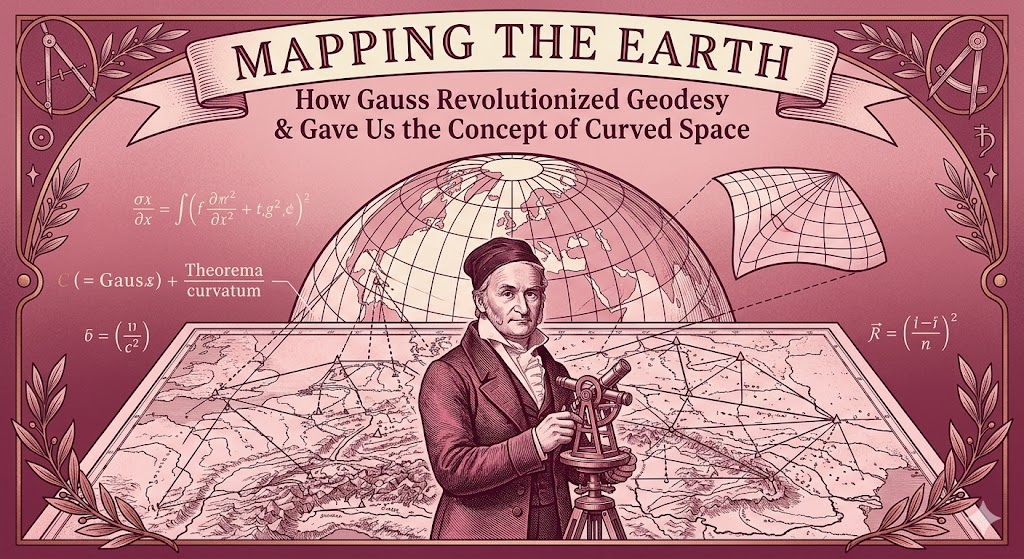
What is the true shape of our planet? For thousands of years, sailors believed the Earth was flat. Ancient Greeks proved it was a sphere. But is it a perfect sphere? How do you measure the subtle bulge at the equator or the dips in mountain valleys? These questions define geodesy, the science of measuring the Earth’s shape and gravity field. In the 1820s, a 50 year old mathematician left his observatory and walked into the muddy fields of Hanover. His name was carl friedrich gauss, the prince of mathematics, and he was about to revolutionize earth’s shape research forever. He did not just measure land; he invented a new way to think about surface curvature. His work on gauss geodesy gave us the mathematical tools to map planets, navigate oceans, and even understand the fabric of the universe. Let us explore how a survey of a small German kingdom changed our understanding of space itself.
Why We Needed to Measure the Earth
Before the 19th century, maps were works of art, not works of science. A ship captain might sail toward an island that did not exist. A king might claim a mountain that was actually ten miles from where the map placed it. The science of cartography was primitive. To make accurate maps, you need accurate measurements of latitude and longitude. But measuring longitude accurately requires knowing the exact shape of the Earth. Is it a perfect sphere? Isaac Newton predicted it was an ellipsoid, flattened at the poles and bulging at the equator. But proving this required massive geodetic surveying projects across entire countries. The Kingdom of Hanover, ruled by King George IV of England, decided to fund such a survey. They needed the best mathematician in the world to lead it. That was carl friedrich gauss. The project would become the defining work of gauss geodesy.
The Challenge of Curved Surfaces
Measuring a flat field is simple. You use a tape measure. But the Earth is not flat. Over long distances, the surface curvature means that straight lines in three dimensions become curved paths on the map. The mathematics of surface curvature is complex. Gauss had to account for the fact that his measurements were being taken on a curved ellipsoid, but his paper maps were flat. This is the problem of map projections: how do you represent a curved surface on a flat piece of paper without distorting distances or angles? You cannot. Every flat map distorts something. Greenland looks as big as Africa on most maps, but Africa is actually 14 times larger. Gauss understood this distortion mathematically. His solution was to use triangulation, a method where you measure a base line very accurately, then use angles to calculate distances to faraway mountains. This is the foundation of gauss geodesy.
The Mathematics of Triangulation
Let us look at the math behind triangulation in gauss geodesy. Suppose you have two points A and B on the ground, and you know the exact distance between them. This is your baseline. From point A, you measure the angle to a distant mountain peak C. From point B, you measure the angle to the same peak C. You now know two angles and one side of triangle ABC. Using the law of sines, you can calculate the other two sides:
Here, a is the side opposite angle A, and so on. By building a network of hundreds of such triangles, Gauss could calculate distances across the entire kingdom without ever physically measuring those distances. This is still how national mapping agencies work today. But Gauss went further. He knew that the Earth’s surface curvature meant that his triangles were not flat Euclidean triangles. They were spherical triangles. On a sphere, the sum of the angles of a triangle is greater than 180 degrees. Gauss had to correct for this spherical excess. His corrections were so precise that his geodetic surveying results were not improved upon for over a century.
The Heliotrope: Gauss’s Brilliant Invention
How do you measure angles between mountain tops that are 50 miles apart? You need a target that is bright enough to see through a telescope. Gauss invented a device called the heliotrope (from helios, meaning sun, and tropos, meaning turning). The heliotrope was a mirror that reflected sunlight directly toward the observer. By tilting the mirror, the surveyor could flash a beam of light that was visible from over 100 kilometers away. This was the laser pointer of the 19th century. With the heliotrope, Gauss could measure angles with astonishing accuracy. His surveying instruments were custom built to read angles to within one second of arc (1/3600 of a degree). This level of precision was unprecedented. The heliotrope became a standard tool in physical geography and topographic mapping for the next hundred years. It transformed land measurement from a rough art into a precise science.
The Theorema Egregium: Gauss’s Most Beautiful Theorem
While conducting gauss geodesy, Gauss made a theoretical discovery that changed mathematics forever. He was studying the surface curvature of the Earth. He asked: can the inhabitants of a curved surface detect their own curvature without looking at the outside world? Imagine ants living on a wrinkled leaf. Can they tell the leaf is wrinkled just by walking on it? Gauss proved that the answer is yes. He discovered a measure of surface curvature that depends only on measurements made within the surface itself. He called this the “curvature” and proved that it is intrinsic. This result is called the Theorema Egregium, Latin for “Remarkable Theorem.” The theorem states that gaussian curvature (which we denote as ) can be calculated from the metric of the surface without referring to the surrounding space. In mathematical notation, for a surface parameterized by coordinates u and v, the gaussian curvature is:
Here, are the coefficients of the first fundamental form, and are the coefficients of the second fundamental form. This formula may look intimidating, but its meaning is profound: curvature is not an illusion; it is a real, measurable property of space itself. This idea would later inspire Einstein’s general theory of relativity.
From Geodesy to Non Euclidean Geometry
The Theorema Egregium opened a door that Gauss had been peeking through for decades. If surfaces can have intrinsic curvature, why not space itself? Gauss realized that the three dimensional space we live in might also be curved. He began developing gauss non euclidean geometry, a system where parallel lines can diverge or converge, and where the angles of a triangle do not always add up to 180 degrees. He was terrified of the philosophical backlash (the famous “uproar of the Boeotians”), so he did not publish this work. But his gauss geodesy gave him a practical test. He measured the angles of a large triangle formed by three mountain peaks: Brocken, Inselsberg, and Hohenhagen. He calculated the sum of the angles. If space were flat Euclidean space, the sum should be 180 degrees. The difference would reveal curvature. Gauss found the difference to be within the margin of measurement error. He concluded that space, over these distances, is effectively flat. But he left open the possibility that on cosmological scales, the universe might be curved. Einstein proved him right.
Practical Results of the Hanover Survey
The Hanover survey, the great work of gauss geodesy, took over 20 years to complete. Gauss and his team measured over 3000 kilometers of triangulation network. They established permanent markers, many of which still exist today. The result was the first scientifically accurate map of a large region. The map showed the true positions of cities, rivers, and mountains. It corrected errors of up to several kilometers in older maps. The spatial data collected by Gauss was used for taxation, land ownership, and military planning. But its greatest impact was scientific. The survey proved that geodetic surveying could be done with high precision over long distances. It set the standard for every national mapping project that followed. The ellipsoid that Gauss used to model the Earth’s shape was refined by later scientists, but his methods remain the foundation of modern cartography.
The Connection to Gauss’s Other Work
The gauss geodesy project was not isolated from his other genius. The method of least squares, which Gauss had invented to find the lost planet Ceres, was essential for processing the survey data. Every measurement had small errors. Gauss used the method of least squares to find the most probable positions of the triangulation points. The gauss normal distribution described the pattern of those errors. The gaussian curvature emerged directly from his theoretical analysis of the Earth’s surface. And the gauss non euclidean geometry that he kept secret was a direct generalization of his work on curved surfaces. Even the gauss-weber telegraph, invented later, used principles of gauss electromagnetism to send signals. For Gauss, everything was connected. The same mathematical mind that explored gauss number theory also mapped mountains and valleys.
Gauss’s Legacy in Modern Geodesy
Today, geodesy has advanced far beyond Gauss’s wildest dreams. We do not need heliotrope mirrors anymore. We have satellites. The Global Positioning System (GPS) uses a network of 31 satellites to determine your location to within a few meters. But the mathematics of GPS is pure gauss geodesy. The system must account for the Earth’s ellipsoid shape, the surface curvature, and the effects of gravity. The satellites carry atomic clocks that measure time with incredible precision. The ground receiver calculates distances by measuring the time it takes for signals to travel. Then, using trilateration (a cousin of triangulation), it solves for your position. Every time your phone gives you directions, it is performing a calculation that Gauss would have recognized. The spatial data industry, worth billions of dollars, rests on the foundations laid by gauss geodesy.
Frequently Asked Questions (FAQs)
What exactly is geodesy and why is it important?
Geodesy is the science of measuring the Earth’s shape, gravity field, and rotation. It is important because accurate maps, GPS navigation, and understanding sea level rise all depend on geodesy. Gauss geodesy transformed this field from rough estimation into precise mathematical science. Without geodesy, bridges would not meet in the middle, planes would miss their runways, and smartphone maps would be useless.
What is the Theorema Egregium?
The Theorema Egregium (Latin for “Remarkable Theorem”) is Gauss’s proof that gaussian curvature is an intrinsic property of a surface. This means that the curvature can be measured entirely from within the surface, without looking at the surrounding space. This profound insight laid the mathematical foundation for gauss non euclidean geometry and later for Einstein’s general theory of relativity. It is the most beautiful result in gauss geodesy.
How did Gauss measure the Earth’s curvature?
Gauss used triangulation combined with precise angle measurements from mountain tops. He established a baseline distance measured with extreme accuracy. Then he measured angles to distant peaks using a theodolite and his invented heliotrope (a mirror that reflected sunlight). By calculating the spherical excess (the amount by which the sum of angles in a triangle exceeded 180 degrees), he determined the surface curvature of the Earth.
What is the heliotrope and why did Gauss invent it?
The heliotrope is an instrument that reflects sunlight toward a distant observer. Gauss invented it because he needed a bright, visible target to measure angles between mountain tops that were tens of kilometers apart. The heliotrope could be seen from over 100 kilometers away, allowing surveyors to align their telescopes precisely. It revolutionized geodetic surveying and remained in use for over a century.
How does Gauss’s geodesy affect modern GPS?
Modern GPS relies directly on the mathematics of gauss geodesy. The GPS system models the Earth as an ellipsoid (flattened at the poles). It accounts for surface curvature when calculating distances and positions. The method of least squares (invented by Gauss for astronomy) is used to process the noisy satellite signals. Without the theoretical and practical foundations laid by gauss geodesy, accurate satellite navigation would be impossible.
Conclusion
The story of gauss geodesy is a story of seeing the invisible. While other men walked across fields and climbed mountains, Gauss saw curves, angles, and intrinsic geometry. He transformed the messy work of land measurement into a branch of pure mathematics. His Theorema Egregium proved that curvature is not a ghost; it is a real, measurable property of surfaces. His secret work on gauss non euclidean geometry anticipated the revolution that Einstein would complete a century later. The prince of mathematics gave us the tools to map our world and understand its shape. From the heliotrope to GPS satellites, from triangulation to differential geometry, his fingerprints are everywhere. In many ways, how ancient greek scientists changed modern science by measuring the Earth’s circumference with shadows and sticks, Carl Friedrich Gauss perfected their method with the rigor of calculus and the power of intrinsic curvature. Today, when you trust your GPS to guide you home, you are trusting the genius of gauss geodesy.