Tree of life theory is one of the most powerful ideas in biology and evolutionary science. It explains that every living organism on Earth shares a common ancestry and is connected through billions of years of evolution. From bacteria to whales, from tiny insects to human beings, all life forms belong to one enormous biological family tree.
The tree of life theory completely transformed humanity’s understanding of nature. Before Charles Darwin, many people believed species existed separately and never changed. Darwin introduced a revolutionary explanation showing that all species evolved gradually from common ancestors through natural selection and adaptation.
Today, modern genetics, DNA sequencing, fossils, and phylogenetics strongly support the tree of life theory. Scientists use evolutionary tree diagrams to study how organisms are related and how biodiversity developed across Earth’s history.
This article explores Darwin’s vision of common ancestry, the scientific evidence supporting evolutionary relationships, the mathematics behind evolutionary trees, and why the tree of life theory remains central to modern biology.
Early Ideas About Life and Classification (1700 – 1830)
Before Darwin, scientists attempted to classify living organisms into categories based on visible similarities. Early taxonomy systems organized plants and animals into kingdoms, species, and groups.
However, most scientists still believed species were fixed and independently created.
Naturalists noticed similarities between organisms, but they lacked a scientific explanation for why those similarities existed.
For example:
- Mammals share similar bone structures
- Birds possess related skeletal systems
- Vertebrates develop similar embryos
These patterns suggested deeper biological connections.
The scientific revolution slowly encouraged researchers to search for natural explanations rather than relying only on traditional beliefs.
Eventually, the work of Charles Darwin transformed biological thinking forever.
Charles Darwin and the Birth of Common Ancestry (1831 – 1859)
Darwin’s revolutionary ideas began developing during the HMS beagle voyage.
Between 1831 and 1836, Darwin traveled around the world observing plants, animals, fossils, and geological formations. He noticed that species from different regions often resembled one another while showing important differences.
These observations became especially important during his studies of galapagos islands and darwin.
On the Galápagos Islands, Darwin observed unique species adapted to local environments. The islands contained finches with different beak shapes, giant tortoises with varying shell structures, and reptiles showing unusual adaptations.
Darwin realized these organisms likely evolved from shared ancestors after becoming isolated on separate islands.
This insight eventually helped inspire the tree of life theory and common descent.
What Is the Tree of Life Theory?
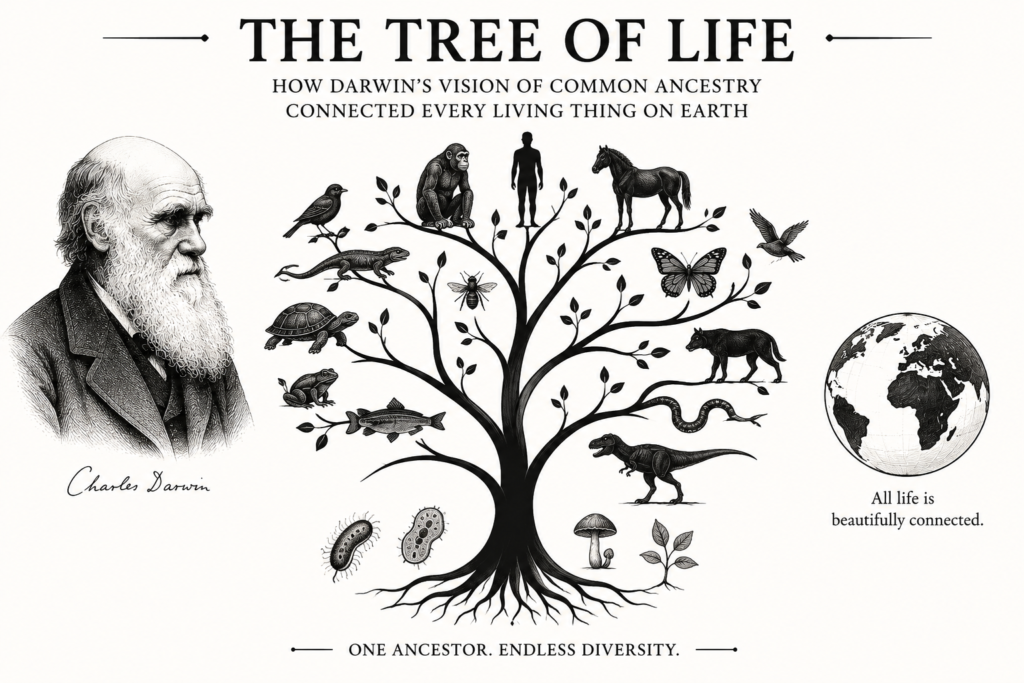
The tree of life theory explains that all living organisms evolved from ancient shared ancestors over immense periods of time.
Darwin imagined evolution as a branching tree:
- The root represents ancient life forms
- Branches represent evolutionary divergence
- Smaller branches represent species relationships
- New branches form through adaptation and speciation
This evolutionary tree diagram demonstrates how biodiversity developed gradually through common ancestry evolution.
Darwin described this process using the idea of descent with modification.
According to this principle:
- Offspring inherit traits from parents
- Mutations and variation create differences
- Natural selection favors beneficial adaptations
- Species slowly diverge into new forms
Over millions of years, these evolutionary changes produced the enormous diversity of life on Earth.
The Theory of Natural Selection and the Tree of Life
The mechanism driving the tree of life theory is the theory of natural selection.
Natural selection explains how organisms best adapted to their environment survive and reproduce more successfully.
Over time:
- Helpful traits become common
- Harmful traits disappear
- Populations diverge genetically
- New species emerge
This gradual evolutionary process creates branching evolutionary lineages.
For example:
- Wolves and domestic dogs share common ancestors
- Humans and chimpanzees evolved from related primates
- Birds evolved from dinosaur ancestors
The tree of life theory explains these biological relationships through common descent.
Darwin’s Famous Tree Sketch (1837)
One of Darwin’s most famous scientific drawings was a small notebook sketch showing a branching evolutionary tree.
Above the drawing, Darwin wrote the words “I think.”
This simple sketch became one of the most important diagrams in scientific history because it visually represented common ancestry.
Darwin understood that species evolve like branches growing from a shared trunk.
Modern phylogenetic trees still use this branching structure today.
Mathematical Understanding of Evolutionary Trees
Modern biology uses mathematics and genetics to study evolutionary relationships.
One important principle involves genetic distance between species.
Genetic similarity can be represented mathematically as:
Where:
- = genetic distance
- = genetic similarity
Smaller genetic distances indicate closer evolutionary relationships.
Population genetics also supports evolutionary branching through allele frequency equations:
Where:
- = frequency of one allele
- = frequency of another allele
Another important equation is the Hardy-Weinberg equilibrium:
This equation helps scientists study genetic variation within populations.
Population growth and adaptation can also be modeled mathematically:
Where:
- = population size at time t
- = initial population
- = growth rate
These mathematical principles help scientists reconstruct evolutionary trees and analyze biodiversity lineage.
Fossil Evidence Supporting Common Ancestry
Fossils provide powerful evidence supporting tree of life theory.
The fossil record reveals gradual evolutionary transitions between species across geological time.
Examples include:
- Fish evolving into amphibians
- Reptiles evolving into birds
- Land mammals evolving into whales
These transitional fossils demonstrate macroevolution evidence and common descent.
Darwin’s own observations of fossils strongly influenced his ideas about evolution and biological relationships.
DNA Sequencing and Modern Evolutionary Science
Modern DNA sequencing has provided overwhelming evidence supporting tree of life theory.
Scientists discovered that all living organisms use:
- DNA as genetic material
- Similar genetic codes
- Shared cellular processes
- Common biochemical systems
Humans share approximately:
- 98.8% of DNA with chimpanzees
- 85% of DNA with mice
- 60% of genes with bananas
These similarities strongly support universal common ancestry.
Research connecting darwin to DNA evolution transformed evolutionary biology into a modern genetic science.
LUCA and the Universal Common Ancestor
Scientists believe all life traces back to LUCA, the Last Universal Common Ancestor.
LUCA likely existed billions of years ago and gave rise to all modern organisms.
From this ancient ancestor emerged the three major domains of life:
- Bacteria
- Archaea
- Eukarya
Over time, these branches diversified into kingdoms, species, and ecosystems across Earth.
The tree of life theory explains how all modern biodiversity developed from this shared origin.
Phylogenetics and Modern Tree Building
Modern scientists use phylogenetics to study evolutionary relationships.
Phylogenetic trees and cladograms compare:
- DNA sequences
- Morphology
- Fossil evidence
- Anatomical structures
- Embryological similarities
Scientists use computer algorithms and genetic analysis to reconstruct evolutionary trees with remarkable accuracy.
These tools help researchers understand:
- Species divergence
- Evolutionary adaptation
- Common ancestry evolution
- Biological classification
Phylogenetics has become one of the most important fields in modern biology.
Misunderstanding the Tree of Life Theory
Some people mistakenly think tree of life theory suggests evolution follows a straight line toward “higher” organisms.
However, evolution works through branching diversification rather than linear progress.
Humans are not the “final goal” of evolution.
Instead:
- Every species adapts to its environment
- Evolution has no predetermined direction
- Organisms survive through adaptation
- Biodiversity continues changing over time
The evolutionary tree resembles a complex branching network rather than a ladder.
The Tree of Life and Biodiversity
Tree of life theory helps explain Earth’s incredible biodiversity.
Millions of species evolved through adaptation, isolation, mutation, and natural selection.
Examples include:
- Coral reef ecosystems
- Tropical rainforest biodiversity
- Bird species diversification
- Mammalian evolution
Each branch of life represents millions of years of evolutionary history.
Understanding these relationships helps scientists protect endangered species and ecosystems today.
Why Tree of Life Theory Matters Today
The tree of life theory remains essential in many scientific fields.
Scientists use evolutionary relationships in:
- Medicine
- Genetics
- Ecology
- Conservation biology
- Agriculture
- Epidemiology
For example:
- Evolutionary trees track virus mutations
- Genetics identifies inherited diseases
- Conservation programs preserve biodiversity
Without common ancestry theory, modern biology would lose its unifying scientific framework.
Darwin and Wallace: Shared Evolutionary Ideas
The development of evolutionary theory was also influenced by Alfred Russel Wallace.
The collaboration between darwin and wallace helped strengthen scientific acceptance of evolution.
Wallace independently proposed ideas similar to Darwin’s natural selection theory.
Together, their discoveries transformed humanity’s understanding of life on Earth.
FAQs About Tree of Life Theory
What is tree of life theory?
Tree of life theory explains that all living organisms share common ancestry and evolved through branching evolutionary processes.
Who created the tree of life theory?
Charles Darwin developed the idea while studying evolution and natural selection.
What evidence supports common ancestry?
Fossils, DNA sequencing, embryology, comparative anatomy, and phylogenetics all support common ancestry.
What is LUCA?
LUCA stands for Last Universal Common Ancestor, the ancient organism from which all life evolved.
What is a phylogenetic tree?
A phylogenetic tree is a branching diagram showing evolutionary relationships between organisms.
Does tree of life theory connect humans with animals?
Yes. Humans share common ancestry with all other living organisms through evolution.
Conclusion
The tree of life theory completely transformed humanity’s understanding of life and evolution. Charles Darwin’s vision of common ancestry revealed that every organism on Earth is connected through billions of years of evolutionary history.
Modern genetics, fossils, and phylogenetics continue confirming Darwin’s revolutionary insight. From microscopic bacteria to giant mammals, all species belong to one enormous biological family tree shaped by adaptation and natural selection.
The scientific importance of tree of life theory remains enormous today because it unifies biology, genetics, ecology, and evolution into one powerful explanation of life itself. Darwin’s revolutionary ideas stand beside the discoveries of many great thinkers whose work transformed civilization, including those explored in how ancient greek scientists changed modern science.