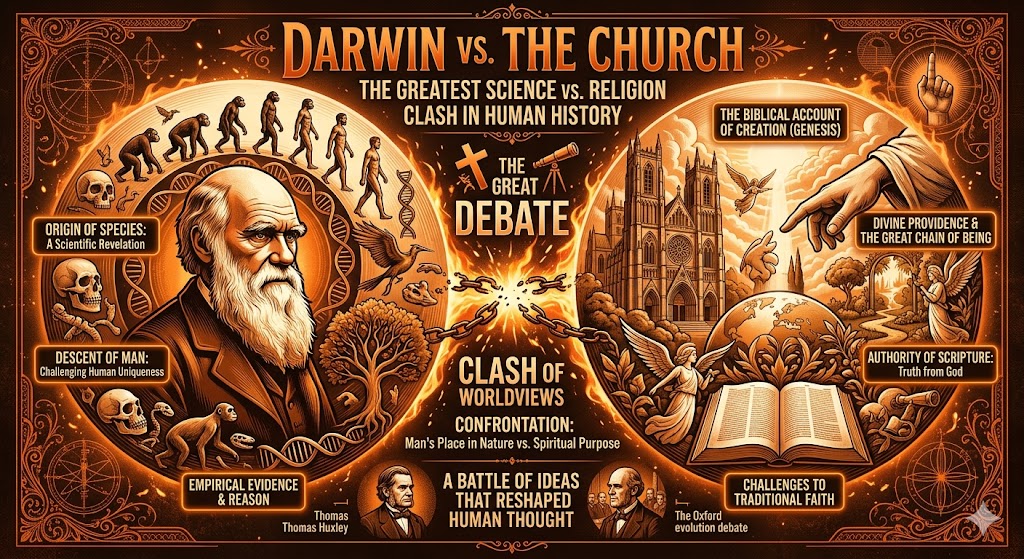
Darwin vs church became one of the most famous intellectual conflicts in human history. When Charles Darwin introduced the theory of evolution through natural selection, his ideas challenged traditional religious beliefs about creation, humanity, and the origin of life. The debate transformed science, religion, philosophy, and society forever.
Before Darwin, many people in Victorian society believed every species was separately created by God exactly as described in Genesis. Humans were often viewed as unique creations placed above the natural world. Darwin’s theory directly challenged these assumptions by proposing that species evolved gradually through natural processes over millions of years.
The controversy surrounding darwin vs church was not simply about biology. It became a larger conflict involving science, theology, authority, education, and human identity. Religious leaders feared evolution undermined faith, morality, and divine creation, while scientists argued evidence strongly supported evolutionary change.
Today, darwin vs church remains one of the most important historical debates ever recorded. The conflict shaped modern science, secular education, evolutionary biology, and public understanding of religion and evidence.
This article explores the origins of the darwin vs church conflict, the Oxford debates, theological objections, mathematical principles behind evolution, and how this controversy transformed modern civilization.
Victorian Society Before Darwin (1800 – 1859)
Before Darwin published his evolutionary ideas, Victorian society was deeply influenced by Christianity and theology.
Most educated people believed:
- Species were fixed creations
- Earth was relatively young
- Humans were uniquely created
- Nature reflected divine design
Natural theology dominated scientific thinking.
Many scholars viewed biology as evidence for God’s wisdom and intentional creation.
Darwin himself originally studied theology at Cambridge University and was expected to become a clergyman.
However, experiences during the HMS beagle voyage gradually changed his understanding of nature.
The Publication of On the Origin of Species (1859)
Everything changed in 1859 when Darwin published on the origin of species.
The book introduced revolutionary ideas including:
- Evolution through natural selection
- Common ancestry
- Adaptation
- Gradual species change
Darwin argued organisms evolve because individuals with advantageous traits survive and reproduce more successfully.
This process became known as the theory of natural selection.
The book immediately shocked religious communities because it contradicted traditional interpretations of Genesis and divine creation.
Why Darwin’s Theory Threatened the Church
The darwin vs church conflict intensified because Darwin’s ideas challenged several core religious assumptions.
Human Origins
Darwin implied humans evolved from earlier animal ancestors rather than being separately created.
Earth’s Age
Evolution required immense geological timescales far older than many biblical calculations.
Natural Processes
Darwin explained biodiversity using natural mechanisms instead of direct divine intervention.
Common Ancestry
Species appeared connected through evolutionary relationships rather than independent creation events.
These conclusions disturbed many religious authorities in Victorian society.
Darwin’s Personal Religious Struggles
Darwin himself experienced complex religious doubts throughout his life.
He never aggressively attacked religion, but he gradually lost confidence in traditional Christian doctrine.
Several experiences influenced Darwin:
- Scientific observations
- Geological discoveries
- Human suffering
- Death of his daughter Annie
- Evolutionary evidence
Darwin eventually described himself as agnostic rather than atheist.
The darwin vs church debate therefore involved both scientific and deeply personal philosophical questions.
The Oxford Debate (1860)
One of the most famous moments in the darwin vs church conflict occurred during the Oxford debate of 1860.
The debate featured:
- Bishop Samuel Wilberforce
- Thomas Henry Huxley
- Scientists and clergy
- Public audiences
Wilberforce criticized Darwin’s evolutionary ideas and defended traditional theology.
Huxley strongly defended evolution using scientific evidence.
The debate symbolized the growing conflict between scientific inquiry and religious orthodoxy.
Huxley later became known as “Darwin’s Bulldog” because of his passionate defense of evolutionary science.
Thomas Huxley and Scientific Defense
Thomas Henry Huxley became one of Darwin’s strongest allies.
Huxley argued science should rely on:
- Observation
- Evidence
- Experimentation
- Rational analysis
Rather than religious authority alone.
The darwin vs church conflict helped establish modern scientific professionalism and secular scientific institutions.
Huxley believed scientific evidence should guide understanding of nature regardless of theological objections.
Mathematical Foundations of Evolution
Modern evolutionary biology uses mathematics to describe principles first introduced during the darwin vs church controversy.
Population growth can be represented mathematically:
Where:
- = population size at time t
- = initial population
- = growth rate
Genetic variation follows allele frequency equations:
Where:
- = frequency of one allele
- = frequency of another allele
The Hardy-Weinberg equilibrium equation models inheritance:
Evolutionary fitness can be expressed mathematically:
These scientific principles strongly support modern evolutionary biology.
Fossils and Geological Evidence
One reason darwin vs church became so controversial was the growing amount of fossil evidence.
Research involving darwin fossil discoveries revealed extinct organisms unlike modern species.
Fossils showed:
- Species changed over time
- Extinction occurred repeatedly
- Ancient organisms resembled modern relatives
Geological strata also revealed Earth was far older than many traditional interpretations suggested.
Scientific evidence increasingly supported evolutionary explanations.
Survival of the Fittest and Misunderstanding
The phrase survival of the fittest became central to public discussions about evolution.
However, many critics misunderstood Darwin’s ideas.
Darwin did not argue evolution promotes cruelty or social oppression.
Instead, evolutionary fitness refers to reproductive success and adaptation.
The darwin vs church conflict often involved misconceptions about what evolution actually claimed.
Darwin and Wallace
Another important figure connected to evolution was Alfred Russel Wallace.
The collaboration between darwin and wallace strengthened scientific support for evolution because Wallace independently reached similar conclusions.
This reduced claims that Darwin’s ideas were merely personal speculation.
Multiple scientists recognized patterns supporting evolutionary biology.
Creationism Versus Evolution
The darwin vs church debate eventually expanded into broader public conflicts involving:
- Creationism
- Intelligent design
- Biblical literalism
- Secular science
- Education policy
Some religious groups rejected evolution entirely, while others attempted to reconcile science and theology.
Different churches responded differently to Darwin’s ideas.
Some clergy accepted evolution gradually, while others strongly opposed it.
Darwin to DNA Evolution
Modern genetics dramatically strengthened evolutionary theory.
Research involving darwin to DNA evolution revealed the molecular mechanisms underlying heredity and adaptation.
DNA evidence now confirms:
- Common ancestry
- Genetic mutation
- Evolutionary relationships
- Population variation
Modern biology strongly supports Darwin’s original evolutionary framework.
The scientific evidence for evolution became even stronger after genetics emerged during the twentieth century.
Religion and Evolution Today
Today, many religious communities accept evolution while maintaining spiritual beliefs.
Some theologians argue evolution can coexist with faith.
Others continue rejecting evolutionary science.
The darwin vs church conflict therefore evolved into a broader philosophical discussion about:
- Science and faith
- Evidence and belief
- Human origins
- Meaning and morality
The debate remains culturally important even today.
Darwin’s Legacy Beyond the Conflict
Although Darwin became associated with controversy, his work transformed scientific understanding forever.
Darwin’s ideas influenced:
- Biology
- Medicine
- Genetics
- Psychology
- Anthropology
- Ecology
The darwin vs church conflict ultimately accelerated scientific progress and encouraged evidence based thinking across society.
Why Darwin vs Church Still Matters Today
The darwin vs church debate remains historically important because it represented a major turning point in intellectual history.
The controversy helped establish:
- Modern scientific methodology
- Secular education systems
- Public science debates
- Evolutionary biology
It also forced societies worldwide to reconsider humanity’s place in nature.
Few scientific debates have influenced civilization more profoundly.
FAQs About Darwin vs Church
Why did the church oppose Darwin?
Many religious leaders believed evolution contradicted biblical creation and traditional theology.
Did Darwin hate religion?
No. Darwin struggled personally with religious questions but did not aggressively attack religion.
What was the Oxford debate?
It was a famous 1860 public debate between supporters of evolution and religious critics.
Who defended Darwin’s theory publicly?
Thomas Henry Huxley became one of Darwin’s strongest defenders.
Does modern science support evolution?
Yes. Genetics, fossils, and biology strongly support evolutionary theory.
Can religion and evolution coexist?
Many religious groups today accept evolution while maintaining spiritual beliefs.
Conclusion
Darwin vs church became one of the greatest intellectual conflicts in human history because it challenged long standing beliefs about creation, humanity, and the natural world. Charles Darwin’s theory of evolution forced society to reconsider humanity’s origins and the mechanisms shaping life on Earth.
Although the debate created enormous controversy during the Victorian era, it also accelerated scientific progress and transformed modern biology forever. Today, evolution remains one of the strongest scientific theories ever developed, supported by genetics, fossils, ecology, and molecular biology.
The historical importance of darwin vs church stands beside the achievements of many great thinkers whose discoveries reshaped civilization, including those explored in how ancient greek scientists changed modern science.