Long before modern laboratories could sequence a genome or visualize the double helix, the fundamental laws of biology were unlocked not by biochemistry, but by pure mathematics. In the mid-nineteenth century, the physical mechanism of how traits passed from parents to offspring was an absolute mystery. The prevailing scientific consensus relied on blending inheritance, a flawed theory suggesting that parental traits mixed together like paints. It was an Austrian monk who realized that nature does not blend traits; it counts them. By applying basic probability theory to plant breeding, he discovered the discrete, digital nature of inheritance. This profound breakthrough established the mathematics of heredity, proving that life follows strict statistical laws fifty years before anyone understood what DNA even was.
The integration of mathematics into biology changed science forever. It transformed a purely descriptive discipline into a predictive, quantitative framework. By analyzing thousands of plant hybrids, it became clear that inheritance behaves exactly like a series of independent coin flips. This article explores how simple mathematical rules managed to decipher the code of life half a century before the physical code itself was ever seen.
The Monastery Garden as a Statistical Laboratory (1856 – 1863)
To understand how mathematics revolutionized biology, one must look at the setting where these discoveries occurred. Working in a small monastic garden plot, an insightful researcher systematically crossed thousands of pea plants to track how distinct traits were transmitted across generations. At the time, biology lacked rigorous mathematical frameworks. Most naturalists recorded qualitative observations rather than exact numbers. However, this specific investigation succeeded precisely because it applied the law of large numbers biology to agricultural observations.
The experimental design was remarkably rigorous. By focusing on seven distinct, clear-cut characteristics, such as seed shape and flower color, it became possible to gather massive datasets that minimized the impact of random variations. Instead of viewing biology as a series of unpredictable anomalies, the researcher recognized that the transmission of physical characteristics could be modeled as a series of stochastic processes. This shift from qualitative descriptions to strict mathematical modeling of heredity laid the foundational groundwork for what would eventually become the field of modern biostatistics.
The Birth of Probability Theory in Genetics
At the core of this biological breakthrough lies the realization that fertilization is fundamentally a matter of chance. When two organisms reproduce, the combination of genetic material is a series of random events in fertilization. To explain the visible patterns of inheritance, researchers had to rely on the foundational laws of probability genetics. The system operates on the principle that parental units separate randomly, and subsequent combinations occur with mathematical predictability.
Two primary rules of probability theory explain how traits manifest across generations: the product rule and the sum rule. The product rule states that the probability of two independent events occurring simultaneously is found by multiplying their individual probabilities. For example, if the chance of inheriting a specific trait from the mother is 1/2 and the chance from the father is 1/2, the probability of an offspring inheriting both is:
21×21=41
Conversely, the sum rule is applied when calculating the probability of mutually exclusive events. If an outcome can occur in more than one distinct way, the individual probabilities are added together. By viewing genetic transmission through the lens of independent events, science finally obtained a tool capable of predicting genetic outcomes with absolute precision. This mathematical approach proved that inheritance was not a chaotic blending process, but a highly structured, predictable system of combinations and permutations genetics.
Mathematical Logic of the Monhybrid Cross
The simplest demonstration of the mathematics of heredity is found in the analysis of a single trait, known as a monhybrid cross. When crossing a purebred yellow-seeded plant with a purebred green-seeded plant, the first filial generation always yields one hundred percent yellow seeds. The green trait completely vanishes. The true mathematical magic happens in the next generation, when these yellow hybrid plants are allowed to self-pollinate.
Source: Shutterstock
Explore
Instead of the green trait disappearing permanently, it reappears in a consistent, predictable ratio. Out of thousands of collected seeds, approximately three-quarters display the dominant yellow trait, while one-quarter display the recessive green trait. This distribution is famously known as the mendel 3 to 1 ratio.
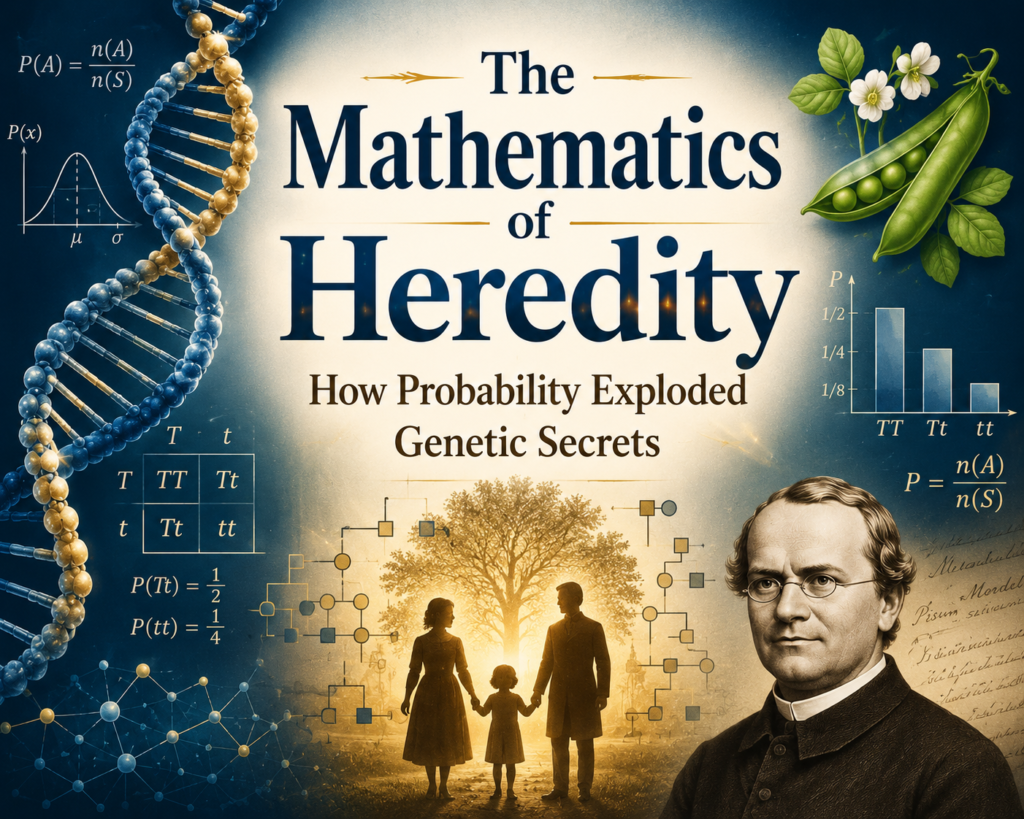
To explain this mathematically, let A represent the dominant trait and a represent the recessive trait. When the hybrid plants produce reproductive cells, the chance of a pollen grain or egg carrying either allele is exactly 1/2. The Punnett grid geometry visually organizes these potential combinations, functioning as a graphic matrix of probability:
| A (21) | a (21) | |
|---|---|---|
| A (21) | AA (41) | Aa (41) |
| a (21) | aA (41) | aa (41) |
By calculating the sums of these independent probabilities, we find the exact distribution of the offspring’s genetic makeup:
Probability of AA=21×21=41
Probability of Aa or aA=(21×21)+(21×21)=41+41=21
Probability of aa=21×21=41
This results in a structural genotypic ratio of 1:2:1. Because both the AA and Aa variations look completely identical on the outside, the visible phenotypic outcome matches the observed statistical split perfectly. This elegant proof showed that hidden factors remain entirely intact, separating and recombining according to standard mathematical laws.
Formulating the Three Fundamental Pillars of Inheritance
By analyzing these numerical ratios across thousands of independent trials, Gregor Mendel formulated a set of principles that defined how traits move through generations. These principles, which collectively form the three laws of inheritance, provided a comprehensive framework that quantified biological development.
The first principle is the law of dominance. This law states that when two different forms of a hereditary factor are present in an organism, one form will completely mask the expression of the other. The expressed attribute is dominant, while the hidden one remains recessive.
The second principle, known as the law of segregation, asserts that every individual organism carries two distinct factors for each specific trait. During the formation of reproductive cells, these two factors separate completely at random, ensuring that each gamete receives only one of the two units.
The third principle is the law of independent assortment. This law stipulates that the internal factors governing different physical traits segregate entirely independently of one another during gamete production. The mathematical implication of this principle is profound. It means that the inheritance of one specific characteristic, such as seed shape, has absolutely no statistical influence on the inheritance of another characteristic, such as flower color. Together, these laws transformed biology from a soft science into an exact, quantitative discipline.
Expanding to Multi-Trait Crosses and Binomial Distribution
Once the mathematics of heredity proved successful for single traits, the next logical step was to analyze multiple characteristics simultaneously. This led to the creation of the dihybrid cross, where two distinct pairs of contrasting traits are tracked at the exact same time. For instance, crossing plants that have round yellow seeds with plants that have wrinkled green seeds yields an entirely uniform first generation. However, when those hybrids self-pollinate, the resulting generation displays a complex distribution.
Instead of a simple single-trait ratio, the multi-trait interaction yields four distinct variations in a highly specific structural distribution. Out of every sixteen offspring, the mathematical distribution of traits breaks down into a predictable 9:3:3:1 ratio. This exact breakdown occurs because the individual probabilities of each independent trait multiply across a larger system of combinations.
(43 Round+41 Wrinkled)×(43 Yellow+41 Green)=169 Round Yellow+163 Round Green+163 Wrinkled Yellow+161 Wrinkled Green
This precise predictability is deeply rooted in binomial expansion in biology. When dealing with larger sample sizes and multiple genetic factors, the distribution of variations can be modeled using the standard binomial expansion formula:
(p+q)n
In this algebraic equation, p and q represent the individual probabilities of alternative alleles, while n represents the total number of independent genetic pairs involved. This algebraic modeling highlighted the deep quantitative trait predictability inherent to living organisms, establishing the historical precursor to biostatistics that would define modern evolutionary research.
Expected Versus Observed Results in Large Datasets
A critical reason this early research succeeded where previous naturalists failed was an understanding of statistical variance and sampling error. In any random system, the observed results from a small sample rarely match the theoretical expected results perfectly. A simple coin flip analogy demonstrates this clearly. If you flip a coin only ten times, you might get seven heads and three tails due to pure chance. However, if you flip that same coin ten thousand times, the ratio converges closely on the expected 50:50 split.
[Theoretical Probability Ratio] ---> 1 : 2 : 1 Genotypic Split
                                 ---> 3 : 1 Phenotypic Split

[Real-World Large Dataset Outcomes] -> 5,474 Dominant vs 1,850 Recessive (Ratio: 2.96 : 1)
During the historic mendel pea plant experiments, thousands of individual crosses were tracked. In one famous series of trials analyzing seed shape, the researcher recorded 5,474 round seeds and 1,850 wrinkled seeds in the second generation. The raw calculated ratio of these real-world findings is 2.96:1.
A lesser scientist might have discarded the data as imperfect or messy. However, an advanced understanding of the mathematics of heredity enabled the researcher to recognize that this minor discrepancy was simply a standard statistical deviation. The massive sample size provided enough raw data to prove that the underlying operational mechanism matched the theoretical expectations perfectly.
Why the Scientific Community Initially Rejected the Math (1865 – 1900)
Despite the flawless mathematical clarity of these findings, when they were published in 1865, the global scientific community met them with overwhelming silence. This historic period highlights why science ignored mendel and his revolutionary insights for more than three decades. The primary reason for this rejection was that nineteenth-century biologists simply were not trained to think in terms of mathematics, probability, or statistical ratios. They viewed biology as a discipline of observation, cataloging, and qualitative descriptions.
Furthermore, prominent thinkers of the era were deeply occupied with other major evolutionary frameworks. The scientific community was focused heavily on the mechanics of natural selection, yet they lacked a valid mechanism to explain how traits were preserved across generations. It remains one of the greatest historical ironies that a clean mathematical solution to the problem of inheritance sat unread on library shelves for thirty-five years, simply because the world was not yet ready for mathematical biology foundations.
The Rediscovery and Transition From Mathematics to Molecules (1900 – 1953)
At the turn of the twentieth century, the scientific landscape shifted radically. Three independent European botanists duplicated the original hybrid breeding experiments, analyzed the numerical ratios, and realized that the mathematics of heredity had already been solved decades earlier. This rediscovery sparked a massive rush to identify the physical structures responsible for these precise mathematical distributions.
[1865: Mathematical Laws] -> [1902: Chromosomal Alignment] -> [1953: DNA Double Helix Molecular Discovery]
In 1902, researchers observed that the physical movement of chromosomes during cell division matched the independent laws of probability genetics perfectly. Finally, in 1953, the structural discovery of the DNA double helix revealed the exact molecular machine driving these statistical outcomes. The digital nature of DNA base-pairing provides the physical reality behind the abstract equations written nearly a century prior. The math did not just describe the biology; the math predicted the structural design of the biology.
Frequently Asked Questions (FAQS)
Why did early genetic experiments specifically rely on pea plants?
The choice of experimental organism was vital to the project’s statistical success. Pea plants were selected because they possess distinct, easily observable traits with no intermediate forms. Additionally, they have a fast life cycle, produce massive quantities of offspring for large statistical datasets, and their pollination can be strictly controlled to prevent accidental outside contamination.
What is the difference between a monohybrid cross and a dihybrid cross?
A monohybrid cross analyzes the inheritance patterns and probability ratios of a single isolated characteristic, such as plant height. A dihybrid cross simultaneously tracks the statistical transmission and independent assortment of two completely separate characteristics at the same time, such as seed shape combined with seed color.
How does the coin flip analogy explain biological inheritance?
A coin flip has two possible outcomes, heads or tails, each with a probability of 1/2. In a hybrid organism, the production of reproductive gametes follows the exact same logic. An egg or sperm cell has an equal 1/2 chance of carrying either the dominant or recessive factor, making fertilization a combination of independent random events.
How did probability theory disprove the theory of blending inheritance?
Blending inheritance claimed that parental traits mixed together like liquids, meaning a tall plant and a short plant would produce medium offspring, permanently erasing the original traits. Probability models proved that traits remain entirely separate, discrete units that can disappear in one generation and reappear completely unchanged in the next.
The Enduring Legacy of Mathematical Biology
Ultimately, history shows us that Gregor Mendel predicted modern genetics by treating the transmission of life as a problem of mathematical logic. Long before anyone could look through an electron microscope or map out a genetic sequence, the mathematics of heredity proved that nature operates on a foundational bedrock of digital, statistical rules.
By calculating simple combinations, managing sampling error, and embracing large datasets, early scientific analysis bypassed the limitations of mid-nineteenth-century technology. The realization that life follows precise, quantifiable laws laid the structural foundation for modern genetics, genomic medicine, and biotechnology. It stands as a timeless monument to the power of quantitative analysis, proving that sometimes the deepest secrets of physical matter are unlocked by abstract mathematics.