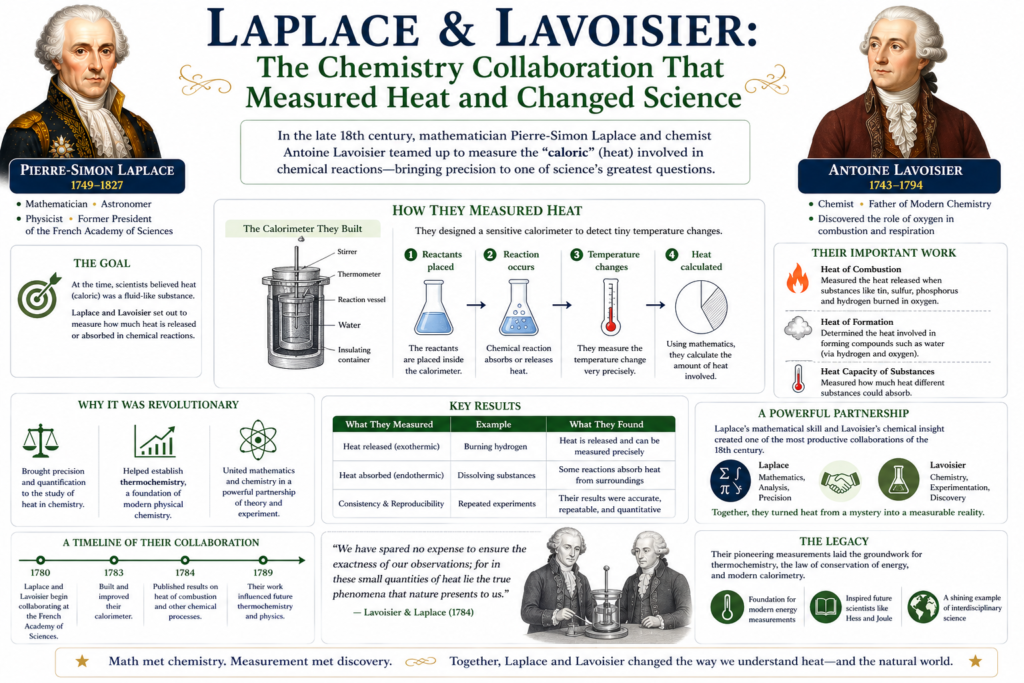
What happens when a legendary mathematician joins forces with the father of modern chemistry? The result is scientific magic. Between 1782 and 1784, Pierre Simon Laplace and Antoine Lavoisier formed one of history’s most remarkable scientific collaborations. Together, they built an ingenious device called the ice calorimeter and used it to measure heat with unprecedented precision. Their work debunked the flawed phlogiston theory, established the foundation of thermodynamics history, and demonstrated the deep connection between chemical reactions, respiration, and heat production. The laplace and lavoisier collaboration was brief but extraordinarily productive. It produced landmark experiments, new instruments, and a lasting legacy that influenced physics, chemistry, and biology for generations. In this article, we will explore how these two giants worked together, what they discovered, why their methods were so powerful, and how their partnership remains a model of interdisciplinary science. Prepare to meet a collaboration that truly changed the world.
Two Giants Before Their Meeting (Pre 1782)
Before their partnership, both men were already famous. Pierre Simon Laplace was a mathematical prodigy who had already begun shaping Celestial Mechanics and Laplace’s Equation. He was deeply interested in applying mathematics to physical problems. Antoine Lavoisier was a French nobleman and chemist who systematized chemistry, discovered the role of oxygen in combustion, and championed the conservation of mass. Lavoisier hated vague speculation. He insisted on precise measurements, calibrated instruments, and reproducible experiments. By 1780, Lavoisier was already dismantling the old phlogiston theory, which claimed that flammable materials released a substance called phlogiston during burning. Lavoisier showed that combustion actually consumed oxygen from the air. But he needed better tools to measure the heat released during chemical reactions. Enter Laplace. The laplace and lavoisier collaboration began when Laplace, who was interested in the mathematical theory of heat, realized that Lavoisier’s chemical questions required rigorous calorimetry. Laplace brought mathematical sophistication and instrumental design. Lavoisier brought chemical expertise and laboratory resources. Together, they were unstoppable.
The Ice Calorimeter: A Masterpiece of Experimental Design (1782 – 1784)
The centerpiece of the laplace and lavoisier collaboration was the ice calorimeter. This device was brilliantly simple yet astonishingly accurate. It consisted of three chambers nested inside one another. The innermost chamber held the experimental subject (a burning candle, a guinea pig, or a chemical reaction). Surrounding this chamber was a layer of pure ice. The outermost chamber contained more ice to insulate against room temperature. Here is how it worked: the heat released by the experiment melted the inner ice layer. The melted water drained out and was collected and weighed. Since the latent heat of fusion of ice was known (the amount of heat required to melt one gram of ice), the total heat produced could be calculated directly. The mathematical relationship was:
Q = m × L_f
where Q is the heat released, m is the mass of ice melted (in grams), and L_f is the latent heat of fusion (approximately 334 joules per gram or 80 calories per gram in their units). By carefully collecting and weighing the meltwater, Laplace and Lavoisier could determine Q with remarkable precision. The laplace and lavoisier collaboration also measured specific heat (the heat needed to raise one gram of a substance by one degree Celsius). They did this by comparing how much ice melted when a hot object cooled from a known temperature. Their experiments on thermal energy transfer set new standards for accuracy. No one had ever measured calorimetry quantities so carefully before. The ice calorimeter became a model for all future instruments.
Key Experiments: Combustion and Respiration
The laplace and lavoisier collaboration performed two classes of groundbreaking experiments. First, they studied combustion. They burned various substances (charcoal, phosphorus, hydrogen) inside the ice calorimeter and measured the heat released per gram of material. They also measured the amount of oxygen consumed. This allowed them to compare different fuels on an equal footing. Their results were astonishingly consistent and helped kill the phlogiston theory forever. If burning released phlogiston, why did burning in pure oxygen release more heat? Their data supported Lavoisier’s oxygen theory. Second, and even more remarkably, they studied respiration. They placed a live guinea pig inside the ice calorimeter and measured the heat it produced over several hours. Simultaneously, they measured the carbon dioxide exhaled and the oxygen consumed. The laplace and lavoisier collaboration discovered that animal respiration is a form of slow combustion. The heat produced by the guinea pig was comparable to the heat produced by burning carbon at the same rate of oxygen consumption. This was a stunning revelation. It connected chemical reactions in the body to physical heat production. Their metabolic heat experiments founded the science of bioenergetics. Today, we know that the food we eat combines with oxygen to release energy, exactly as Laplace and Lavoisier first demonstrated systematically.
The Mathematical Foundation: Latent Heat and Calibration
The laplace and lavoisier collaboration also contributed to the mathematical theory of heat. Laplace, being a master mathematician, developed equations to describe heat flow and phase changes. While the ice calorimeter was simple in concept, its accurate use required careful calibration. Laplace derived formulas for correcting heat losses through the outer ice layer. He also calculated the heat capacity of the apparatus itself. The basic equation for heat balance in the calorimeter was:
Q_experiment = Q_melt + Q_warm + Q_loss
where Q_melt is heat used to melt ice, Q_warm is heat used to warm melted water from 0°C to room temperature, and Q_loss represents heat exchanged with the environment. By minimizing Q_loss (through the outer ice insulation) and measuring Q_warm from the collected meltwater temperature, they could compute Q_experiment to within a few percent. Their work on latent heat (heat absorbed or released during phase change without temperature change) was pioneering. The concept of latent heat had been introduced by Joseph Black a few decades earlier, but Laplace and Lavoisier made it a precise measurement of heat tool. They also measured specific heat capacities of various substances (metals, liquids, gases) by comparing how much ice melted when equal masses cooled through equal temperature intervals. The formula they used was:
m_substance × c_substance × ΔT = m_ice_melted × L_f
where c_substance is the unknown specific heat. Solving for c_substance gave numerical values that still hold up today. This was physical chemistry at its finest.
Why Their Collaboration Was So Effective
The laplace and lavoisier collaboration succeeded where others failed for several reasons. First, they combined complementary skills. Laplace thought mathematically and designed precise instruments. Lavoisier understood chemistry and ensured pure substances. Second, they shared a philosophy: measure everything, trust no assumption, and let data guide theory. Third, they were both wealthy and well connected, allowing them to build sophisticated apparatus. Fourth, they worked in Lavoisier’s laboratory at the Arsenal in Paris, which was among the best equipped in Europe. Fifth, they published their results jointly in 1784 in the prestigious Mémoires de l’Académie Royale des Sciences. Their paper, titled “Memoir on Heat,” became a classic. The laplace and lavoisier collaboration also demonstrated the power of interdisciplinary science. Neither man alone could have built the ice calorimeter or interpreted its results so comprehensively. Laplace needed Lavoisier’s chemical knowledge; Lavoisier needed Laplace’s mathematical rigor. Their partnership is a model for modern scientific collaboration, where physicists, chemists, and biologists work together on complex problems. Their work also influenced later scientists, including Joseph Louis Gay Lussac and Sadi Carnot, who founded thermodynamics.
The Tragic End and Lasting Legacy (1794)
Tragically, the laplace and lavoisier collaboration ended in bloodshed. During the French Revolution, Antoine Lavoisier was targeted as a former tax collector for the hated Ferme Générale. Despite his immense scientific contributions, he was arrested, tried, and guillotined on May 8, 1794. The mathematician Joseph Louis Lagrange famously said: “It took them only an instant to cut off that head, but France may not produce another like it in a century.” Laplace survived the Revolution by keeping a low profile and carefully navigating politics. He never again collaborated as closely with anyone. However, he carried forward the lessons of their partnership. Laplace’s later work on Laplace’s Equation and Nebular Hypothesis was influenced by the experimental mindset he learned from Lavoisier. The laplace and lavoisier collaboration lived on through their published results. Their ice calorimeter became a standard tool in 19th century chemistry labs. Their measurement of specific heat and latent heat provided critical data for the development of the first law of thermodynamics. Their respiration experiments inspired later studies on metabolism, leading to the work of Max Rubner and others. Even today, when a biologist measures oxygen consumption to calculate metabolic rate, they are following a path first cleared by Laplace and Lavoisier.
Modern Relevance and Recognition
The laplace and lavoisier collaboration is celebrated today as a landmark in the history of science. Their ice calorimeter is displayed at the Musée des Arts et Métiers in Paris. Modern laboratory instruments for calorimetry, such as differential scanning calorimeters and bomb calorimeters, are direct descendants of their device. The principles they established heat measurement via phase change are still used in physics teaching labs worldwide. Their work also connects to gas laws because they carefully measured gases consumed and produced during combustion and respiration. The science breakthroughs they achieved include: (1) establishing calorimetry as a precise quantitative discipline, (2) proving that respiration is a form of combustion, (3) providing key evidence against phlogiston theory, (4) measuring specific heat for multiple substances, and (5) demonstrating the power of interdisciplinary research. The laplace and lavoisier collaboration also influenced Pierre Simon Laplace’s other work. His Laplace Transform and Bayesian Foundations in probability reflect the same commitment to rigorous quantification. The Shape of the Earth and Early Black Hole Theory also emerged from his desire to measure and predict. But perhaps no other project combined pure mathematics with hands on experiment as beautifully as their calorimetry work.
Frequently Asked Questions (FAQs)
What did Laplace and Lavoisier discover together?
They built the first precision ice calorimeter, measured the heat released by chemical reactions and respiration, proved that animal respiration is a form of slow combustion, and provided key data that helped debunk the phlogiston theory.
How did the ice calorimeter work?
The heat from an experiment melted ice in an inner chamber. The melted water was collected and weighed. Using the known latent heat of fusion of ice (heat required to melt one gram), the total heat produced was calculated as Q = m × L_f.
Why was the Laplace and Lavoisier collaboration so important?
It was one of history’s first major interdisciplinary scientific collaborations, combining mathematics (Laplace) with chemistry (Lavoisier). It established calorimetry as a precise quantitative science and connected chemical reactions to heat production.
What happened to Antoine Lavoisier after the collaboration?
Lavoisier was executed by guillotine in 1794 during the French Revolution because of his former role as a tax collector. Laplace survived and continued his mathematical work.
Are the concepts of latent heat and specific heat from Laplace and Lavoisier?
They did not discover these concepts (Joseph Black discovered latent heat earlier), but they perfected their measurement. Their precise measurements of latent heat and specific heat for multiple substances were among the best of their time.
Conclusion: A Partnership That Measured the Unseen
The laplace and lavoisier collaboration lasted only a few years, but its impact echoes across centuries. Two extraordinary minds, one a mathematician and one a chemist, joined forces to measure heat itself. They built an elegant instrument, performed careful experiments, and drew profound conclusions about combustion, respiration, and energy. Their work helped dismantle the phlogiston theory and laid the groundwork for thermodynamics. Pierre Simon Laplace, known for Laplace’s Demon, Father of Probability, Laplace Transform, and Mécanique Céleste, showed his experimental side alongside Lavoisier. Antoine Lavoisier, despite his tragic death, is remembered as the father of modern chemistry. Their partnership reminds us that great science happens at the boundaries between disciplines. It also connects to how ancient greek scientists changed modern science by first asking fundamental questions about matter, heat, and change. The Greeks speculated about the four elements; Laplace and Lavoisier measured them. So the next time you see a calorimeter, a metabolic test, or a nutritional label, remember the brilliant and powerful collaboration that made it all possible. Laplace and Lavoisier measured the invisible flow of heat and, in doing so, illuminated the hidden engine of the universe.