Before he became the prince of mathematics, before he mapped the Earth and tamed magnetism, he was just a poor boy in Brunswick with a fierce intelligence and an abusive father who wanted him to be a laborer. The story of the gauss child prodigy is one of the most inspiring tales in the history of science. It is a story of a young mind that saw patterns where others saw tedious work, of a boy who corrected his father’s payroll errors at age three, and of a schoolroom moment that has become legendary. That moment, when a young carl friedrich gauss summed all the numbers from 1 to 100 in seconds, reveals the essence of his genius. He did not work harder than the other children. He thought smarter. This article explores the early life, the famous anecdote, and the mathematical intuition that marked the gauss child prodigy as someone extraordinary.
A Humble Beginning in Brunswick
On April 30, 1777, carl friedrich gauss was born in Brunswick, in the Duchy of Brunswick-Wolfenbüttel. His father, Gebhard Gauss, was a hardworking but harsh man who worked as a gardener, a bricklayer, and a treasurer for a small insurance fund. Gebhard believed that education was a waste of time for a poor boy. He wanted young Carl to learn a trade and start earning money. Fortunately, the boy had two fierce advocates: his mother, Dorothea, who recognized his brilliance, and his uncle, Friedrich, who encouraged his love of numbers. By the age of three, the gauss child prodigy was already demonstrating his mathematical intuition. He would sit with his father as Gebhard calculated the weekly payroll for his workers. One evening, after his father had finished his sums, little Carl looked up and said, “Father, your calculation is wrong. It should be this number.” Gebhard checked his work and was astonished to find that his three year old son was correct. The gauss child prodigy had discovered numbers before he could properly read.
The Famous Classroom Anecdote
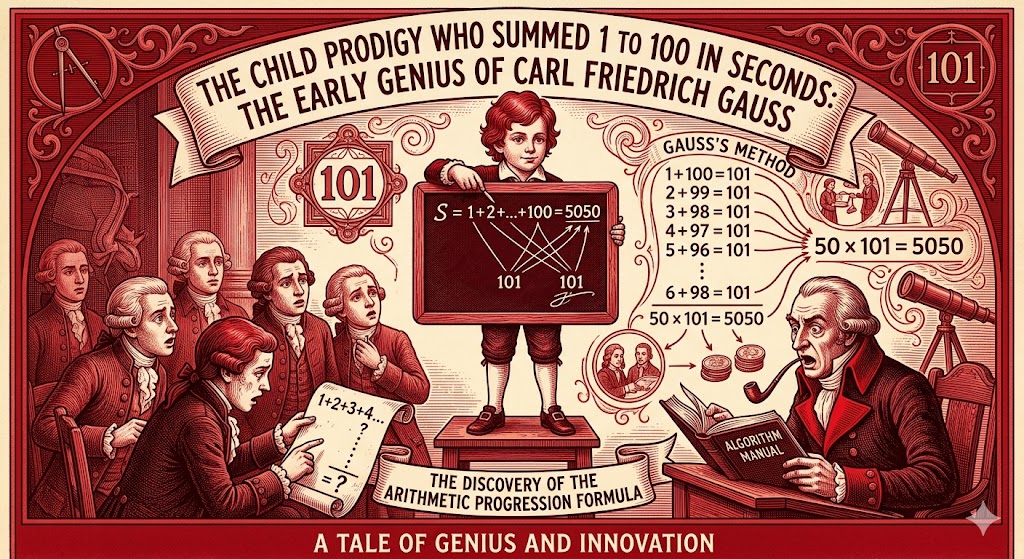
The most famous story of the gauss child prodigy takes place in a noisy schoolroom in Brunswick. Gauss was about nine years old. His teacher, a strict man named Büttner, wanted to keep the class busy so he could have a moment of peace. He assigned the students a tedious task: add all the whole numbers from 1 to 100. The teacher expected this to take the children half an hour. The other students began laboriously adding 1 plus 2 equals 3, plus 3 equals 6, plus 4 equals 10, and so on. They wrote line after line of numbers, their slates filling with cramped figures. But the gauss child prodigy did not reach for his slate immediately. He stared at the problem for a few seconds. Then he wrote a single number on his slate: 5050. He placed his slate on the teacher’s desk and said, “There it lies.” The teacher was annoyed, thinking the boy was being lazy. But when the other students finally finished, only Gauss had the correct answer. Everyone else was wrong.
The Mathematical Insight: Not Addition, but Multiplication
How did the gauss child prodigy solve the problem so quickly? He did not add the numbers sequentially. He looked for a pattern. Gauss realized that if you add the first number (1) to the last number (100), you get 101. Then add the second number (2) to the second last number (99), you also get 101. The third number (3) plus the third last number (98) is also 101. This pattern continues all the way to the middle. There are exactly 50 such pairs in the numbers from 1 to 100. Instead of 100 additions, Gauss performed one multiplication: 50×101=5050.
In mathematical terms, the gauss child prodigy had discovered the formula for the sum of an arithmetic series. For the sum of the first natural numbers, the formula is:
For , this gives . The gauss child prodigy had derived this formula intuitively, without ever being taught it. His teacher, Büttner, was so shocked that he immediately ordered a more advanced arithmetic textbook for the boy. He also purchased a special tutor for Gauss, a brilliant young man named Johann Martin Bartels, who would later become a teacher to the famous Russian mathematician Nikolai Lobachevsky. The gauss child prodigy had impressed the one person who could change his life.
Deeper Than a Trick: The Nature of His Genius
The story of the gauss child prodigy is often told as a charming anecdote. But it reveals something profound about Gauss’s approach to mathematics. Most people see a problem and attack it directly. Gauss always looked for structure, symmetry, and pattern. He did not ask “How do I add these numbers?” He asked “What is the underlying rule that governs this sequence?” This ability to step back, to generalize, and to find hidden order is what made him the prince of mathematics. The same mind that saw the pairing pattern in 1 to 100 would later see the quadratic reciprocity in gauss number theory, the method of least squares in astronomy, and the gaussian curvature in geometry. The gauss child prodigy never disappeared. He just grew up.
The Triangular Numbers Connection
The sum of the first n natural numbers has a beautiful geometric interpretation that the gauss child prodigy would have appreciated. These sums are called triangular numbers because you can arrange dots in an equilateral triangle. The first triangular number is 1 (one dot). The second is 3 (a triangle with two dots per side). The third is 6. The fourth is 10. The formula counts the number of dots in a triangle of side . Gauss’s insight, that 1 + 100 = 2 + 99 = 3 + 98, is equivalent to pairing opposite sides of this triangle. This geometric visualization is a classic example of mathematical logic translating a calculation into a pattern. The gauss child prodigy did not need the geometry. He saw the algebra directly. But the connection shows how deeply number patterns run through all of mathematics.
The Role of His Mother and the Duke
The gauss child prodigy would have remained a laborer if not for two people. His mother, Dorothea, never stopped believing in him. She had no education herself, but she recognized that her son was special. She pushed back against her husband’s demands that Carl work in the brickyard. The second benefactor was the Duke of Brunswick, Charles William Ferdinand. When the teacher Büttner and the tutor Bartels showed the Duke the boy’s extraordinary abilities, the Duke agreed to pay for Gauss’s education. From that point on, the gauss child prodigy had a patron. He attended the Collegium Carolinum (1792-1795) and then the University of Göttingen (1795-1798). Without the Duke’s financial support, Gauss would never have had access to books, let alone the freedom to discover gauss and ceres or write Disquisitiones Arithmeticae. The gauss child prodigy was lucky, but he also made his own luck through undeniable brilliance.
Beyond 1 to 100: Other Childhood Feats
The summation of 1 to 100 is the most famous story about the gauss child prodigy, but it is not the only one. Even before he could read, Gauss could do complex mental arithmetic. He could calculate change for his mother’s errands faster than the shopkeeper. He memorized multiplication tables for numbers that he had never been taught. He developed his own methods for calculating compound interest and currency conversions. By age ten, the gauss child prodigy was teaching himself Latin and Greek, and he soon mastered the works of Newton and Euler in their original languages. His mental math abilities were legendary. He could perform long divisions and square roots in his head faster than most adults could with pencil and paper. The gauss child prodigy was not just a fast calculator. He was a deep thinker who used speed as a tool for discovery.
The Psychological Profile of a Prodigy
What makes a gauss child prodigy? Modern psychologists who study cognitive development point to several factors: exceptional working memory, pattern recognition ability, and a relentless drive to understand why. Gauss exhibited all of these. His working memory allowed him to hold multiple numbers and operations in his head simultaneously. His pattern recognition allowed him to see the pairing strategy for 1 to 100 instantly. And his drive to understand why meant that he was never satisfied with a memorized procedure. He had to derive it himself. This combination is rare. Many children can memorize formulas. Few can reinvent them from scratch. The gauss child prodigy did both. He also benefited from early exposure to numbers through his father’s work. Watching Gebhard calculate payrolls was like an informal apprenticeship in arithmetic.
The Legend Grows: Fact vs. Fiction
How much of the gauss child prodigy story is true? Historians have confirmed that Gauss did attend a school taught by Büttner, and that Büttner did recognize Gauss’s talent. The summation story appears in several early biographies, including one written by Gauss’s friend, the mathematician Wolfgang Sartorius von Waltershausen. However, the exact age of Gauss at the time (often given as 7, 8, 9, or 10) varies between sources. Some scholars suggest that the problem may have been 1 to 100, or 1 to 1000, or even 1 to 100,000. The core truth remains undisputed: at a very young age, the gauss child prodigy demonstrated an extraordinary ability to see mathematical structure. The specific numbers are less important than the lesson. When others grind, genius finds a shortcut.
The Prodigy Becomes the Master
The gauss child prodigy grew into the prince of mathematics, but he never lost his childlike wonder. Throughout his long career, he continued to approach problems with fresh eyes. He asked naive questions that led to deep answers. He was not afraid to look foolish. When he discovered gauss non euclidean geometry, he was challenging 2000 years of mathematical orthodoxy. When he invented the gauss fast fourier transform, he was rethinking a calculation that everyone else accepted as tedious but necessary. The gauss child prodigy who added numbers in a schoolroom became the man who measured the Earth’s curvature, mapped the orbit of Ceres, and laid the foundations for Einstein’s relativity. The child was father to the man.
Frequently Asked Questions (FAQs)
Is the story about Gauss summing 1 to 100 true?
The core of the story is true. Historians agree that carl friedrich gauss, as a young gauss child prodigy, demonstrated an exceptional ability to sum an arithmetic series quickly. The specific numbers (1 to 100) and the exact age (about nine years old) come from early biographies written by people who knew Gauss personally. While some details may have been embellished, the mathematical insight and the teacher’s astonishment are well documented.
What formula did the Gauss child prodigy discover?
The gauss child prodigy discovered the formula for the sum of the first n natural numbers: . For , this gives . This formula works for any arithmetic progression with a common difference of 1. It is one of the most famous formulas in sequence and series mathematics.
How did Gauss solve 1 to 100 so quickly?
Instead of adding sequentially, the gauss child prodigy paired the numbers: 1+100=101, 2+99=101, 3+98=101, and so on. There are 50 such pairs in the numbers 1 through 100. He then multiplied 50 × 101 = 5050. This method works because of the symmetry of the arithmetic series. It is a classic example of mathematical intuition turning a long calculation into a simple multiplication.
What other childhood feats did Gauss perform?
Beyond the famous summation, the gauss child prodigy corrected his father’s payroll errors at age three. He taught himself to read and calculate before formal schooling. He memorized multiplication tables for large numbers without instruction. He could perform complex mental math including square roots and long divisions faster than adults. He also taught himself Latin and Greek to read scientific works in their original languages.
Did Gauss have a difficult childhood?
Yes. The gauss child prodigy was born into a poor family. His father, Gebhard, wanted him to become a laborer and often tried to pull him out of school. His mother, Dorothea, was his champion. The family could not afford books or candles for night study. Gauss was saved by the Duke of Brunswick, who recognized his talent and paid for his education from age 14 onward. Without the Duke’s support, the world might have lost the prince of mathematics.
Conclusion
The story of the gauss child prodigy is a story of raw, undeniable talent meeting opportunity. A poor boy with a harsh father and a loving mother looked at a tedious math problem and saw a shortcut. He did not have a calculator. He did not have a formula sheet. He had only his mind, and his mind was extraordinary. That moment in the schoolroom became a legend, but the reality is even more impressive. The gauss child prodigy grew up to become carl friedrich gauss, the prince of mathematics, whose discoveries in gauss number theory, gauss normal distribution, method of least squares, gauss and ceres, gauss geodesy, gauss electromagnetism, gaussian curvature, gauss fast fourier transform, and gauss non euclidean geometry changed the world. In many ways, how ancient greek scientists changed modern science by asking fundamental questions about numbers and shapes, the gauss child prodigy changed science by proving that a child’s curiosity, properly nurtured, can move the world. The next time you see a young student struggling with math, remember Gauss. Genius is not just hard work. It is seeing the pattern that everyone else missed.