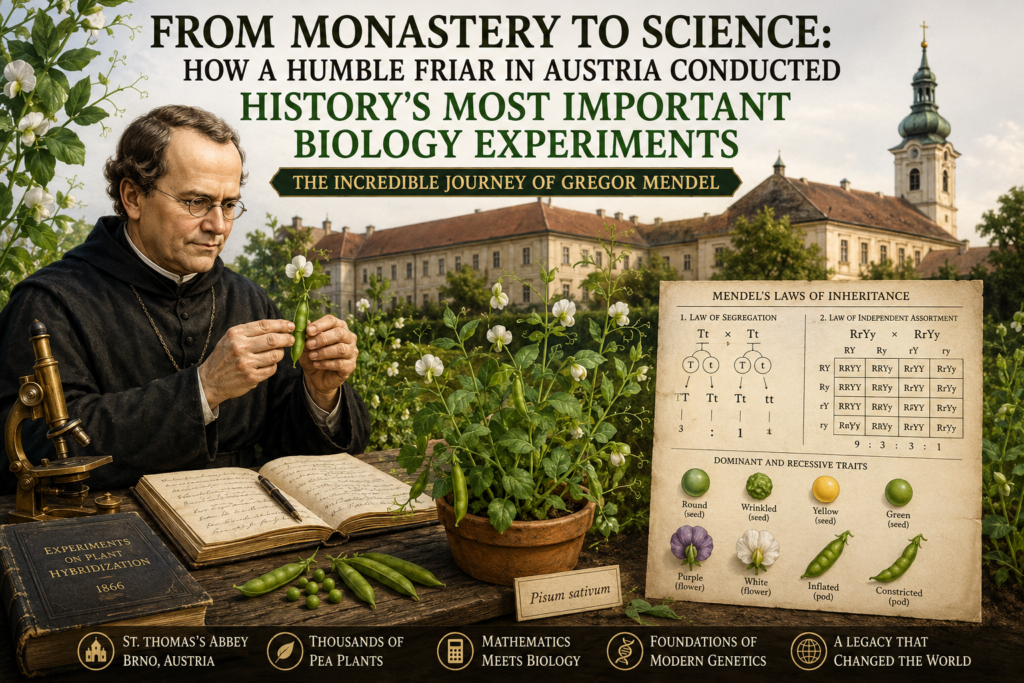
The story of the gregor mendel monastery journey is one of the most remarkable transformations in scientific history. In a quiet monastery in Austria, a humble friar carried out experiments that would eventually revolutionize biology, genetics, agriculture, and medicine. While the world paid little attention during his lifetime, his discoveries later became the foundation of modern genetics.
Today, scientists recognize Gregor Mendel as the father of genetics. Yet his path to scientific greatness did not begin in a famous university laboratory. Instead, it started in a religious community where intellectual curiosity, education, and careful observation were encouraged. The story of the gregor mendel monastery environment reveals how scientific breakthroughs can emerge from the most unexpected places.
The Early Life of Gregor Mendel (1822 – 1843)
Gregor Mendel was born in 1822 in Heinzendorf, then part of the Austrian Empire. His family were farmers, and from a young age he developed an interest in plants and nature.
Despite financial difficulties, Mendel excelled in school. His teachers recognized his intelligence and encouraged him to continue his studies. Eventually, he sought a path that would allow him to pursue education while maintaining financial stability.
This journey led him toward religious life, a decision that would unexpectedly shape the future of biology.
St. Thomas’s Abbey Brno: A Unique Intellectual Center (1843 – 1850)
In 1843, Mendel entered St. Thomas’s Abbey Brno as an Augustinian friar. Contrary to the stereotype of monasteries as isolated places, this institution was a vibrant cultural hub filled with scholars, teachers, and intellectuals.
The abbey represented one of the finest examples of intellectual monastery history in Central Europe. Members of the Augustinian order intellectuals actively participated in science, philosophy, literature, and education.
The monastery promoted:
- Scientific discussion
- Mathematical learning
- Agricultural innovation
- Natural history research
- Educational excellence
This environment became the perfect setting for the future gregor mendel monastery experiments.
The abbey’s leader, Abbot Cyrill Napp, strongly encouraged scientific investigation. Napp was fascinated by heredity and often asked an important question:
“What is inherited and how?”
That question would inspire Mendel’s life’s work.
Education and Scientific Training (1851 – 1853)
Recognizing Mendel’s talent, the monastery sent him to the University of Vienna.
There he received advanced instruction in:
- Physics and mathematics education
- Botany
- Statistics
- Experimental science
At the university, Mendel studied under distinguished professors who emphasized quantitative measurement rather than simple observation.
This mathematical approach would later distinguish the gregor mendel monastery experiments from nearly every biological study conducted during the nineteenth century.
Most naturalists merely described plants and animals. Mendel measured, counted, calculated, and analyzed patterns numerically.
Scientific Freedom Inside the Monastery
One reason the gregor mendel monastery story is so extraordinary is the scientific freedom Mendel enjoyed.
The monastery provided:
- Land for experimentation
- Access to books
- Greenhouse facilities
- Financial support
- Time for research
This scientific infrastructure was rare during the nineteenth century.
The monastery also supported weather observation programs, agricultural studies, and participation in the Brno natural history society.
These opportunities allowed Mendel to combine theology, mathematics, and biology in ways few others could.
The monastery became a model example of religious institutions and scientific discovery working together.
Why Mendel Chose Peas (1856 – 1863)
One of the most brilliant decisions in the history of science was why mendel chose peas.
Pea plants offered several advantages:
- Fast growth
- Easily observable traits
- Natural self-pollination
- Easy cross-pollination
- Large numbers of offspring
Mendel selected seven traits, including:
- Flower color
- Seed shape
- Seed color
- Pod shape
- Pod color
- Flower position
- Plant height
Within Mendel’s monastery garden and monastic greenhouse experiments, thousands of pea plants were carefully cultivated and monitored.
The experimental plot became one of the most important locations in scientific history.
The Remarkable Pea Plant Experiments
The famous mendel pea plant experiments involved crossing plants with contrasting traits.
For example:
- Tall plants × Short plants
- Yellow seeds × Green seeds
- Round seeds × Wrinkled seeds
Mendel carefully recorded every result.
Unlike previous researchers, he counted every offspring and analyzed the results mathematically.
This quantitative approach allowed him to identify hidden patterns that other scientists had missed.
The success of the gregor mendel monastery research depended not only on biological observation but also on mathematical reasoning.
Mathematics Enters Biology
One of Mendel’s greatest achievements was introducing mathematics into biological research.
Consider a simple trait:
Tall plant (TT) × Short plant (tt)
First generation:
TT × tt
All offspring:
Tt, Tt, Tt, Tt
Result:
100% Tall
Second generation:
Tt × Tt
Using probability:
| Parent Combination | Result |
|---|---|
| T × T | TT |
| T × t | Tt |
| t × T | Tt |
| t × t | tt |
Genotype Ratio:
1 TT : 2 Tt : 1 tt
Phenotype Ratio:
3 Tall : 1 Short
This famous 3:1 ratio became one of the greatest discoveries in biology.
Mathematically:
Probability(Tall) = 3/4 = 75%
Probability(Short) = 1/4 = 25%
This relationship became known through the famous mendel 3 to 1 ratio.
Discovery of the Laws of Inheritance
After years of experimentation, Mendel formulated the famous three laws of inheritance.
These laws explained how traits pass from one generation to another.
His discoveries laid the foundation for modern genetics.
The gregor mendel monastery experiments demonstrated that inheritance follows predictable rules rather than random mixing.
The Law of Segregation
The first principle became known as the law of segregation.
According to this law:
Every organism possesses two hereditary factors for a trait.
During reproduction:
TT → T + T
Tt → T + t
tt → t + t
Each parent contributes only one factor to the offspring.
This simple concept remains central to genetics today.
Dominance and Recessiveness
Mendel also identified what we now call dominant and recessive traits.
If T represents tallness and t represents shortness:
TT = Tall
Tt = Tall
tt = Short
The dominant trait masks the recessive trait when both are present.
This discovery explained why certain characteristics appear while others remain hidden for generations.
Monohybrid Cross Experiments
The famous monohybrid cross experiments focused on a single trait.
Example:
Tt × Tt
Result:
1 TT : 2 Tt : 1 tt
Phenotypic outcome:
3 Tall : 1 Short
These experiments provided overwhelming evidence that heredity follows predictable mathematical rules.
Dihybrid Cross and Advanced Discoveries
Mendel later expanded his studies using the dihybrid cross method.
Example:
RrYy × RrYy
Expected ratio:
9 : 3 : 3 : 1
Mathematically:
9/16 dominant for both traits
3/16 dominant for first trait only
3/16 dominant for second trait only
1/16 recessive for both traits
This result helped establish the principle of independent inheritance.
Daily Life Inside the Monastery
The image of Mendel as a scientist working alone is not entirely accurate.
His cloister life included:
- Teaching students
- Religious duties
- Gardening
- Scientific meetings
- Community activities
The monastery connected him with the local intellectual elite and scientific communities throughout Central Europe.
The religious background of Mendel did not hinder science. Instead, it provided the stability and support necessary for his groundbreaking research.
This remains one of history’s strongest examples of monastic science contributions.
Presenting the Results (1865 – 1866)
After completing years of work, Mendel presented his findings to members of the Brno natural history society.
He later published:
“Experiments on Plant Hybridization”
The paper contained detailed observations, mathematical analysis, and revolutionary conclusions.
Today it is regarded as one of the most important scientific papers ever written.
Yet almost nobody noticed.
Why Science Ignored Mendel
One of the great mysteries of scientific history is why science ignored mendel.
Several factors contributed:
- Biology was largely descriptive.
- Few scientists understood statistics.
- The paper circulated locally.
- Many researchers favored blending inheritance theories.
As a result, Mendel’s discoveries remained largely forgotten for decades.
The gregor mendel monastery research sat unnoticed despite its enormous significance.
Mendel and Darwin
An interesting historical question involves mendel and darwin.
Both men were studying inheritance during the nineteenth century.
Darwin explained evolution through natural selection.
Mendel explained how traits are inherited.
Together, their ideas form the foundation of modern evolutionary biology.
Unfortunately, there is no evidence that Darwin fully appreciated Mendel’s work during his lifetime.
Had the two theories been connected earlier, genetics might have advanced decades sooner.
Rediscovery and Recognition (1900 – 1910)
Around 1900, several scientists independently rediscovered Mendel’s findings.
When they compared their results with his paper, they realized Mendel had already solved the problem decades earlier.
The scientific community quickly recognized the significance of the gregor mendel monastery experiments.
Mendel was finally acknowledged as the founder of genetics.
His once-overlooked monastery garden became legendary.
How Gregor Mendel Predicted Modern Genetics
The statement that Gregor Mendel predicted modern genetics is not an exaggeration.
Although he never saw chromosomes or DNA, his mathematical laws accurately described genetic inheritance.
Modern genetics later confirmed:
- Genes exist.
- Genes occur in pairs.
- Genes separate during reproduction.
- Genes can assort independently.
Mendel discovered these principles decades before scientists understood their physical basis.
From Mendel to DNA
The journey from mendel to DNA represents one of science’s greatest success stories.
Mendel discovered inheritance patterns.
Scientists later identified chromosomes.
Eventually DNA was discovered as the molecule carrying genetic information.
Today:
- Genetic engineering
- Gene therapy
- DNA testing
- Personalized medicine
all trace their origins back to the work conducted within the gregor mendel monastery environment.
The Lasting Legacy of the Monastery
The history of Central European science contains many achievements, but few compare to Mendel’s.
His work demonstrates:
- The value of careful observation
- The power of mathematics
- The importance of scientific patience
- The benefits of interdisciplinary learning
The monastery provided exactly the conditions needed for discovery:
- Educational resources
- Intellectual support
- Research facilities
- Academic freedom
Without that environment, modern genetics might have emerged much later.
FAQs
Who was Gregor Mendel?
Gregor Mendel was an Austrian Augustinian friar whose pea plant experiments established the foundations of modern genetics.
Why are Mendel’s experiments important?
They revealed the basic laws governing heredity and trait transmission.
Why did Mendel use pea plants?
Pea plants grow quickly, have clear traits, and are easy to cross-pollinate and study.
What was Mendel’s biggest discovery?
His biggest discovery was that inheritance follows predictable mathematical patterns rather than random blending.
Why was Mendel ignored initially?
Most scientists of his era did not understand statistical methods and failed to recognize the importance of his findings.
How does Mendel influence modern genetics today?
Modern genetics, genomics, DNA research, and biotechnology all build upon Mendel’s original principles.
Conclusion
The story of the gregor mendel monastery is one of history’s most inspiring scientific journeys. A humble friar working in a monastery garden transformed our understanding of life itself. Supported by enlightened religious leaders, rigorous education, and a culture of intellectual curiosity, Gregor Mendel conducted experiments that changed biology forever.
His work proved that science can flourish in unexpected places and that careful observation combined with mathematics can reveal the deepest secrets of nature. From a quiet monastery in Brno emerged discoveries that ultimately led humanity from simple pea plants to the age of DNA, genomics, and modern medicine. Few scientific achievements have had such a profound impact on the world, making Mendel’s monastery experiments among the most important ever conducted.