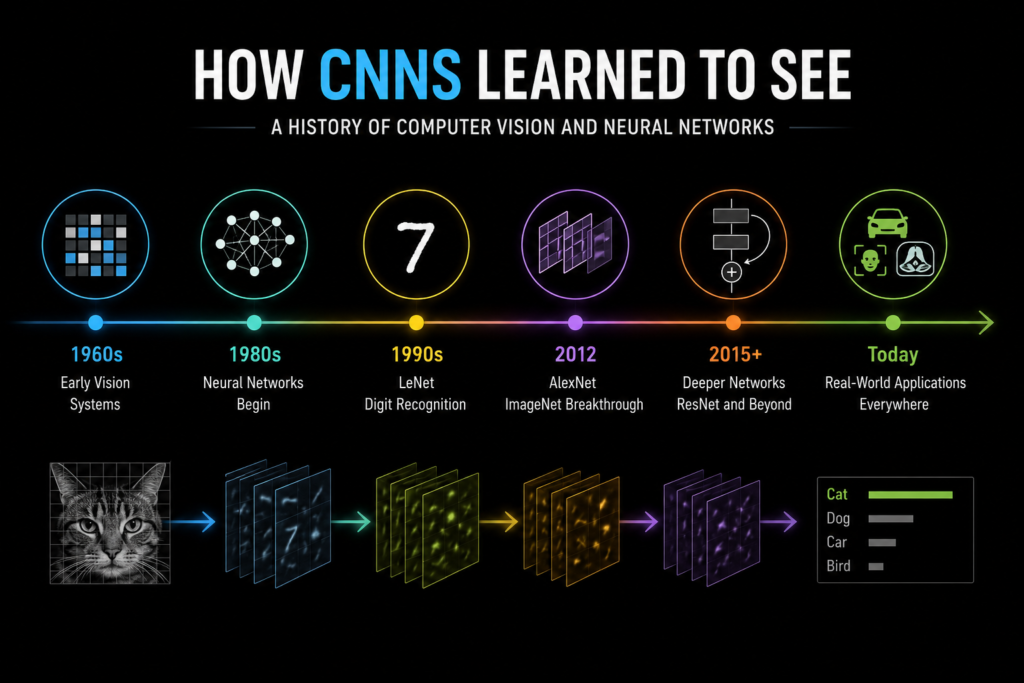
The story of cnn computer vision history represents one of the greatest technological revolutions in artificial intelligence. For decades, scientists dreamed about building machines capable of seeing and understanding the world like humans.
That dream once seemed impossible.
Early computers could calculate numbers quickly, but they could not recognize faces, understand objects, or interpret visual scenes.
Then convolutional neural networks changed everything.
The rise of cnn computer vision history transformed artificial intelligence from rule-based systems into visual learning machines capable of:
- Facial recognition
- Medical imaging
- Object detection
- Self-driving navigation
- Real-time surveillance
- Image segmentation
Today, computer vision powers countless AI technologies across the world.
In this article, we will explore the complete cnn computer vision history, from early visual experiments to modern deep learning systems that can “see” almost as effectively as humans.
The Origins of Computer Vision (1940 – 1960)
The foundations of cnn computer vision history began long before modern deep learning.
Scientists first attempted to understand how biological vision worked inside the human brain.
Researchers studied:
- Visual cortex behavior
- Pattern recognition
- Edge detection
- Spatial awareness
This research became strongly connected to:
At the same time, early artificial intelligence researchers explored ways to simulate human perception using machines.
The first artificial neuron model appeared in 1943 through Warren McCulloch and Walter Pitts.
Their work became foundational to:
These early ideas inspired future machine vision systems.
Early Computer Vision Challenges (1960 – 1980)
The early era of cnn computer vision history faced enormous limitations.
Computers lacked:
- Fast processors
- Large memory systems
- Visual datasets
- Efficient algorithms
Researchers attempted rule-based vision systems using manually programmed logic.
These systems struggled badly with:
- Shape recognition
- Lighting changes
- Object variation
- Pixel intensity interpretation
Scientists realized visual perception required learning systems rather than fixed programming rules.
The Rise of Neural Networks
Another important stage in cnn computer vision history came through neural networks.
Frank Rosenblatt introduced the perceptron during the 1950s.
This breakthrough became linked to:
The perceptron showed machines could learn simple patterns automatically.
However, single-layer neural networks could not process complex images effectively.
The field later suffered because of the:
Many researchers temporarily abandoned neural systems.
The Biological Inspiration Behind CNNs
The future of cnn computer vision history strongly connected to neuroscience.
Scientists discovered the visual cortex processes information hierarchically.
Different neurons specialize in:
- Edge detection
- Motion recognition
- Shape analysis
- Pattern interpretation
Researchers wanted machines capable of imitating biological visual systems.
This idea inspired convolutional neural networks.
Kunihiko Fukushima and the Neocognitron (1980)
One major breakthrough in cnn computer vision history came from Kunihiko Fukushima.
Fukushima created the Neocognitron in 1980.
The architecture introduced several revolutionary concepts:
- Local receptive fields
- Hierarchical features
- Shift invariance
- Feature hierarchy
Although primitive by modern standards, the Neocognitron became one of the earliest CNN-like architectures.
Its ideas later influenced modern deep learning dramatically.
Yann LeCun and LeNet (1989 – 1998)
The defining breakthrough in early cnn computer vision history came through Yann LeCun.
LeCun developed LeNet, one of the first successful convolutional neural networks.
This breakthrough became connected to:
LeNet successfully recognized handwritten digits.
Applications included:
- Postal mail sorting
- Bank check reading
- Character recognition
This achievement proved neural systems could solve real-world visual tasks.
How CNNs Process Images
To fully understand cnn computer vision history, we must examine how CNNs work.
CNNs process images through multiple layers.
Convolution Layers
These layers apply image filters called kernels.
The system learns:
- Edges
- Textures
- Patterns
- Shapes
Pooling Layers
Pooling reduces image dimensions while preserving important visual information.
Fully Connected Layers
These layers generate final predictions.
CNNs gradually build semantic understanding from raw pixels.
Backpropagation and Deep Learning
Another major breakthrough in cnn computer vision history involved backpropagation.
This learning method became connected to:
Backpropagation allowed neural systems to update weights automatically.
The learning equation became:
This optimization process enabled large-scale neural learning.
ImageNet Changes Everything (2009 – 2012)
The biggest turning point in cnn computer vision history involved ImageNet.
Fei-Fei Li and her team created a massive labeled image dataset.
This breakthrough became connected to:
ImageNet provided:
- Millions of labeled images
- Massive dataset diversity
- Large-scale benchmarking
Researchers finally had enough visual data for deep learning systems.
AlexNet Launches the Deep Learning Revolution (2012)
The defining moment in cnn computer vision history occurred in 2012.
Alex Krizhevsky developed AlexNet alongside Geoffrey Hinton and Ilya Sutskever.
This breakthrough became linked to:
AlexNet dramatically outperformed traditional computer vision systems during the ImageNet competition.
Its success shocked the scientific world.
Deep learning suddenly became the dominant AI paradigm.
GPU Computing and Visual AI
Another critical factor behind cnn computer vision history involved GPU acceleration.
This breakthrough strongly connected to:
GPUs enabled:
- Faster matrix operations
- Massive parallel computation
- Deep CNN optimization
Without GPUs, modern computer vision systems would likely remain impossible.
ResNet and Extremely Deep Networks (2015)
The next major breakthrough in cnn computer vision history came through ResNet.
Researchers at Microsoft introduced residual learning architectures capable of training extremely deep neural systems.
This became linked to:
ResNet solved major deep learning limitations using skip connections.
The architecture transformed computer vision accuracy dramatically.
CNNs and Real World Applications
Today, the impact of cnn computer vision history can be seen everywhere.
CNN systems now power:
- Autonomous vehicles
- Medical imaging
- Facial recognition
- Security cameras
- Industrial robotics
- Satellite analysis
This progress strongly connects to:
Modern visual AI systems can now detect objects faster and more accurately than humans in some situations.
R-CNN, YOLO, and Object Detection
Another major advancement in cnn computer vision history involved object detection systems.
Architectures such as:
- R-CNN
- Fast R-CNN
- YOLO
allowed real-time visual analysis.
These systems enabled:
- Automated surveillance
- Traffic monitoring
- Video understanding
- Real-time processing
Object detection became one of the most commercially valuable areas of AI.
Vision Transformers and the Future of Computer Vision
Modern AI research is now exploring Vision Transformers (ViT).
Although CNNs remain powerful, transformers introduced new approaches for visual understanding.
Researchers continue combining:
- CNN architectures
- Attention mechanisms
- Generative models
- Visual-language systems
The future of computer vision continues evolving rapidly.
CNNs and Medical Imaging
One major achievement in cnn computer vision history involves healthcare.
CNN systems now assist doctors with:
- Tumor detection
- MRI analysis
- X-ray interpretation
- Disease prediction
Medical imaging became one of the most important AI applications worldwide.
CNNs and Generative AI
Modern generative systems also rely heavily on visual learning techniques inspired by CNN research.
This progress influenced:
- AI image generation
- Visual synthesis
- Pattern analysis
- Semantic understanding
Even modern best free ai tools often depend heavily on convolutional neural network technology.
Frequently Asked Questions (FAQs)
What is computer vision?
Computer vision is a field of AI focused on helping machines understand visual information.
What are CNNs?
CNNs are Convolutional Neural Networks designed for image and visual processing tasks.
Why are CNNs important?
CNNs revolutionized image recognition and modern computer vision systems.
What launched modern computer vision?
The success of AlexNet in 2012 launched the modern deep learning revolution.
Are CNNs still used today?
Yes. CNNs remain essential in computer vision, robotics, healthcare, and AI systems.
Conclusion
The story of cnn computer vision history represents one of the greatest breakthroughs in artificial intelligence history. From early neuroscience research and primitive neural models to AlexNet, ResNet, and modern computer vision systems, convolutional neural networks transformed machines into powerful visual intelligence systems.
CNNs enabled computers to recognize faces, detect objects, analyze medical scans, drive autonomous vehicles, and understand visual scenes with extraordinary accuracy. Their success launched the deep learning revolution and reshaped modern AI research forever.
Today, the legacy of cnn computer vision history continues powering advanced robotics, healthcare systems, automated surveillance, generative AI, and next-generation intelligent machines across the world.