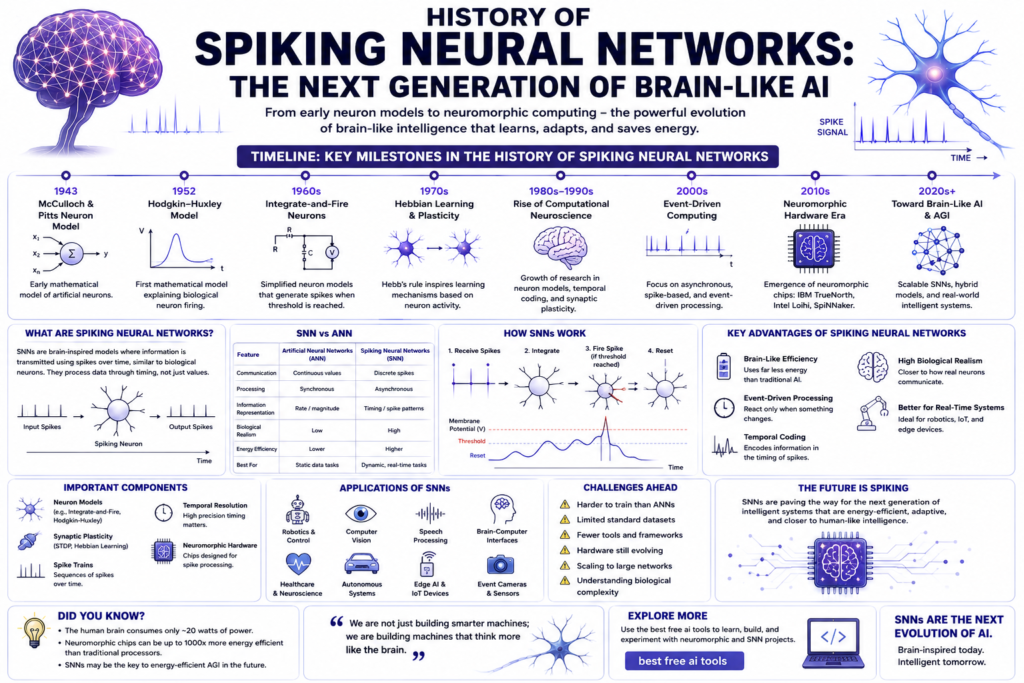
History of spiking neural networks represents one of the most exciting frontiers in artificial intelligence because researchers are now trying to build AI systems that behave more like the human brain itself. Traditional neural networks achieved incredible success in image recognition, speech processing, and language understanding, but they still operate very differently from biological neurons.
Spiking Neural Networks, commonly called SNNs, introduced a radically different approach.
Instead of continuously transmitting numerical values like standard artificial neural networks, SNNs communicate using spikes that imitate biological neuron firing behavior. These systems process information through signal timing, pulse-coded information, and asynchronous communication patterns similar to real neural activity.
Today, the rise of history of spiking neural networks is reshaping neuromorphic engineering, energy-efficient AI, robotics, neuroscience, and brain-inspired computing systems worldwide.
Many researchers believe SNNs may eventually become the foundation of next-generation artificial intelligence.
Early Foundations of Brain-Inspired Computing (1940 – 1960)
The roots of the history of spiking neural networks began with early attempts to understand biological intelligence mathematically.
In 1943, Warren McCulloch and Walter Pitts introduced one of the earliest computational neuron models.
The famous mcculloch and pitts neural network became the foundation of modern neural computation.
Their model simplified neurons into binary switching units:
Although revolutionary, this model remained extremely simplified compared to real biological neurons.
Actual neurons communicate through spikes occurring over time rather than static mathematical activations.
Researchers soon realized biological realism required more advanced neuron models.
Biological Neurons Inspired Spiking Models
The modern history of spiking neural networks became heavily connected to neuroscience research.
Biological neurons communicate using electrical impulses called action potentials.
These spikes occur at precise moments in time.
Unlike traditional artificial neural networks, biological systems depend strongly on:
- Signal timing
- Temporal coding
- Synaptic plasticity
- Asynchronous computing
- Event-driven communication
Researchers wanted to imitate these mechanisms computationally.
This goal eventually gave birth to spiking neural networks.
The Hodgkin-Huxley Model (1952)
One major milestone in the history of spiking neural networks arrived through the Hodgkin-Huxley model.
Alan Hodgkin and Andrew Huxley developed mathematical equations describing how biological neurons generate electrical spikes.
Their membrane voltage equation became:
Where:
- = membrane potential
- = input current
- = membrane capacitance
This work became foundational for computational neuroscience.
Researchers finally possessed realistic mathematical descriptions of neural firing behavior.
Integrate-and-Fire Neuron Models
The history of spiking neural networks advanced further through integrate-and-fire neuron models.
These models simplified biological neuron behavior while preserving spike timing mechanisms.
The membrane potential evolves according to:
When voltage exceeds a threshold, the neuron fires a spike.
After firing, the voltage resets.
This event-driven computing style became central to SNN architectures.
Researchers viewed these models as a bridge between neuroscience and artificial intelligence.
Artificial Neural Networks vs Spiking Neural Networks
The history of spiking neural networks differs significantly from traditional ANN systems.
Traditional Artificial Neural Networks
ANNs use:
- Continuous numerical activations
- Synchronous processing
- Layer-based computation
Spiking Neural Networks
SNNs use:
- Discrete spikes
- Temporal coding
- Event-driven communication
- Asynchronous computation
Researchers discussing neural networks vs human brain often describe SNNs as much closer to biological intelligence than standard neural architectures.
This biological realism remains one of SNNs’ greatest advantages.
Third-Generation Neural Networks
Researchers often call SNNs the third generation of neural networks.
The generations are typically:
- Perceptrons
- Artificial Neural Networks
- Spiking Neural Networks
The history of spiking neural networks became increasingly important because SNNs introduced time directly into neural processing.
This temporal resolution allowed systems to process dynamic information far more naturally.
Examples include:
- Audio streams
- Sensor data
- Robotic movement
- Biological signals
SNNs process information more similarly to living nervous systems.
Hebbian Learning and Synaptic Plasticity
The history of spiking neural networks became closely connected to Hebbian learning theories.
Researchers discussing hebb learning rule often describe it as one of the earliest inspirations for adaptive neural plasticity.
Hebb proposed:
“Neurons that fire together wire together.”
Spiking systems later expanded this idea into Spike-Timing Dependent Plasticity (STDP).
STDP updates synaptic weights based on spike timing relationships.
The weight update rule resembles:
Where:
- = spike timing difference
This biologically inspired learning mechanism became fundamental in SNN research.
Neuromorphic Engineering and Hardware
The history of spiking neural networks accelerated rapidly through neuromorphic engineering.
Neuromorphic systems attempt to build hardware inspired directly by brain architecture.
Unlike traditional CPUs and GPUs, neuromorphic chips process spikes asynchronously and efficiently.
Major projects include:
- IBM TrueNorth
- Intel Loihi
- SpiNNaker
These systems prioritize:
- Energy efficiency
- Parallelism
- Event-driven processing
- Real-time adaptation
Researchers discussing gpu history in ai often compare traditional GPU acceleration with emerging neuromorphic hardware systems.
Why Spiking Neural Networks Matter
The history of spiking neural networks became important because modern AI systems consume enormous energy.
Large deep learning models require massive computational resources.
Biological brains, however, operate with remarkable efficiency.
The human brain consumes roughly:
Yet it outperforms many AI systems in adaptability and energy efficiency.
SNNs attempt to replicate this efficiency through sparse spike-based communication.
This makes them attractive for:
- Robotics
- Edge computing
- Autonomous systems
- Brain-computer interfaces
Deep Learning and SNN Challenges
Despite their promise, the history of spiking neural networks also includes major difficulties.
Training SNNs remains challenging because spike functions are non-differentiable.
Traditional backpropagation methods struggle with discrete spikes.
Researchers discussing history of backpropagation often note this limitation in spiking systems.
Scientists developed alternative methods including:
- Surrogate gradients
- Spike-based learning
- STDP optimization
- Hybrid ANN-SNN systems
These approaches continue improving rapidly.
Spiking Neural Networks and Computer Vision
The history of spiking neural networks expanded into computer vision research.
Researchers studying cnn computer vision history began exploring how spiking systems could process visual streams more efficiently.
Applications include:
- Event cameras
- Motion tracking
- Real-time robotics
- Autonomous navigation
Unlike standard frame-based cameras, event cameras detect only changes in brightness.
This event-driven design pairs naturally with SNN architectures.
The result is highly energy-efficient visual processing.
Robotics and Brain-Like AI
The rise of robotics became another important chapter in the history of spiking neural networks.
Robots operating in real-world environments require:
- Fast reactions
- Low power consumption
- Adaptive learning
- Temporal awareness
SNNs offer advantages for these tasks because they process information continuously over time.
Researchers discussing self driving cars and ai increasingly explore neuromorphic systems for autonomous navigation and sensor processing.
Brain-inspired robotics remains a rapidly growing field.
Spiking Neural Networks and Speech Processing
The history of spiking neural networks also intersects with speech AI.
Researchers studying speech recognition neural networks explore how spike-based systems process temporal audio patterns naturally.
Speech contains dynamic timing information ideal for SNN processing.
Potential applications include:
- Voice assistants
- Audio classification
- Real-time speech recognition
- Neuromorphic hearing systems
SNNs may eventually improve energy-efficient speech processing dramatically.
Spiking Neural Networks vs Transformers
Modern AI research increasingly compares SNNs with transformers.
Researchers discussing transformer neural networks often view transformers as dominant in current AI systems.
However, transformers require enormous computational resources.
SNNs offer possible advantages:
- Lower energy usage
- Event-driven efficiency
- Brain-inspired computation
- Real-time adaptation
Some researchers believe future AI systems may combine transformer architectures with spiking computation.
Brain-Computer Interfaces and SNNs
The history of spiking neural networks may become critical for brain-computer interfaces.
Since biological brains communicate through spikes, SNNs naturally align with neural recording systems.
Potential future applications include:
- Prosthetic control
- Neural decoding
- Cognitive enhancement
- Medical neurotechnology
Researchers discussing history of neural networks in medicine often identify neuromorphic systems as promising healthcare technologies.
The connection between neuroscience and AI continues growing stronger.
Spiking Neural Networks and Artificial General Intelligence
Many researchers believe SNNs could contribute to Artificial General Intelligence.
Current AI systems excel at narrow tasks but struggle with flexible adaptation.
Brain-inspired spike systems may improve:
- Continual learning
- Real-time intelligence
- Adaptive reasoning
- Energy-efficient cognition
The history of spiking neural networks may eventually become one of the most important chapters in future AI evolution.
OpenAI, DeepMind, and Neuromorphic AI
Major AI organizations continue exploring brain-inspired computing.
Researchers discussing deepmind vs openai often debate whether future AI should become more biologically realistic.
DeepMind researchers frequently study neuroscience-inspired learning mechanisms.
Other labs focus heavily on neuromorphic hardware and spike-based learning systems.
The race toward brain-like AI continues accelerating rapidly.
Challenges Facing Spiking Neural Networks
Despite exciting progress, the history of spiking neural networks still faces serious challenges.
These include:
- Difficult training methods
- Limited software tools
- Hardware compatibility
- Sparse datasets
- Scalability issues
Researchers continue improving frameworks and neuromorphic chips.
The field remains highly experimental but extremely promising.
The Future of Brain-Like AI
The future of history of spiking neural networks looks incredibly exciting.
Researchers are now exploring:
- Neuromorphic supercomputers
- Brain-inspired robotics
- Energy-efficient AI
- Autonomous edge systems
- Cognitive architectures
Many of today’s best free ai tools still rely mainly on traditional deep learning, but future generations may increasingly adopt spiking approaches for efficiency and adaptability.
The dream of truly brain-like AI continues moving closer to reality.
The Lasting Legacy of Spiking Neural Networks
The history of spiking neural networks represents one of the boldest attempts to imitate biological intelligence directly.
From early neuron models to neuromorphic chips and event-driven computing, SNNs introduced a fundamentally different vision for artificial intelligence.
The combination of:
- Temporal coding
- Biological realism
- Synaptic plasticity
- Neuromorphic engineering
- Energy efficiency
created powerful new possibilities for future AI systems.
Spiking neural networks may eventually redefine how intelligent machines learn and interact with the world.
Important FAQs About Spiking Neural Networks
What are spiking neural networks?
Spiking neural networks are brain-inspired AI systems that communicate using timed electrical spikes similar to biological neurons.
Why are spiking neural networks important?
They offer better biological realism, energy efficiency, and event-driven processing compared to traditional neural networks.
What is neuromorphic engineering?
Neuromorphic engineering designs hardware systems inspired by biological brains and neural communication.
How are SNNs different from traditional neural networks?
SNNs process information through spikes and timing, while traditional neural networks use continuous numerical activations.
What are neuromorphic chips?
Neuromorphic chips are specialized processors designed for spike-based neural computation.
Can spiking neural networks replace deep learning?
Researchers believe SNNs may complement or improve deep learning in areas requiring energy efficiency and real-time adaptation.
Conclusion
The story of history of spiking neural networks represents one of the most fascinating journeys in artificial intelligence research. By imitating biological neural communication through spikes and temporal coding, researchers created AI systems much closer to real brain behavior.
The rise of spiking systems became deeply connected to neural networks vs human brain, history of deep learning, speech recognition neural networks, transformer neural networks, and history of neural networks in medicine research.
Today, spiking neural networks continue driving advances in neuromorphic engineering, robotics, edge computing, and brain-inspired AI.
As artificial intelligence evolves further, SNNs may become one of the key technologies shaping the future of truly intelligent machines.