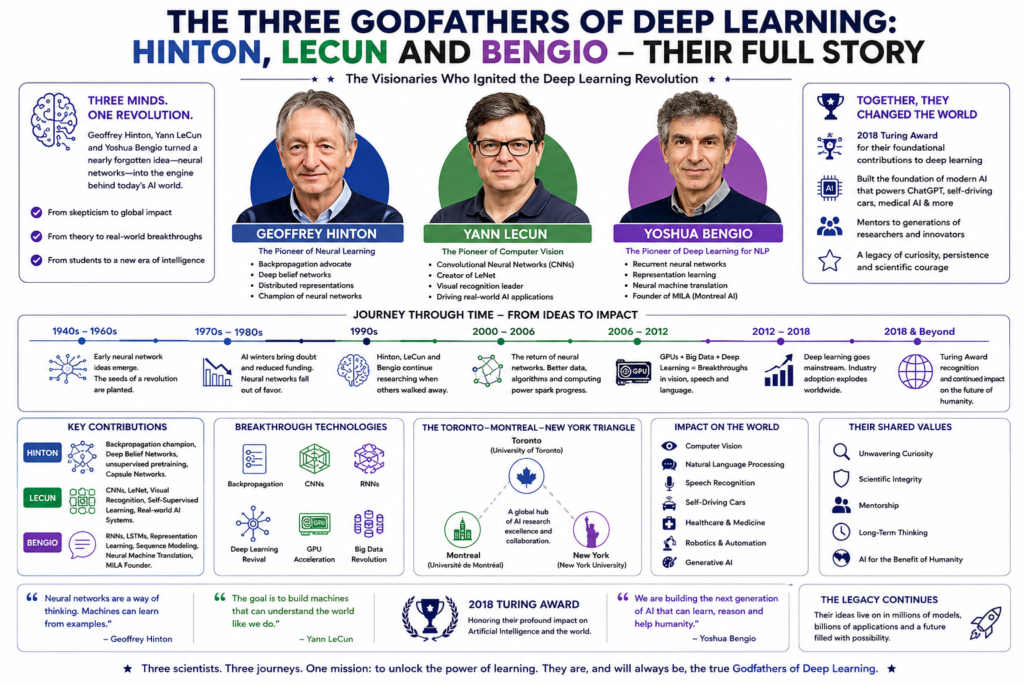
Godfathers of deep learning is one of the most important phrases in modern artificial intelligence because it represents the three scientists who helped transform neural networks from a nearly abandoned research topic into the foundation of modern AI. Geoffrey Hinton, Yann LeCun, and Yoshua Bengio changed the future of computing through decades of persistence, scientific courage, and groundbreaking discoveries.
Today, deep learning powers:
- ChatGPT
- Computer vision
- Speech recognition
- Self-driving cars
- Medical AI
- Generative systems
However, this success did not happen overnight.
For many years, neural networks were unpopular and heavily criticized. Funding disappeared, researchers abandoned the field, and many scientists believed neural learning systems would never work.
Yet the godfathers of deep learning refused to quit.
Their combined work eventually launched one of the greatest technological revolutions in human history.
Early Neural Network Foundations (1940 – 1960)
The story of the godfathers of deep learning began long before Hinton, LeCun, and Bengio entered AI research.
In 1943, the famous mcculloch and pitts neural network introduced one of the earliest mathematical neuron models.
Researchers attempted to imitate biological intelligence using computational systems.
The neuron activation looked like:
These early ideas inspired future neural research.
Scientists believed machines might eventually learn similarly to the human brain.
Perceptrons and Early Optimism (1950 – 1970)
The next chapter leading toward the godfathers of deep learning involved perceptrons.
Frank Rosenblatt introduced the perceptron as an early learning machine.
Perceptrons could classify simple patterns automatically.
At first, excitement grew rapidly.
Researchers believed intelligent machines might soon become reality.
However, limitations soon appeared.
Single-layer perceptrons struggled with complex logical problems.
The famous perceptron controversy later damaged confidence in neural network research severely.
AI Winters and Neural Network Collapse
One of the most difficult periods before the rise of the godfathers of deep learning involved the AI winters.
Funding declined dramatically.
Researchers discussing history of ai often describe the 1970s and early 1990s as extremely discouraging periods for neural research.
Many scientists abandoned neural networks entirely.
Alternative methods became more popular:
- Symbolic AI
- Expert systems
- Statistical learning
- Rule-based systems
However, Geoffrey Hinton, Yann LeCun, and Yoshua Bengio continued believing in neural learning.
This persistence later changed history.
Geoffrey Hinton and Neural Learning
One major pillar of the godfathers of deep learning story is Geoffrey Hinton.
Researchers discussing geoffrey hinton biography often describe him as the scientific leader who kept neural networks alive during difficult years.
Hinton strongly believed the human brain processed information through distributed neural representations.
He worked heavily on:
- Backpropagation
- Distributed representations
- Deep architectures
- Boltzmann Machines
His persistence inspired an entire generation of researchers.
Backpropagation Changed Everything
The rise of the godfathers of deep learning became closely connected to backpropagation.
Researchers discussing history of backpropagation often identify Hinton as one of the key figures who helped popularize neural learning methods.
Backpropagation trains neural networks through gradient optimization:
Where:
- = weight
- = learning rate
- = prediction error
This method allowed multi-layer networks to learn complex patterns effectively.
Backpropagation became foundational for deep learning.
Yann LeCun and Computer Vision
Another major figure among the godfathers of deep learning is Yann LeCun.
Researchers discussing yann lecun biography often describe him as the scientist who built modern computer vision.
LeCun developed convolutional neural networks capable of processing images efficiently.
CNNs introduced:
- Convolution layers
- Pooling
- Spatial feature extraction
- Gradient-based visual learning
The convolution operation became:
This architecture revolutionized image recognition forever.
LeNet and Practical Neural Systems
The godfathers of deep learning story expanded dramatically through LeNet.
LeNet became one of the earliest successful convolutional neural networks.
Applications included:
- Postal code recognition
- Handwritten digit classification
- Banking automation
Researchers discussing history of cnn often identify LeNet as one of the first practical deep learning systems ever created.
At a time when neural networks remained unpopular, LeCun demonstrated real-world success.
Yoshua Bengio and Language Learning
The third major pillar of the godfathers of deep learning story is Yoshua Bengio.
Researchers discussing yoshua bengio biography often describe him as the quiet scientific force behind deep learning’s expansion into language and sequence learning.
Bengio focused heavily on:
- Recurrent networks
- Language modeling
- Representation learning
- Neural machine translation
His research later influenced:
- GPT models
- Transformers
- Large language models
- Neural embeddings
Modern NLP owes enormous debt to Bengio’s work.
Recurrent Networks and Sequence Learning
The rise of the godfathers of deep learning also involved recurrent neural systems.
Researchers discussing history of rnn often recognize Bengio’s contributions to sequence learning research.
RNNs process sequential data through hidden states:
These systems became highly important for:
- Speech recognition
- Translation
- Text prediction
- Sequential reasoning
However, they also faced major limitations.
The Vanishing Gradient Problem
One major challenge facing the godfathers of deep learning involved the famous vanishing gradient problem.
As gradients moved backward through deep networks, they often became extremely small.
This made long-term learning difficult.
The problem limited:
- Deep architectures
- Recurrent systems
- Long-sequence modeling
Researchers spent years improving optimization methods to solve these issues.
Their persistence eventually paid off.
The Toronto-Montreal-New York Triangle
One of the most important aspects of the godfathers of deep learning story was collaboration across research centers.
The three major deep learning hubs became:
- Toronto → Geoffrey Hinton
- Montreal → Yoshua Bengio
- New York → Yann LeCun
This became known as the Toronto-Montreal-New York triangle.
Together, these scientists built the foundations of modern neural research.
Their collaboration reshaped AI permanently.
GPUs and the Deep Learning Revival (2006 – 2012)
The modern rise of the godfathers of deep learning accelerated during the deep learning revival.
Several breakthroughs made deep learning practical:
- GPU acceleration
- Larger datasets
- Improved hardware
- Better optimization
Researchers discussing gpu history in ai often identify GPUs as essential for modern deep learning growth.
Neural systems suddenly achieved extraordinary performance improvements.
This transformed the AI field completely.
Deep Belief Networks and Hinton’s Breakthrough
Geoffrey Hinton helped reignite interest in deep learning through Deep Belief Networks.
These systems used:
- Layer-wise pre-training
- Unsupervised learning
- Hierarchical representations
The work demonstrated deep neural networks could train effectively.
The AI community suddenly became interested in neural architectures again.
The godfathers of deep learning finally began receiving global recognition.
ImageNet and the CNN Explosion
One major turning point for the godfathers of deep learning came through ImageNet competitions.
Researchers discussing history of imagenet often describe AlexNet as the moment deep learning conquered computer vision.
AlexNet dramatically outperformed traditional approaches in 2012.
CNNs quickly became dominant across:
- Medical imaging
- Security systems
- Autonomous driving
- Facial recognition
Deep learning became impossible to ignore.
The Rise of Generative AI
The influence of the godfathers of deep learning expanded even further through generative AI.
Researchers discussing generative neural networks often connect modern generative systems directly to deep learning foundations established by Hinton, LeCun, and Bengio.
Applications expanded into:
- Image generation
- Chatbots
- AI art
- Video synthesis
- Music generation
The deep learning revolution accelerated globally.
Transformers and Modern AI
The rise of transformers became another major chapter connected to the godfathers of deep learning.
Researchers discussing transformer neural networks often recognize deep learning pioneers as the scientists who created the environment necessary for transformer success.
Transformers later revolutionized:
- Language generation
- Search engines
- AI assistants
- Scientific modeling
Modern large language models depend heavily on the foundations created by these researchers.
Turing Award Recognition (2018)
The achievements of the godfathers of deep learning eventually earned the highest recognition in computer science.
In 2018:
- Geoffrey Hinton
- Yann LeCun
- Yoshua Bengio
received the Turing Award.
The award recognized their contributions to:
- Neural networks
- Deep learning
- Artificial intelligence
The honor confirmed their role in transforming modern computing forever.
AI Ethics and Scientific Responsibility
The godfathers of deep learning also became important voices in AI ethics.
They frequently discuss:
- AI safety
- Responsible deployment
- Scientific openness
- Human-centered AI
Their influence extends beyond research into public conversations about the future of artificial intelligence.
DeepMind, OpenAI, and Industry Influence
The work of the godfathers of deep learning strongly influenced modern AI companies.
Researchers discussing deepmind vs openai often identify deep learning as the core technology powering both organizations.
Their research shaped:
- OpenAI
- DeepMind
- Meta AI
- Google Brain
- Anthropic
The entire modern AI industry depends heavily on their discoveries.
Modern Applications of Deep Learning
Today, the influence of the godfathers of deep learning appears across nearly every technological field.
Deep learning now powers:
- Speech assistants
- Medical diagnostics
- Robotics
- Recommendation systems
- Autonomous vehicles
- Scientific discovery
Researchers discussing speech recognition neural networks and history of neural networks in medicine often rely directly on architectures pioneered through deep learning research.
The impact continues growing rapidly.
Challenges Facing Modern AI
Despite enormous success, the godfathers of deep learning also recognize serious AI challenges.
These include:
- Bias
- Hallucinations
- Energy costs
- Safety concerns
- Ethical misuse
Researchers continue improving:
- Model reliability
- AI alignment
- Explainability
- Efficiency
The deep learning revolution still continues evolving.
The Lasting Legacy of the Three Godfathers
The story of the godfathers of deep learning represents one of the greatest scientific collaborations in technological history.
Together, Geoffrey Hinton, Yann LeCun, and Yoshua Bengio transformed neural networks from rejected research ideas into the foundation of modern AI.
Their combined contributions included:
- Backpropagation
- CNNs
- Representation learning
- Deep architectures
- Neural optimization
These breakthroughs changed computing forever.
Today, many of the world’s best free ai tools rely directly on technologies influenced by their discoveries.
Their legacy continues shaping the future of intelligence itself.
FAQs About the Godfathers of Deep Learning
Who are the Godfathers of Deep Learning?
The Godfathers of Deep Learning are Geoffrey Hinton, Yann LeCun, and Yoshua Bengio.
Why are they important?
They helped develop neural networks and deep learning systems that power modern AI technologies.
What did Geoffrey Hinton contribute?
Hinton contributed to backpropagation, deep belief networks, and distributed neural representations.
What did Yann LeCun contribute?
LeCun pioneered convolutional neural networks and modern computer vision systems.
What did Yoshua Bengio contribute?
Bengio advanced recurrent networks, language modeling, and representation learning.
Did they win the Turing Award?
Yes. All three researchers received the 2018 Turing Award for their contributions to deep learning.
Conclusion
The story of the godfathers of deep learning represents one of the greatest scientific revolutions in modern history. Geoffrey Hinton, Yann LeCun, and Yoshua Bengio transformed neural networks from unpopular academic experiments into the foundation of artificial intelligence worldwide.
Their work became deeply connected to history of deep learning, history of cnn, history of rnn, gpu history in ai, and transformer neural networks research.
Today, deep learning powers modern AI systems across healthcare, robotics, language generation, autonomous vehicles, and scientific discovery.
As artificial intelligence continues evolving, the legacy of the three Godfathers of Deep Learning will remain foundational to the future of intelligent machines.